


An AI that can “undress” photos is already generating real profits – one advertiser tested this non-mainstream bot and scored a 150% ROI on HilltopAds. This article breaks down the campaign, the strategies that worked, and how to leverage the trend for high conversions.
An AI that undresses photos? It sounds like science fiction, but it’s reality in 2025. A new wave of AI non-mainstream bots are taking the internet by storm, letting users create photorealistic nudes at the click of a button. And for savvy affiliate marketers, this craze is turning into serious profits.
One recent HilltopAds campaign promoting an AI bot offer hit roughly a 150% return on investment. So what’s behind this unconventional niche, and how can advertisers tap into its potential?
How an AI Non-Mainstream bot campaign on HilltopAds delivered 150% ROI
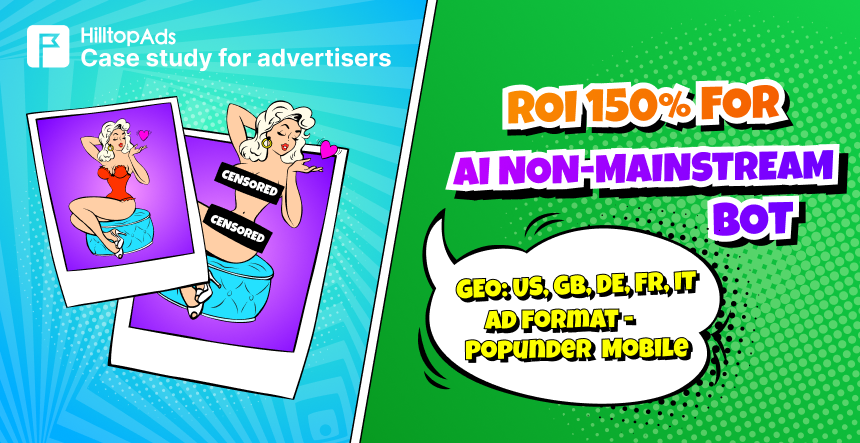
To find out, we interviewed the advertiser behind that win. In this candid Q&A, they break down how these bots work, why demand is skyrocketing, and the exact tactics that unlocked triple-digit ROI.
If you’ve been curious about the buzz around AI “nudification” tools – and how to monetize them – read on for an insider’s playbook.
The offer tested in this campaign was from a non-mainstream AI-bot company; our interview was conducted with the campaign’s Marketing and PR Specialist, who managed creative, targeting and optimization decisions.
Launch your non-mainstream ad campaign
with HilltopAds and achieve success.
Inside the AI Bot Campaign
– Let’s start with the basics. What exactly are AI non-mainstream bots?
These are basically AI-driven apps or bots that generate non-mainstream imagery through artificial intelligence. For example, our product is an AI-based site that can undress a person in a photo, replace someone’s face in a video, and even generate explicit images or videos from a text description.
In plain terms, it’s like having an “AI non-mainstream creator” at your fingertips. The AI uses advanced neural networks trained on massive image datasets to realistically remove clothing or create new NSFW visuals. It might sound like just a fancy filter, but the results can look shockingly real.AI “undressing” pipelines aren’t magic, they’re engineering: modern services segment garments, use inpainting or GAN-style synthesis, then render a photorealistic result.
The accessibility is what changed the game – users no longer need editing skills, just an upload and a few clicks. That low friction is precisely why this niche converted from curiosity to commerce so quickly.
– Why has this niche become so popular recently? Are people really using these tools that much?
Absolutely – the demand has exploded. The tech became widely accessible only recently (you don’t need any special skills; just upload a photo and the AI does the rest), and curiosity is a powerful driver.
According to reports, the top 50 AI “undressing” bots online now attract about 4 million users each month, and the top dedicated websites in this niche collectively amassed around 200 million visits in just the first half of 2024.
That’s huge. The audience is also very specific: mostly young men from places like the US and Europe who are tech-savvy and intrigued by edgy content. In fact, one study found roughly 69% of young men (ages 15-25) who know about these apps have tried them (versus about 45% of young women).
So yes – it’s a hot trend. People are curious about these AI tricks, and that mass interest creates a big opportunity for marketers to step in.
– It sounds like a pretty wild offer. Are there special challenges to promoting something like this?
For sure. The content is essentially non-mainstream and a bit controversial. Major ad platforms like Google won’t allow ads for deepfake non-mainstream content or “undressing” services, so you can’t go the usual mainstream route.
This is where specialized advertising networks come in. We used HilltopAds – you have a dedicated non-mainstream traffic category for this vertical, which let us launch without friction.
We kept creatives suggestive but compliant – no explicit nudity in banners or copy – and moderation was smooth, no compliance pushback. The other challenge is traffic quality: in non-mainstream you can hit bots or junk clicks.
We countered that with HilltopAds settings: disabled Proxy traffic, allowed WebView where it performs, and turned on Auto-Optimization to drop underperforming sources fast. With the right platform and a close eye on quality, the hurdles are manageable.
In our HilltopAds ad network, non-mainstream traffic plus built-in controls like Auto-Optimization, Proxy/WebView filters, frequency caps, and GEO/device targeting help you stay compliant while cutting low-quality supply before it eats your ROI.
Policy-wise, Google prohibits deepfake sexual content ads – which naturally pushes advertisers toward ad networks that accept non-mainstream traffic.
Choose the right partner, wire up Postback, switch on Auto-Optimization from day one, and ask your account manager for current whitelists/blacklists to speed up learning.

Start advertising with HilltopAds and get:
- Advanced targeting options
- Direct traffic sources
- Self-serve platform
- Fully-managed service
- Postback tracking
– Your campaign ran on mobile Popunder ads. Why did you choose Popunders for an offer like this?
Popunder ads are kind of perfect for testing and scaling this niche. For one, they let you get a lot of traffic quickly at a relatively low cost. This format is inexpensive and has high volume, which is ideal when you want to try many variations and see what sticks.
In our experience, the Popunder format on HilltopAds was easy to set up with simple campaign settings and didn’t require a huge budget to start seeing results. We could run numerous tests to figure out which GEOs or approaches made sense without burning cash.
Plus, think about the user’s context: a Popunder appears behind the main browser window when someone is likely already browsing other content. It’s less intrusive than a popup, but it still grabs attention once they notice it.
For an offer like an AI non-mainstream bot, catching users during an active browsing session worked well to spark their curiosity without feeling too “in their face.”
Popunder has a long track record in the non-mainstream niche – high reach, fast testing, and a strong seen-rate once the main window closes.
In our HilltopAds ad network, we see higher engagement and conversion potential with Popunder than many display formats, which is why we recommend it as a smart first lever when you’re validating GEOs and angles on a tight budget.
Join our Winter Prize Draw! Read the rules here:
– Can you walk us through how you set up the actual campaign on HilltopAds?
Sure. We focused on several Tier-1 countries: the US, UK, Germany, France, Italy… basically places where users have the interest and the willingness to pay for such services.
HilltopAds has a category for non-mainstream traffic, so we specifically targeted the Non-Mainstream High & Medium inventory on mobile devices. We set a daily budget of a few hundred dollars to gather data quickly (during testing we used about $300 per day).
We also set our bid (CPM) around the network’s suggested rate – roughly $3 in this case – to ensure we were competitive in the auction. Once the campaign was live, we enabled the Auto-Optimization feature from day one.
That meant the system would automatically blacklist any ad spots that, say, delivered 1,500 impressions without a conversion within a 48-hour window. This was crucial: it saved us from wasting budget on sources that weren’t converting.
We also tweaked the traffic filters – for example, we disabled Proxy traffic (to cut out likely bot traffic) but allowed WebView traffic (users browsing from inside apps) since that can perform well.
Overall, the setup was straightforward: Popunder ads, non-mainstream mobile traffic, Tier-1 GEOs, and then letting it run with smart targeting and optimization in place.
Every detail here matches best practices from the public case: suggested CPM for initial reach, a ~$300 daily test budget, enabling WebView while cutting Proxy, and Auto-Optimization with a 48-hour lookback and 1,500-impression threshold.
Taken together, those settings create a controlled sandbox where you can quickly separate signal from noise and avoid the classic trap of scaling into overlap or bots.
– What about the creatives and landing pages? Did you use any sort of Prelander to warm up users?
Yes, we did use a Prelander. When you’re promoting something this edgy, you don’t want to drop users directly into a sign-up or payment page.
Our prelander was designed to tease the AI’s capabilities and qualify the user. It had a bold, curiosity-piquing headline like “Undress a photo for free!” – playing on that instant gratification trigger, which we found works best.
The page then briefly explained how the AI works (in simple terms) and showed a blurred sample image as a teaser. Essentially, it promised the user a peek at what the AI could do, if they continued. This approach did two things: it built up curiosity and it filtered out casual visitors.
Only those truly interested would click through to the actual offer page (where they could upload a photo and then pay to see the magic happen). We actually tested a few different prelander variations during the campaign to see which messaging and layout converted best – experimenting with different headlines, images, and even slight changes in tone.
In fact, A/B testing various prelanders (and even targeting tweaks like different mobile OS versions) was one of our main tactics to optimize this campaign. The winning prelander was the one that kept it simple and enticing: highlight the “try it for free” aspect of the AI and hint at the end result without giving it all away. Once we had that funnel in place, users flowed through pretty smoothly.
– And the results? How did the campaign perform in the end?
The results were excellent. Over about a week of running the Popunder ads, we saw roughly 248 conversions on an ad spend of around $2,100. That worked out to an eCPA of about $8.47 per conversion, meaning every ~$8 brought us a paying user – an impressively efficient result for such a niche vertical.
In terms of ROI, we were looking at roughly 120-150% ROI for that week. In other words, we more than doubled our money in just seven days. Profit-wise, that was about $2,600 net profit from the test run. And here’s the kicker: the offer we promoted runs on a subscription model, meaning a lot of those conversions were people who subscribed and will be billed monthly.
Thanks to those recurring subscriptions, the projected ROI over a full month climbs up to nearly 300% in the best-case scenario. Now, of course, not every user stays subscribed long-term, but even accounting for typical churn rates, it’s a very profitable campaign.
These figures align with the public case study: 25-31 May run, 673k impressions at ~$3.12 CPM, 248 conversions on ~$2.1k spend, weekly ROI in the 120-150% range and compounding monthly returns due to subscriptions. It’s a textbook example of how disciplined Popunder testing can translate into cash-flow positive scaling in a hot niche.
Launch your ad campaign today
and maybe next time we’ll be sharing your success story!
– Why do you think this campaign worked so well? What made users convert so eagerly?
I’d credit two main things: the novelty factor and how we leveraged it. First, the offer itself is something people haven’t really seen before. It’s almost a “forbidden” technology – an AI that can undress photos or create non-mainstream content on the fly.
That naturally sparks intense curiosity. Everyone has that “I have to see this to believe it” reaction. But curiosity alone isn’t enough; we also tapped into a strong psychological trigger: instant gratification.
We basically told users, “You can fulfill this naughty curiosity right now, instantly.” Offering an immediate payoff – upload a pic and see results in seconds – is huge. In our case, the phrase “undress a girl for free” was a killer hook because it promises an instant, no-cost taste of the experience.
Once users tried the demo and saw a blurred or partial result, their FOMO kicked in – they didn’t want to miss out on seeing the full image. Also, the AI actually delivers on its promise: the outputs are surprisingly realistic thanks to advanced neural networks doing the heavy lifting.
It’s not some cheesy fake gimmick; people are genuinely impressed that the generated photos look like real snapshots. That satisfaction with the product itself makes them more willing to pay.
Lastly, we made sure to target the right audience at the right moment – namely, young men browsing on mobile in contexts where they’re open to non-mainstream content.
We caught them in a moment of curiosity, gave them a seamless experience (thanks to the Prelander and a smooth payment flow), and the conversions followed. In short, the campaign hit a sweet spot: a novel product + a curious audience + a frictionless, instantly rewarding user experience = high conversion rates.
The instant-gratification lever is doing the heavy lifting, but credibility matters too: when mainstream outlets report millions of users for these bots, skepticism fades and “I’ll try it” wins. Tie that to a friction-free flow and you’ve got a momentum loop that’s hard to beat.
Read our article about the top 10 Affiliate trackers:
– Any advice for other advertisers who want to try this AI bot niche?
Sure!
– First off, don’t be scared off by the “non-mainstream” label. The niche is hot precisely because it’s new and a bit daring, which means relatively less competition and big rewards if you do it right. That said, you must run these offers on the right traffic sources. Stick to networks that are friendly to non-mainstream content – HilltopAds was a great choice in our case, and I’d recommend it, especially for Popunder traffic. Networks like this have the volume and high-quality traffic across a wide variety of GEOs that you’ll need.
– Also, use the tools they provide: set up your tracking (Postback) from the start, and take advantage of features like auto-optimization to cut off bad traffic early.
– On the creative side, test multiple approaches. Try out different Prelanders, different headlines or images, maybe even different angles (curiosity vs. shock value, for example) to see what resonates best. Keep an eye on regulations too – be aware that this niche exists in a gray area legally. Some jurisdictions are starting to crack down on non-consensual deepfake content, and big companies like Google have banned ads for these services outright. So choose reputable offers and always ensure you’re not violating any laws or platform policies.
– Another tip: make good use of your account manager if the ad network provides one. Our HilltopAds manager was extremely helpful – always on hand to assist, even after hours, with campaign optimization tips, creative feedback, and useful whitelist/blacklist suggestions. That kind of support can really fast-track your success. In fact, I often say HilltopAds has become our go-to testing ground: it helps us quickly identify the strongest GEOs and even OS segments for a new offer, which we can then scale out to other traffic sources later.
– Finally, be data-driven and agile. If you see something working, don’t hesitate to increase budgets and scale up fast – these trends can spike quickly. And if something isn’t working, be ruthless in pausing it or tweaking your approach. The AI bot wave is still rising, and those who jump on it with the right strategy can ride it to the bank.
Conclusion
First, a big thank you to our interview partner for the time, candor, and field-tested answers!
This candid conversation makes one thing clear: AI non-mainstream bot offers are no gimmick – they’re a genuinely hot niche capable of delivering serious ROI when handled correctly. By combining a novel product with the right traffic sources and a strategic approach, affiliates can tap into this trend and potentially reap substantial rewards. And with HilltopAds ready to support such campaigns, now is a great moment to give this unconventional vertical a shot.