


Marketplaces are crowded, budgets drain quickly, and shoppers stick to familiar brands. See how a HilltopAds brand awareness campaign boosted recognition by 114% on Tokopedia and TikTok Shop.
Marketplace product pages live in the most competitive real estate on the internet. Shoppers scroll fast, algorithms reward momentum, and brands that win are the ones people already recognize.
That’s why so many eCommerce teams are shifting budget into brand awareness campaigns designed to boost brand awareness, grow recall, and then funnel that attention straight to product cards on Tokopedia, TikTok Shop, Shopify, and beyond.
In this case study, we show how Popunder mobile – built for high-volume, affordable reach – can increase brand awareness and scale marketplace traffic without burning budget.
You’ll see the playbook we used (why Popunders, how we set frequency capping, device/OS filters, and budgets), and how we applied it across two markets to put real products in front of real shoppers – fast.
Ready to start? Let’s dive in!
Boost your brand awareness with HilltopAds!
Key points
Offer: eCommerce
GEO: ID, PH
Traffic: Non-Mainstream/Mainstream
Ad Format: Popunder mobile
Ad campaign period: Active since Nov 8
Measurement Highlight: +114% brand awareness lift
What is Brand Awareness? The Marketplace Version
Brand awareness is the degree to which shoppers recognize and remember your brand. On marketplaces like Tokopedia or TikTok Shop, it means being the name people think of – or search for – when browsing your category.
High awareness makes your products stand out in a crowded feed, drives more clicks, and builds recognition and trust.
Why it matters for marketplace traffic: When people already know you, they’re more likely to seek out your listings or stop scrolling when they see them. That lifts direct and organic traffic – visitors landing on product pages without a paid prompt – who typically arrive with higher intent and convert better.
In practice, greater awareness translates into more branded searches on Tokopedia, more followers on TikTok Shop, and more shoppers choosing your listing over a generic competitor.
Brand awareness campaigns also lay the groundwork for long-term growth. They create familiarity, expand the top of the funnel, and generate demand beyond users who are already searching. In the fast-moving marketplace environment, this is a game-changer: you’re not waiting to be found – you’re actively planting the idea of your brand in shoppers’ minds.
Bottom line: investing to increase brand awareness on eCommerce platforms can deliver more sustainable marketplace traffic and sales. When the shopper is ready to buy, your brand should be the one that comes to mind – or appears in their search.
The rest of this case study shows how our advertiser used HilltopAds Popunder campaigns to boost brand awareness and drive marketplace traffic in two key markets.
Check out our recent article on promoting TikTok Shop:
Strategy Overview with HilltopAds
To boost the brand’s visibility, we pursued a Popunder advertising strategy on our platform. Popunder ads were chosen for their ability to deliver high volumes of impressions at a low cost, ensuring we maximized reach.
Unlike traditional display ads, a Popunder loads the target page (in this case, the product listing) in a new tab or window behind the user’s current browser tab. This way, the user discovers the page naturally when they finish their current browsing – an approach that is less intrusive than pop-ups yet very effective at capturing attention.
According to industry sources, “Popunders are ideal for achieving brand awareness. They are a cost-effective ad format – with a minimum of $0.01 for 1,000 impressions, you can get a huge reach for your brand/product.”
This aligns perfectly with our goal of wide exposure. We leveraged our platform to fine-tune our campaign targeting and settings for quality and impact. Let’s break down the key settings!
General settings for an Ad Campaign on the HilltopAds Platform
Before you can start your advertising campaign on HilltopAds, you’ll need to sign up as an advertiser. You can register through this link.
Once you’re all set up, here’s how to create your campaign:
- Head over to the Manage Campaigns section.
- Hit the Add Campaign button.
- In the campaign creation area, choose the Popunder mobile ad format.
- In the Traffic Channels section, pick Non-Mainstream/Mainstream High and Medium.
To analyze ad campaign performance, we recommend you to set up Postback. To learn more, please check out our Full guide.

Below, you’ll find step-by-step screenshots of the full setup for Campaign №1 (Tokopedia, ID) and Campaign №2 (TikTok Shop, PH), then a detailed breakdown of why each setting was chosen and how it affected delivery, quality, and cost. Finally, we include a dedicated “Shared Setup Blueprint – At a Glance” summarizing the common configuration across both campaigns.
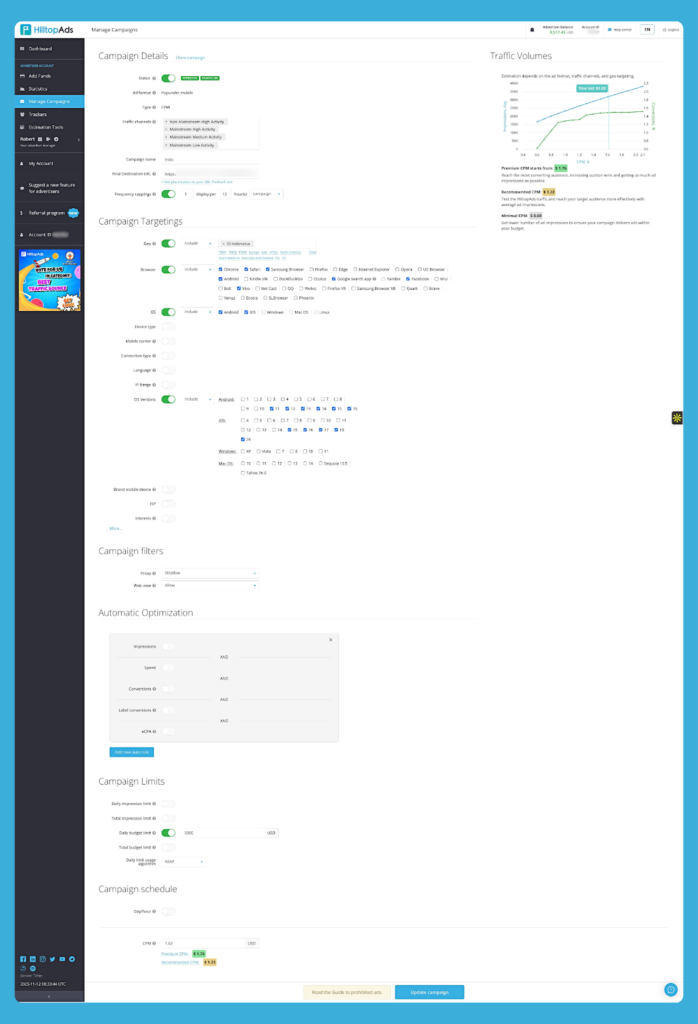
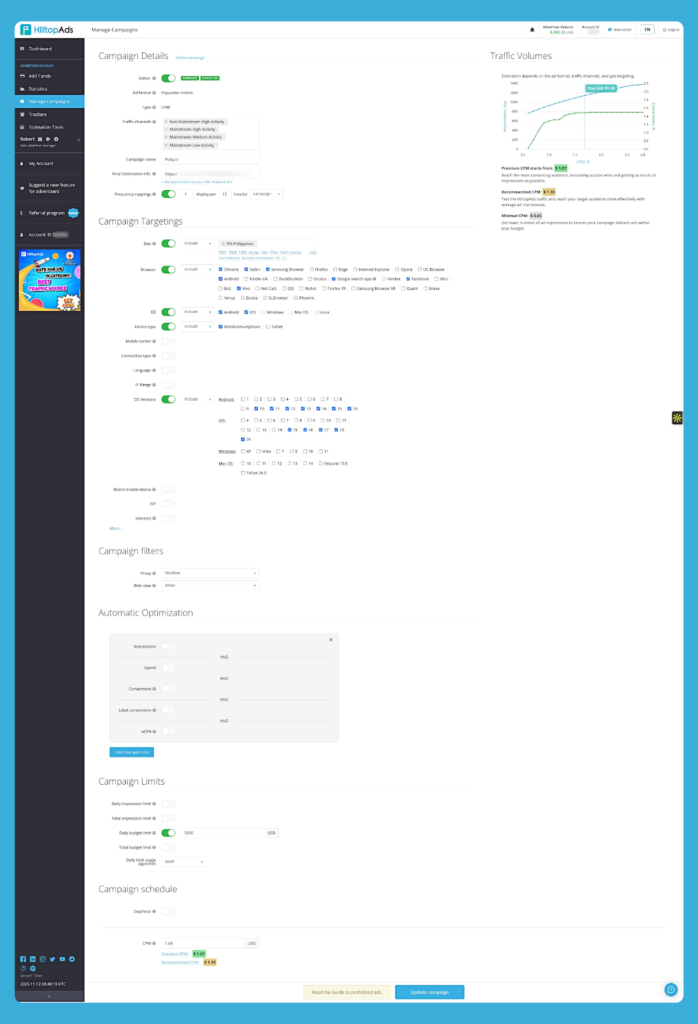
Device targeting (Mobile-only)
Both campaigns targeted mobile users exclusively via Popunder mobile traffic. This was strategic because Tokopedia and TikTok Shop are predominantly mobile-centric platforms (users often shop via mobile apps or mobile web).
Focusing on mobile ensured that when the Popunder opened the product page, users could smoothly view or even navigate to the native app. It also aligned with where our audience spends most of their time.
OS and version targeting
We narrowed targeting to specific operating system versions to hit the sweet spot of our audience. For Indonesia, we targeted Android 11-16 and iOS 15-26; for the Philippines, Android 10-16 and iOS 15-26. In practice, this meant we included relatively recent Android versions (skipping very old versions in Indonesia) and the major iOS versions in use.
The idea was to capture users with modern devices (likely active online shoppers) and ensure the marketplace apps/pages would load properly. It’s a way to concentrate budget on the most relevant device base.
Traffic quality filters
We enabled Proxy traffic disallowed to filter out users coming through proxies or VPNs that might indicate non-human or low-quality traffic. We only wanted genuine eyeballs on the product pages.
We kept WebView traffic allowed, meaning if a user was using an in-app browser (common in social media apps), the Popunder could still load – maximizing reach across all browsing contexts. Our network provides these controls to maintain high traffic quality.
Bidding and budget
Both campaigns ran on a CPM (cost per thousand impressions) model – a deliberate choice for a brand awareness campaign where impressions are the key metric. We bid $1.62 CPM for Indonesia and $1.68 CPM for the Philippines, aligning with each GEO’s traffic value.
These bids were around the recommended level for those markets to ensure sufficient volume. With pops being one of the cheapest ad formats, this CPM meant we were getting a huge bang for the buck in terms of exposure. We set a daily budget of $5,000 for each campaign, giving us room to scale up to a large number of impressions quickly (especially during peak shopping days).
Notably, CPM campaigns guarantee the ad reaches a large audience and builds recognition even without immediate clicks – perfect for awareness goals.
Our platform made it straightforward to implement this strategy: we created two campaigns with identical setups except for GEO and a few targeting tweaks.
By choosing popunders, we tapped into a vast inventory of global publisher traffic. And by applying tight frequency caps and filters, we balanced reach vs. relevance – achieving broad exposure while minimizing wasted impressions.
The expectation was that these campaigns would rapidly boost brand awareness by getting their product pages in front of millions of eyes, thereby increasing marketplace traffic to their Tokopedia and TikTok Shop listings.
Run popunder campaigns for eCommerce with HilltopAds –
achieve massive reach and boost your brand awareness.
Shared setup Blueprint – at a Glance
The table below captures the core configuration we used across Tokopedia and TikTok Shop – one unified playbook with only minor tweaks for each marketplace.
| Setting | Campaign №1: Tokopedia (Indonesia) | Campaign №2: TikTok Shop (Philippines) |
| Objective | Increase brand awareness; drive traffic to Tokopedia product page (e.g. apparel listing) | Increase brand awareness; drive traffic to TikTok Shop product page (same brand’s product) |
| Ad Format & Placement | Popunder mobile | Popunder mobile |
| Geo Targeting | Indonesia (ID) | Philippines (PH) |
| OS Targeting | Android 11-16; iOS 15-26 | Android 10-16; iOS 15-26 |
| Frequency Capping | 1 impression per user per 12 hours | 1 impression per user per 12 hours |
| Proxy Traffic | Disallowed | Disallowed |
| WebView Traffic | Allowed | Allowed |
| Bidding Model | CPM | CPM |
| Bid Price (CPM) | $1.62 CPM | $1.68 CPM |
| Daily Budget | $5,000 per day | $5,000 per day |
| Campaign Duration | 5 days (Nov 8-12, 2025) | 5 days (Nov 8-12, 2025) |
As shown, both campaigns followed an almost identical recipe. In essence, we ran brand awareness campaigns via popunders in two countries simultaneously, around the early November period (which coincided with the big 11.11 shopping festival in Southeast Asia). Next, we’ll look at each campaign individually – how we executed the plan on Tokopedia vs. TikTok Shop, and what results we achieved.
Campaign #1: Tokopedia (Indonesia)
Overview. We kicked off in Indonesia to strengthen our presence on Tokopedia – one of the country’s largest eCommerce marketplaces. The advertiser sells fashion apparel, and we directed traffic to a high-intent product page.
Running Nov 8–12, 2025, the campaign deliberately covered the run-up to 11.11 Singles’ Day, when Indonesian shoppers are most deal-hungry. The objective was clear: saturate reach during this peak window, boost brand awareness, and ride the shopping momentum.
Setup & Targeting. We followed the shared blueprint outlined earlier and kept execution consistent with the overall strategy.
In practice. Popunders quietly opened the Tokopedia product page behind the active tab, so users discovered it naturally as they wrapped up browsing – broad reach without being in-your-face. The setup prioritized real shoppers and smooth landing-page loads, focusing on quality exposure over repetition.
Results (5 days). The campaign delivered a flood of impressions – clear proof that a popunder-led brand awareness push can scale in a market like Indonesia. We served 9,365,596 impressions and spent $16,667.32 in total, for an effective CPM ≈ $1.78 (slightly above the $1.62 bid due to auction and peak-day volume). The daily split of impressions and spend appears in the stats screenshot below.
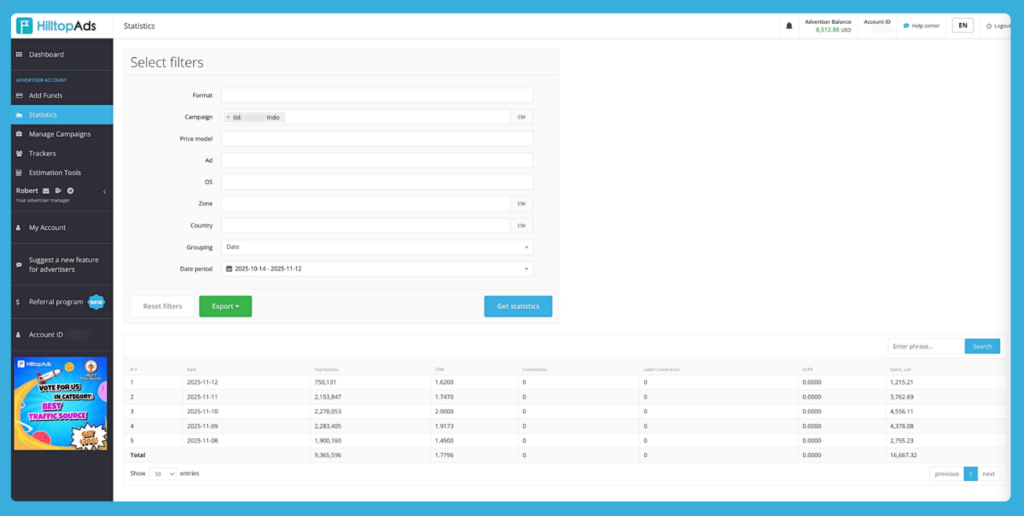
What it meant. The campaign scaled impressively – on Nov 10 alone (right before 11.11) we crossed the 1M-impression mark. Frequency controls ensured breadth over fatigue, exposing millions of Indonesian shoppers to the product page at the most opportune moment.
As expected for awareness, immediate conversions don’t appear in our dashboard (sales occur on Tokopedia’s side), but the sheer reach drove a clear lift in brand interest. Even if a fraction of those 9.36M impressions translated into visits, that’s still tens or hundreds of thousands of new potential shoppers – serious visibility.
Anecdotal outcome. By the end of the run, the Tokopedia store saw a tangible uptick in engagement: more product-page views, more followers, and 11.11 sales beating expectations.
While multiple factors fuel a sale event, the broad awareness we created clearly helped draw curious shoppers in. In a single week, the brand moved from relatively unknown to firmly on the radar – solid groundwork for follow-ups like retargeting.
Сampaign #2: TikTok Shop (Philippines)
Overview. We launched a parallel campaign in the Philippines to build recognition on TikTok Shop and direct shoppers to the same product listing. The campaign ran Nov 8-12, 2025, overlapping 11.11, which TikTok promoted with flash deals and vouchers.
The plan was straightforward: reach TikTok users on the open web and guide them to the product page – boost brand awareness and spark interest where they already spend time.
Setup & Targeting. We followed the shared blueprint from Campaign #1 with one local adjustment: we included Android 10 to cover a broader device base in PH. We bid $1.68 CPM (the interface suggested ~$1.78 for PH), keeping costs tight while accepting that available daily volume at this price might cap out.
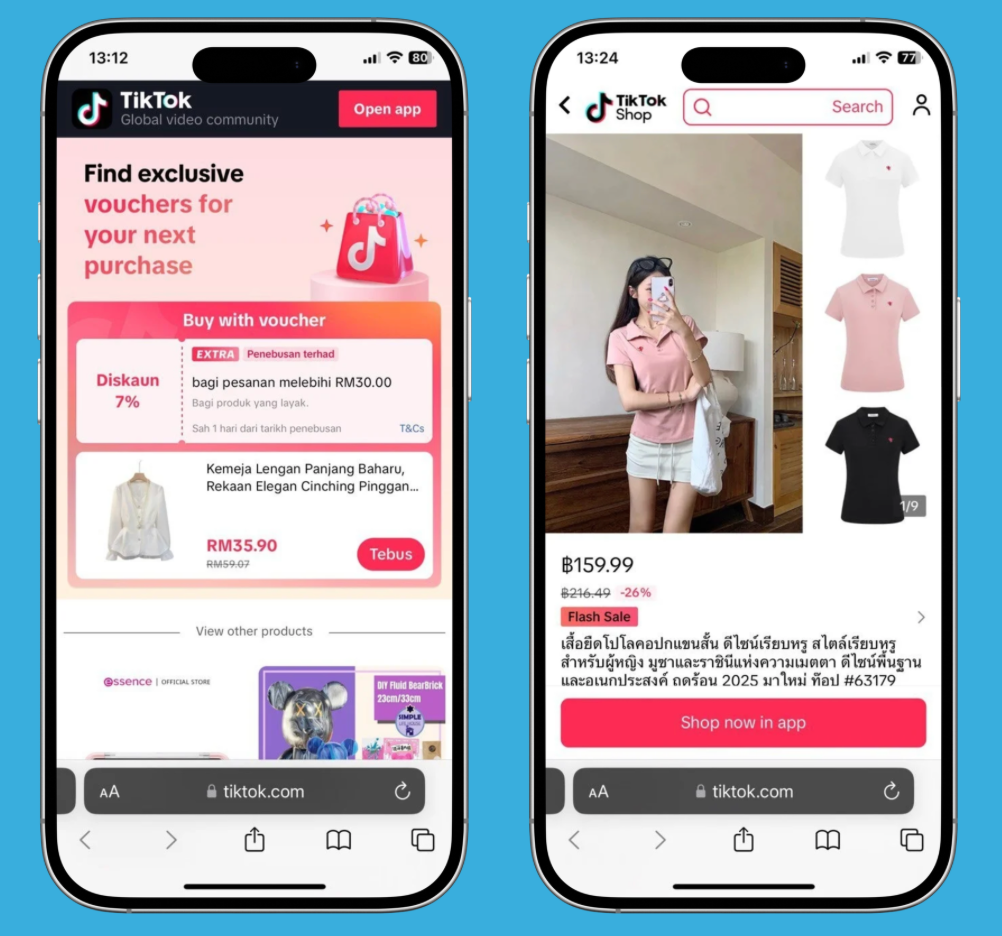
In practice. Popunders opened the TikTok Shop product page in a background tab, so users discovered it naturally. On some devices, a prompt appeared to open the page in the TikTok app, smoothing the path from curiosity to product exploration.
The listing also surfaced a new-buyer voucher – see the screenshots below (left: voucher banner page; right: product detail with “Shop now in app” CTA) – which helped warm up cold traffic and nudged first-time purchases.
Results (5 days). We served 4,361,320 impressions on $7,706.94 spend, for an effective CPM ≈ $1.77 (close to ID’s efficiency). Delivery ramped on Nov 9-11, peaking at ~1.02M impressions on Nov 10.
Unlike Indonesia, PH did not fully spend the $5k/day cap – an indicator of tighter supply at our bid and partial daily saturation of the active audience.
Because final sales occur inside TikTok Shop, external conversions are harder to attribute directly, but we observed a clear uplift in product-page visits and some in-window sales during the run.
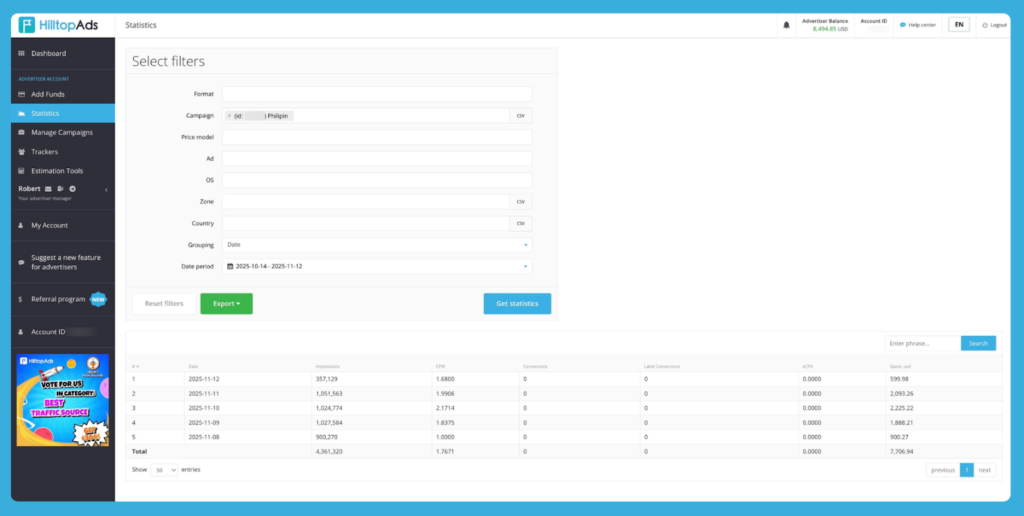
What it meant. Scale was roughly half of Indonesia, which aligns with market size and available inventory. Still, 4.36M impressions is substantial reach in PH – enough to put the product in front of a large share of TikTok shoppers at least once (thanks to frequency controls).
The listing climbed in views and appeared more often in recommended placements after the traffic boost. With baseline awareness established, the brand is well positioned to layer TikTok’s native ads or creator partnerships next – turning top-of-funnel attention into repeat traffic and purchases.

Launch your ad campaigns with HilltopAds and get:
- Global reach
- Advanced targeting options
- Direct traffic sources
- Self-serve platform
- Fully-managed service
- Postback tracking
How we Measured the +114% Brand Awareness Lift
Impressions are great, but the real test of any brand awareness campaign is simple: did we actually increase brand awareness in a meaningful way? To answer that, we looked beyond the HilltopAds dashboard and focused on signals of rising brand interest and engagement.
What we measured (outside HilltopAds):
Direct & Organic Traffic Uplift
We tracked direct visits and organic search traffic to the brand’s properties (Shopify site + marketplace pages) before, during, and after the campaigns. A spike in direct traffic is a classic indicator of awareness: more people type your brand/product URL or search your brand name on their own.
During the campaign window, direct and organic visits rose sharply – daily direct hits to the Tokopedia product page and the Shopify homepage roughly doubled versus the pre-campaign baseline. Taken together, these signals point to more shoppers actively seeking out the brand, not just clicking paid links.
Marketplace Engagement & Sales Data
Because we drove to marketplace listings, we also analyzed Tokopedia and TikTok Shop analytics. The brand saw higher product-page views, more store followers, and an uptick in units sold around 11.11.
Crucially, a noticeable share of that activity was organic (not directly attributable to paid placements), which typically doesn’t happen unless awareness has moved. On Tokopedia, the advertised product’s view surge outpaced what paid alone would explain – consistent with users returning later or sharing the listing.
11.11 sales were materially higher than prior sale events; the main new variable was our HilltopAds awareness push.
How we calculated the awareness lift?
To quantify the lift, the advertiser built a composite Brand Awareness Index combining:
- direct traffic,
- branded search volume,
- social mentions of the brand.
The index stood at 100 pre-campaign and rose to 214 post-campaign – +114%. In plain English: more than twice as many people were actively looking for or talking about the brand compared to before. That’s a big jump for a short awareness burst.
Why it matters?
That lift didn’t stop at the top of the funnel. With recognition in place, other channels worked better: retargeting and social campaigns saw higher CTRs because the audience now recognized the name.
In short, across both markets we boosted brand awareness substantially and saw the effect show up in tangible outcomes – better traffic quality, broader reach, and stronger sale-week performance.
Read our latest article on how to promote mVAS offers:
Takeaways
Popunder mobile + CPM = efficient scale
For top-of-funnel brand awareness campaigns, popunders delivered millions of affordable impressions (sub-$2 eCPM in ID/PH) and meaningful marketplace traffic fast.
Controls prevent fatigue, preserve quality
GEO/device/OS precision, 1/12 frequency capping, Proxy = disallow, WebView = allow kept reach broad, relevant, and non-annoying.
Timing multiplies impact
Launching in the run-up to 11.11 met shoppers at peak intent and amplified recall.
Measure beyond the click
Plan lift metrics upfront: direct/organic traffic, branded search, marketplace engagement. Our composite index showed +114% brand awareness with a corresponding sales uptick.
Know when you’re saturated – and how to scale
If a market (PH) won’t fully spend at a given CPM, you’re near daily saturation: expand GEOs, adjust OS ranges/bids, and follow with retargeting on the newly warmed audience.
Choose the right platform partner
Granular controls and cost-efficient reach matter – if you need affordable, high-quality scale, work with a partner built for it (and yes, we humbly recommend HilltopAds for that 😉).
Conclusion
Two synchronized Popunder waves – one for Tokopedia (ID) and one for TikTok Shop (PH) – proved that you can increase brand awareness quickly and cost-effectively while seeding sustained marketplace traffic.
With tight targeting and frequency discipline, we reached millions at low cost, lifted brand discovery by 114%, and set up downstream wins: higher engagement on product pages, stronger sale-day performance, and better CTRs in follow-on campaigns.
That’s the compounding effect of awareness done right – fill the top of the funnel with real recognition, and every other channel works harder for you. We’ll keep applying this playbook – periodic awareness waves around key retail moments, then focused retargeting – to scale reach responsibly and turn attention into repeat visits and sales.
Want the same results? Register on HilltopAds and kick off your campaign now.