


Budgets get burned, campaigns underperform, and CPM feels misleading. This article shows how to calculate CPM correctly, use a smart calculator, and turn impressions into measurable ROI with clear formulas
Ad spend leaks, campaigns underperform, and CPM often misleads. Mastering CPM with the right tools turns confusion into clarity, tracks every impression, and boosts ROI. This article shows how to calculate CPM accurately and use a powerful calculator to optimize campaigns.
It’s hard to overestimate the importance of the right bidding model. After all, the way you spend the budget on ad spots affects your net profit. While we would like to go through all of the models here, there’s just not enough space for that.
Instead, we will focus on just CPM, including the definition, application, and ways to calculate it. On top of that, we’ll highlight our CPM calculator that you can use to ease your planning. Of course, you will find some extra comments from our invited experts on how to make the most out of CPM.

Start working with HilltopAds and
keep your CPM campaigns fully under control.
What Is CPM and Why It Matters in Advertising
Before we dive deeper, we need to ensure we’re on the same page regarding CPM. CPM (Cost per Mille, also known as cost per thousand impressions) is a standard metric that, as the name suggests, helps advertisers determine the cost of 1,000 impressions and evaluate the effectiveness of their ad budget. CPM is essential for determining your ad campaign strategy, and the model provides precise data on whether the overall cost for impressions is worth it.
Affiliate marketing loves its acronyms, and many of them can be confusing for beginners, especially when they look alike. This is why we created a little list of terms that look similar to CPM, but are not the same, so you won’t mistake them in the future.
- eCPM (effective Costper Mille) – is a metric that, just like CPM, shows the cost for every 1,000 impressions. The difference is that eCPM can be used as an intermediary to compare CPM, CPC, CPV, CPA, and other models if needed.
- CPC (Costper Click) – is the cost that advertisers pay for every click on their ad, unlike CPM where impressions without clicks also count.
- CPA (Costper Acquisition) – is the cost of acquiring a lead or completing any other target action, a.k.a. conversion. It can be a sign-up, a download, or a purchase.
In a nutshell, all the terms above describe the fee that advertisers have to pay when users interact with their ads, whether it’s clicks, sales, or impressions. But the devil is in the details, and if you want to learn more about CPC and CPA pricing models, you can read about them in HilltopAds’ blog.
And here, we will provide two visions of our invited experts on the CPM matter: from an advertiser’s and publisher’s perspectives.

Elm
Business Development Manager
CPM is more relevant for advertisers, as this metric always shows the real cost for impressions and how much one will pay.
eCPM can be used to compare CPM and CPC ad campaigns, since eCPM shows how much impressions would cost if the campaign were converted to CPM. It indicates the campaign’s competitiveness in the auction and reflects the campaign’s performance. For instance, CPC and CPM campaigns can have the same eCPM, but because the payment prices differ, the risks will vary.

Nik
Publisher Sales Manager
eCPM helps you bring click formats, where the payment model is sometimes CPC-based, to a single denominator – CPM. The metric allows for an objective comparison of different ad formats with varying payment models. Calculate eCPM by using this equation: total revenue / total number of impressions * 1000.
How to Calculate CPM
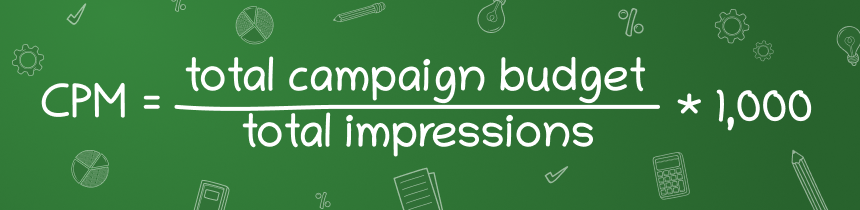
Here is a convenient formula for calculating CPM:
Calculation for Advertisers
For example, the cost of your campaign is $500 (i.e., your budget spent), and your ad received 100,000 impressions. All you have to do is follow the equation: 500 / 100,000 × 1,000 = 5. By using the formula, we found out that your CPM would be $5.
The equation by itself is quite simple. But in reality, you need to pay attention and keep track of multiple things at one time, and adding on top of that mental arithmetic can significantly hinder your success. When doing calculations on your own, you might accidentally lose a number somewhere, which will result in a totally different CPM. So when the time to pay for ad impressions comes, the actual cost will hit much harder than you expected.
Elm
Business Development Manager
CPM wins when the advertiser needs to maximize impressions, make a massive launch, or quickly test hypotheses with a broad audience. The metric works well for brand awareness, launches of brand-new apps, and when new brands enter the market.
Run CPM campaigns with HilltopAds and forget about inefficient budget spending.
Calculation for Publishers
If your website earned $500 from 100,000 ad impressions, calculating CPM is simple. Just use the formula: 500 / 100,000 × 1,000 = 5. This means your CPM is $5, or in other words, you earn $5 for every 1,000 ad impressions.
Put simply, this metric helps you understand how much revenue your traffic generates at a given impression volume. To avoid manual calculations and potential mistakes, HilltopAds has introduced a new CPM Calculator. It allows you to quickly calculate your CPM based on actual earnings and impression data. This is especially useful when comparing different ad formats, GEOs, or traffic sources and wanting a clear, accurate picture.
By working with HilltopAds as a high CPM ad network for publishers, you benefit from competitive rates, transparent analytics, and the ability to maximize revenue from every single impression.
Nik
Publisher Sales Manager
CPM is effective compared to other pricing models when advertisers prioritize impressions, reach, and branding, as they directly purchase traffic, providing predictable ad reach and frequency control. This approach is particularly suitable for the top of the sales funnel.
Sign up with HilltopAds as a publisher and earn with high CPM rates.
What Affects CPM
CPM isn’t a fixed metric, so advertisers have to pay attention to several factors if they want to get the most bang for their buck. Let’s take a look at 6 factors that directly influence your CPM:
GEO
The development and spending power of the country can significantly change the CPM. For example, ad impressions from the US will cost more than ad impressions from India, due to competition, local well-being, and some other factors.
Vertical
Some verticals are more popular than others, e.g., iGaming or non-mainstream, so the competition there will be higher, as well as the price. At the same time, it’s balanced by the fact that such ad spots have fewer intermediaries and less moderation than Google or Facebook, which drives the price tag down. So, every vertical is affected by multiple forces, and their lucrativeness might not be very intuitive.
Traffic source
There are tons of traffic sources online. Ad networks aggregate a whole plethora of them, but there are other options, such as social media platforms like Facebook, TikTok, or Instagram. Generally, the price tag for CPM correlates with the potential audience reach. But you don’t always want to go broad, as your goal is to convert, and this is where niche audience segments come in handy. And since they are niche, the impressions are also more affordable.
Device
Because of several reasons, like a faster scrolling speed that directly affects the ad viewability, the cost for impressions will be lower on mobile devices than on desktops.
Seasonality
Holidays, like Christmas, and major sale events, like Black Friday, tend to increase your CPM. But usually it’s well worth it, considering that the demand catches up and even overtakes the price increase, meaning you’re net positive (not a guarantee, though!).
Creatives
Videos attract more attention than still images, and more attention means more impressions, which directly influences the cost.
Elm
Business Development Manager
Name the main factors affecting the CPM rate and, if possible, elaborate on their respective dynamics, e.g., competition drives the price tag higher, but seasonality can go both ways.
Competition. The more competitive the auction is, the higher the CPMwill be.
GEO. Every country has its own rates.
Seasons. CPMis affected by holidays, historical events, or anything similar.
Offer’s vertical. While finance and iGaming have high CPM, dating, for example, is much more affordable in terms of rates.
Nik
Publisher Sales Manager
Of course, the main factor influencing CPM is demand from advertisers for this kind of traffic, because even if quality is through the roof, CPM may remain low if advertisers buy ad inventory elsewhere. You should also consider the following factors: seasonality, audience quality (a narrow segment can yield good results), GEO, and targeting.
Read our recent case study on monetizing X traffic using Direct Link:

How to Analyze and Interpret CPM Results
CPM analysis is fundamental for cost efficiency and profit increase, but keep in mind that the cost for ad impressions will vary from source to source. Traditionally, low CPM is anything below $1, and high is anything over $5–10; everything in-between is medium, but please note that these borders can shift from year to year.
Keep in mind that CPM (and CPC) rates depend heavily on your vertical of choice, as well as your preferred ad format. Also, a high CPM rate can be balanced out by high conversion and payouts from your affiliate program.
We also recommend looking at the industry average, and if what you pay is lower, you have a good CPM. For example, as of writing this article, the averageFacebook Ads CPM is $16.88, so anything below that cost is low.
What we’re trying to convey is that higher CPM isn’t always bad, just like lower CPM isn’t always good. Usually, a low cost is preferable, but you also need to look at the quality of impressions, the goal of your advertising campaign (e.g., to raise brand awareness), and the likelihood of conversions.
However, if you think the CPM is too high given how poorly your ad campaign performs, this isn’t a sign to change the traffic source, as you can still turn everything to your advantage. Let’s see how exactly you can do that.
Elm
Business Development Manager
Can you group CPMs, so that readers understand what low, middle, and high levels are as of 2025? Please say a few words on whether high CPM is necessarily bad, or whether there are cases when increased expenses are justified.
Low is anything under $1 and is usually in Tier 3 countries, medium is from $1 to $3.5 (Tier 2), and high is anything over $3.5 (Tier 1). High CPM gives access to first impressions and a more engaged audience.
Launch ad campaigns with HilltopAds
and work with the best rates on the market.
How to Lower Your CPM
There are several ways you can reduce your CPM. For your convenience, we have compiled a list of 5 methods to help you with the task. You can use one of the options below, or combine them to make your CPM as low as possible.
Increasing the quality of creatives
Ads ought to be relatable. They don’t have to be polished, but they have to communicate clearly their problem-solving capabilities. Fear Of Missing Out (FOMO) is a good approach, but there are other tricks you can use to hook the user. For example, there is the anchoring effect, when you deliberately display a suboptimal option first to make every subsequent offer look like a bargain. Alternatively, you can utilize proper framing, e.g., 80% fat-free vs. only 20% fat. And don’t forget about using matching colors with the help of Itten’s color circle.
Testing different GEOs and devices
Tier 1 is generally good, but the world doesn’t revolve around it. In fact, Tier 3 is more welcoming not only in terms of CPM rates, but regarding approaches as well. See, what used to work 5–10 years ago in Europe and the USA still converts in T3. Don’t be afraid to spend money on testing and go worldwide. This will pay off with data that you can use to narrow your targeting settings precisely. The same goes for devices, OS versions, age of subscription, and other parameters.
Cap the frequency of impressions
Capping is important to mitigate click-stealers and malevolent users. 3 impressions per 24 hours should be enough for the user to get acquainted with your product. If they don’t click, they probably won’t even after 20 impressions. To learn more, you can also read our article about frequent ad impressions.
Partner with ad networks utilizing anti-ad blocking
Ad blockers can mess with your targeting settings and page layout. They can even leave a bitter taste in the user’s mouth after seeing lots of blank spaces on a page. All in all, consider working with an ad network that counters ad blockers, like HilltopAds.
Automatic optimization and postback
Several ad networks provide you with automatic optimization tools, like CPA Goal, when you input your desired acquisition price. Postback, a.k.a. S2S tracking, is usually required for such advanced tools, so set it up. As an added bonus, you’ll be able to track user data more precisely with postback.
And if you don’t know how to set up postback, consult HilltopAds. We’ll help not only set it up, but also provide all the guidance you need to build a funnel that engages the users.
Elm
Business Development Manager
CPM helps to determine how competitive your ad campaign is in the auction. High CPM indicates high competition (due to the season, more advertisers, or increasing demand).
You can improve creatives, landings, and pre-landings to increase conversions, and then you won’t have to increase your rates. Update your creatives regularly, or rotate landings. Expand your targeting. Redistribute your budget to more active hours of the day (for example, adult converts better in the evenings and on weekends). And finally, optimize your zones by creating blacklists.
Nik
Publisher Sales Manager
CPM shows how much demand your traffic has and how advertisers value it. If the CPM is increasing, it means that the quality of traffic or demand is also growing – you can consider investing more in your SEO and improving your current rankings. Alternatively, if the CPM decreases, it may indicate a drop in market quality or interest; it is worth conducting a traffic quality assessment.
There are several ways to increase your CPM:
Traffic geography. Focus on countries with high CPM.
Filtering low-quality traffic. Remove bots and random clicks to avoid lowering your CPM.
And last, but not least, ensuring high page loading speeds (e.g., via Google PageSpeed Insights).
Also, check out our latest article on the best mobile ad networks:

Conclusion
As we stated several times in this article, CPM isn’t a fixed metric and is affected by many variables, such as the source of traffic, device type, and the number of impressions your ad receives.
Such inconsistency can scare away some beginners, but if you dive a little deeper, CPM isn’t as complicated as it seems and is actually quite important.
CPM helps you determine the value of the traffic source and whether the impressions here are worth your money or not. And even when your cost for impressions is higher than you want it to be, there are several methods that can help you reduce CPM.
And HilltopAds can help you get valuable impressions without excessive cost. Join us and start earning with the team of professionals today. While you’re still here, how about checking an article about another metric that we touched upon today – CPA.