


Compare the best mobile ad networks in 2026. Find the right platform for advertisers and publishers with advanced targeting, multiple ad formats, flexible pricing models, and effective traffic monetization.
Mobile ad networks connect advertisers who want to buy mobile traffic with publishers who want to monetize their apps and mobile websites. They simplify media buying by bringing together ad inventory, targeting tools, campaign analytics, and payment management on a single platform.
In this guide, you’ll learn how mobile ad networks work, what ad formats and pricing models they support, and what advertisers and publishers should consider when choosing a platform. You’ll also find a comparison of the top 7 mobile ad networks in 2026, as well as practical recommendations from an industry expert.
Sign up with HilltopAds – the leading mobile ad network.
What Is a Mobile Ad Network
A mobile ad network is a platform that connects advertisers looking to purchase mobile traffic with publishers who want to monetize their mobile apps or websites. The network simplifies the process of interaction between them through specialized tools, a large database of advertisers and publishers, built-in tracking, and automatic optimization.
Modern mobile ad networks support various ad formats and provide tools for targeting, analytics, automated optimization, and protection against ad fraud. This allows advertisers to engage their audience more effectively and publishers to better monetize their mobile traffic. This is especially important today, when, according to StatCounter, more than 55% of global web traffic comes from mobile devices.

Roman
Business Development Manager at HilltopAds
Mobile ad networks remain one of the key channels for digital advertising, as they reach users who spend most of their time online. As desktop traffic continues to decline, mobile advertising has become the primary source of audience reach for many industries.
Their popularity stems from a combination of high traffic volumes, flexible targeting, performance-based pricing models, and the ability to monetize even complex traffic using formats such as pop-ups and push notifications.
Mobile ad networks are expected to remain relevant in the future, but they will need to continue adapting to stricter privacy regulations, higher traffic quality standards, and growing demand for transparency.
How Mobile Ad Networks Work
After an advertiser launches a campaign, the mobile ad network automatically matches it with suitable ad inventory across participating mobile apps and websites. Every time a user opens an app or visits a mobile page, the network evaluates the available placement, applies the campaign’s targeting settings, and selects the most relevant ad to display. This entire process takes place in real time and is typically completed within milliseconds.
Behind the scenes, the platform also tracks impressions, clicks, conversions, and other performance metrics, allowing advertisers to optimize campaigns and publishers to monitor revenue. The ad delivery process itself consists of several key stages.
Ad Request
The process begins when a user opens a mobile app or visits a website. The built-in SDK (Software Development Kit) identifies an available ad slot such as a banner or video slot and sends an anonymous ad request to the network. The request typically includes information such as the app or website category, device type, location, and other contextual signals, without transmitting any personally identifiable information.
Bid Request
The ad request is then forwarded to a real-time bidding (RTB) marketplace or the ad network’s demand partners. Advertisers whose targeting criteria match the available impression are invited to participate in the auction.
Digital Auction
Within milliseconds, automated bidding algorithms evaluate the available impression based on factors such as audience, device, location, campaign settings, and bid price. The advertiser with the winning bid gets the opportunity to display their ad. This automated process, known as programmatic advertising, helps deliver relevant ads while maximizing the value of each impression.
Ad Placement
The winning creative is retrieved from the advertiser’s server and displayed within the mobile app or website. During this stage, the network verifies that the ad is served correctly and activates tracking to measure impressions, clicks, viewability, and other engagement metrics.
Reporting&Optimization
After an ad is served, the network records performance data such as impressions, clicks, conversions, and other metrics. This information is displayed in real time on the advertiser’s dashboard, helping to optimize targeting, bids, and creatives. While most mobile ad networks provide built-in tracking, many advertisers also use third-party trackers to independently verify campaign performance and attribution.
Check out our recent article on optimizing In-Page Push Ad campaigns:
Payment Models in Mobile Ad Networks
Mobile ad networks support several pricing models that determine how advertisers pay for traffic and how publishers earn revenue. The most common models are CPM, CPC, CPA, CPI, and CPV.
| Pricing model | Advertiser pays for | Typical use cases |
| CPM | 1,000 impressions | Brand awareness, high-reach campaigns |
| CPC | Clicks | Driving website traffic |
| CPA | Completed actions | Lead generation, sales, subscriptions |
| CPI | App installs | Mobile app promotion |
| CPV | Video views | Video advertising campaigns |
CPM
CPM (Cost Per Mille) is a pricing model in which advertisers pay for every 1,000 ad impressions. It is commonly used for high-volume campaigns and provides predictable revenue for publishers because earnings depend on impressions rather than clicks or conversions. However, publishers with highly engaged audiences may generate higher revenue under performance-based models such as CPC or CPA.
CPC
CPC (Cost Per Click) is a pricing model where advertisers pay only when users click on an ad. Unlike CPM, revenue depends on user engagement rather than impressions, making this model well suited for websites and apps with high click-through rates (CTR).
CPA
CPA (Cost Per Action) charges advertisers only when users complete a specific action, such as signing up, making a purchase, or subscribing to a service. It is one of the most performance-focused pricing models, offering advertisers greater control over costs while rewarding publishers that deliver high-quality traffic.
CPI
CPI (Cost Per Install) is a pricing model in which advertisers pay only when a user installs their app. It is widely used for mobile app promotion, especially in the gaming industry. Today, many advertisers also measure post-install events, such as purchases or user retention, to evaluate campaign performance more accurately.
CPV
CPV (Cost Per View) is primarily used for video advertising, where advertisers pay when users watch a video ad according to the platform’s viewing criteria. It is commonly used in gaming, streaming, and social media apps, where video content naturally attracts user attention.
Earn with the most profitable CPM, CPC, or CPA Goal rates with HilltopAds
How to Choose the Right Payment Model
The optimal pricing model depends on your campaign goals, the quality of your traffic, and the results you want to achieve. For example, CPM is often chosen to increase reach, CPC to drive traffic, CPI to improve campaign performance, and CPV to promote apps.
Although certain ad formats are most commonly associated with specific pricing models, the available options ultimately depend on the ad network and the type of campaign. Before launching a campaign, check which pricing models and ad formats your chosen platform supports to find the combination that best aligns with your goals.
Roman
Business Development Manager at HilltopAds
The choice of a pricing model directly affects a media buyer’s costs, scalability, and overall campaign performance. CPM can deliver the highest traffic volumes but requires continuous optimization to remain profitable. CPI and CPA provide more predictable acquisition costs, although they usually come with higher competition and lower scalability. CPV is best suited for video campaigns focused on building awareness and engagement, so it’s important to understand how video views contribute to downstream conversions.
Ad Formats in Mobile Ad Networks
Mobile ad networks support a variety of ad formats, each designed to meet different campaign objectives and enhance the user experience. Below are the most common formats used by advertisers and publishers.
Banner Ads
Banner ads (also known as display ads) are static or animated ads placed within a mobile app or on a website. It is one of the most widely used ad formats due to its ease of implementation and consistent monetization potential. Although banner ads are effective at increasing brand awareness and reaching a broad audience, their effectiveness can be limited by banner blindness and ad blockers.
Interstitial Ads
Interstitial ads are full-screen ads that appear at natural transition points, such as between app screens or game levels. Their high visibility often leads to higher engagement and conversion rates than banner ads, making them a popular choice for user acquisition campaigns. However, displaying them too frequently can negatively impact the user experience, so choosing the right time and placement is crucial.
Video Ads
Video ads are short promotional clips that appear in mobile apps and on websites. They can appear before, during, or after video content (in-stream) or as standalone placements in app feeds and on out-of-stream pages. Thanks to their engaging format, video ads are widely used to increase brand awareness, boost app installs, and drive user engagement.
Popunder Ads
Popunder ads open in a separate browser tab or window without immediately interrupting the user’s current browsing session. Because they don’t cover the active page, they are generally considered less intrusive than traditional pop-ups. Popunders are commonly used in performance marketing, where they can deliver high traffic volumes while giving users the opportunity to engage with the advertised offer after they finish browsing.
Offerwall Ads
Offerwalls allow users to earn in-app rewards by completing specific actions, such as installing another app, taking a survey, or watching a video. Advertisers pay only for completed actions, while publishers generate revenue by offering users optional rewarded experiences. This format is particularly popular in gaming and freemium apps, where it can increase both engagement and monetization.
Roman
Business Development Manager at HilltopAds
For me, popunders are still the go-to format – they’re extremely strong in certain verticals, and the volume-to-price ratio is crazy compared to FB or PPC traffic in the same geos.
How to Choose the Right Mobile Ad Network
The right mobile ad network depends on your goals. Advertisers and publishers often evaluate the same platforms using different criteria, so the table below highlights the key factors to consider before choosing a network.
| What to evaluate | Why it matters | Advertisers | Publishers |
| Traffic quality | Higher-quality traffic improves conversions and ROI. | ✅ | |
| GEO coverage | Helps reach the right markets and audiences. | ✅ | |
| Ad formats | Different formats support different campaign goals. | ✅ | ✅ |
| Targeting | More precise targeting improves campaign performance. | ✅ | |
| Analytics | Helps measure and optimize campaign performance. | ✅ | ✅ |
| Anti-fraud | Protects against invalid traffic and ad fraud. | ✅ | ✅ |
| Integration | Faster setup with SDKs or ad tags. | ✅ | |
| Payout terms | Minimum payout, payment frequency, and payment methods. | ✅ | |
| Support | Responsive technical and account support. | ✅ | ✅ |
| Reputation | Indicates reliability and transparency. | ✅ | ✅ |
Roman
Business Development Manager at HilltopAds
At the end of the day, I guess it all comes down to a few things: traffic quality, anti-fraud measures, experience in your vertical, suitable pricing models, and API capabilities. Oh, and don’t forget about responsive support and a good market reputation, too.
The Best Mobile Ad Networks in 2026
| Ad Network | Best For | Main Ad Formats | Pricing Models | Minimum Payout | Key Strength |
| HilltopAds | Performance marketing, affiliate traffic monetization | Popunder, In-Page Push, Display Banners, VAST Video | CPM, CPC, CPA | $20 | Flexible targeting (GEO, device, OS), weekly payouts and strong performance traffic |
| Unity Ads | Mobile gaming monetization | Rewarded Video, Interstitial | CPM, CPI | $100 | Deep integration with Unity engine and strong engagement in gaming apps |
| Google AdMob | App developers and large mobile publishers | Banner, Native, Interstitial, Rewarded Video | CPM, CPC | $100 | Access to Google Ads demand and strong analytics ecosystem |
| InMobi | Global brand campaigns and large publishers | Native, Video, Interstitial, Rich Media | CPM, CPC | $50–$300 | Global reach with strong advertiser demand and AI-driven targeting |
| Smaato | Programmatic monetization and RTB marketplaces | Display, Native, Video | CPM | $100 | Large programmatic exchange with global demand partners |
| AppLovin | Gaming apps and user acquisition campaigns | Rewarded Video, Interstitial, Banner | CPM, CPI, CPA | varies | AI-driven bidding and strong monetization for gaming |
| PubMatic | Premium publishers and programmatic monetization | Display, Native, Video, Rich Media | CPM | varies | Advanced SSP infrastructure and header bidding support |
| Adsterra | Mobile app acquisition | Popunder, Social Bar, Interstitials, In-Page Push | CPM, CPC, CPA | $5 | High-engagement mobile ad formats, conversion-driven optimization |
HilltopAds
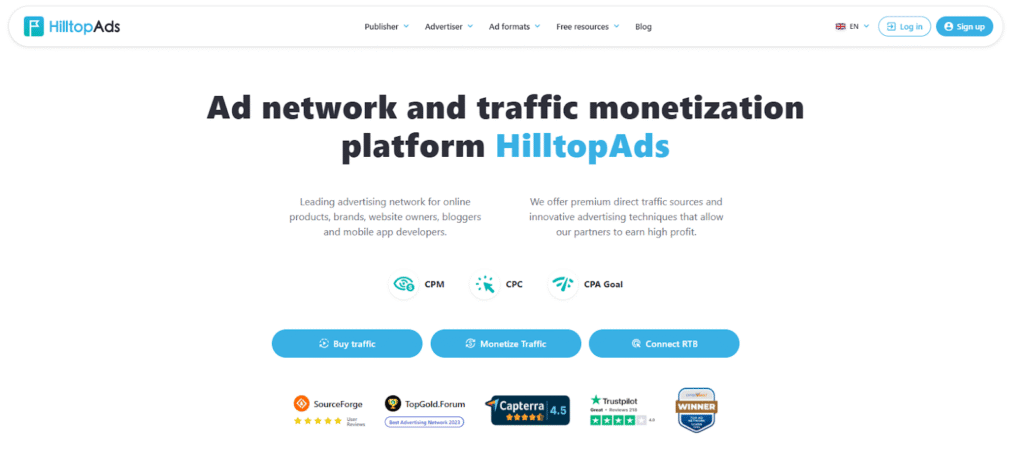
HilltopAds has been a big player in the mobile ad networks niche since 2013. For more than 10 years, HilltopAds’ mobile advertising solutions have been designed to deliver the right users to your app with tailored strategies that align with your app’s objectives. HilltopAds offers advanced targeting and performance optimization to ensure optimal results, regardless of whether the app is designed for iOS or Android.
HilltopAds specializes in all kinds of niches, but primarily the mainstream ones. Some of them are: Games, Mobile Apps, iGaming, Pin-Submits, E-commerce, Streaming Dates, Sweepstakes, and many more.
From a publisher’s point of view, HilltopAds offers features relevant to monetizing mobile traffic, including anti-ad-block solutions, weekly payouts, low minimum payout thresholds, and support for both apps and mobile sites.
Pros
- Vast ad inventory
- A diverse range of ad formats
- Advanced mobile targeting
- Low minimum payout
- Global reach
- Personal manager support
Cons
- Rigorous approval process (which is not that long, but still)
- Monetization is GEO-sensitive
- Some ad formats can be intrusive
Start working with the top mobile ad network today
to achieve maximum results.
Unity Ads
Originally, Unity is a game engine that allows the creation of both PC and mobile video games. The company itself was founded in 2004 in Denmark, and Unity Ads was launched in 2015. Given its significant experience in the gaming business, Unity Ads is ideal if you are looking to monetize mobile games. They seamlessly integrate ads into gameplay, especially video ads that reward players.
Basically, if you work with mobile games, this is the definite choice for you. It covers most of the niches on the market: rewarded videos, interstitial, playable ads, banners and so on.
Pros
- Made specifically for mobile games
- Support for both iPhone and Android
- High player engagement and retention
- High-quality videos
- Unintrusive when it comes to gameplay
Cons
- Limited if you’re not making games
- Focused mostly on video ads
- Works better in some countries than others
- Not many traditional ad options
Google AdMob
AdMob was founded in April 2006. Later in 2009, Google purchased AdMob, and it has since been integrated into Google’s ecosystem, representing the mobile ad market. AdMob is used by top-tier mobile apps, such as Duolingo, Clash of Clans, and Pokémon GO.
By leveraging Google’s extensive network, AdMob can deliver a significant reach and improved conversion rates. The setup is simple, and you can start with small apps. The only downside is that, due to the size of the network, support is mostly provided by chatbots that may not be able to assist in some specific situations.
Pros
- Has a huge database of advertisers
- Provides exact stats
- Easy to get started
- Maintains ad quality
Cons
- Not available everywhere
- Support is mostly automated
- Some settings are too general
- Tools can be limited
InMobi
InMobi is a global mobile ad company that originated in India in 2007. It focuses on helping brands engage with their audiences through mobile ad platforms. The company has been recognized for its innovative and impactful work in mobile advertising. It offers its customers in-app inventory reach, DSP services, and targeting to enlarge their campaigns.
The ad network mostly works with native ads. It has advertisers and ad buyers worldwide. InMobi has a smart system that matches ads for every user, based on their activity. It may take a while for the algorithms to learn, but eventually, the network will display only relevant ads.
Pros
- Works with advertisers and ad buyers worldwide
- Specializes in native ads
- Has a smart targeting system
Cons
- Takes time to reach maximum performance
- Setup might be tricky
Smaato

Smaato is a mobile ad network that boasts its omnichannel ad server and monetization capabilities. The network offers a variety of services both for advertisers and publishers. One of the features is a platform for managing and optimizing ad inventory.
Smaato was founded in 2005. Since then, it has become a strong player in the arena. 20 years of experience make it a trustworthy choice. The network supports native ads, OTT/CTV ads, video ads, and display ads
Pros
- Supports apps and ad inventories across many countries
- Offers a wide variety of ad formats
- Has a strong anti-fraud system
- Omnichannel support
Cons
- Performance may vary significantly depending on the region
- Precise setup and active support needed
AppLovin
AppLovin was founded in 2012 by Adam Foroughi, Andrew Karam, and John Krystynak. It started as a mobile game-related company. Now it is a respectable mobile ad network that specializes in the mobile games niche. It supports the most popular ad formats (banners, interstitials, rewarded videos, native, and even newer placements like lock-screen ads).
One of the main features is their monetization platform called MAX. For publishers, MAX offers mediation, in-app bidding, and automation. For advertisers, AppLovin provides AI tools and extensive data sets to enhance targeting and performance.
Pros
- Has a wide selection of ad formats
- Allows live bidding
- Worldwide coverage
- Keeps ads brand-safe
Cons
- Takes time to set up
- Lots of settings to learn
- Needs traffic to start
- Extra cost for access to better tools
PubMatic

PubMatic is a publicly traded ad‐technology company that operates a supply-side platform (SSP) for digital publishers, helping them monetize their inventory programmatically. In 2025, PubMatic launched a unified platform combining AI-driven yield optimization, first-party data monetization, and omnichannel demand access.
19 years of experience have brought the network to an astonishing nearly 75 trillion impressions in Q1 2025. The company has its own data centers and infrastructure to support real‐time bidding at scale.
Pros
- AI-driven tools give potential for higher revenue
- Only premium ads
- Global reach
Cons
- Complicated setup
- Inconvenient UI
Adsterra
Adsterra is a global advertising and monetization network founded in 2013, helping advertisers acquire users and drive conversions across mobile and desktop traffic. Its mobile advertising solutions are built around performance, combining high-engagement ad formats, advanced targeting, and conversion-focused optimization to help advertisers reach the right users and achieve their campaign goals across both iOS and Android.
Adsterra supports a wide range of mobile-focused verticals, including Mobile Apps, Games, iGaming, VPNs, Utilities, E-commerce, Mobile Subscriptions, and more. Advertisers can choose from mobile-friendly formats such as In-Page Push, Social Bar, and Interstitials, with flexible CPM, CPC, and CPA pricing models. For advertisers focused on performance, Adsterra provides tools designed to improve mobile campaign efficiency, including CPA Goal, Custom Bid, and Multi-Event Tracking.
From a publisher’s point of view, Adsterra provides multiple monetization solutions for mobile websites and apps. Publishers can access a global pool of advertisers, benefit from flexible monetization options, and use Adsterra’s optimization technology to maximize revenue from their mobile traffic.
Pros
- Strong mobile user acquisition
- High-engagement ad formats
- Advanced targeting
- Conversion-focused optimization
- 248+ GEOs covered
- Multiple monetization options for publishers
Cons
- Performance varies by GEO and vertical
- Ad formats should be chosen mindfully
Choose HilltopAds and
make the most of the benefits offered by a mobile ad network
Trends in Mobile Ads
Last but not least, let’s talk about what to expect from mobile ads and ad networks in the future.
Growing Role of AI
Artificial intelligence is rapidly becoming one of the main drivers of innovation in mobile advertising. Today, it handles everything from bid optimization and audience targeting to creative development and campaign analysis, helping advertisers make data-driven decisions more quickly.
At the same time, artificial intelligence is no substitute for strategy or manual optimization—it works best when combined with human expertise. As these tools continue to evolve, advertisers who actively test AI-powered features are likely to gain a competitive advantage over those who rely solely on traditional campaign management.
Interactive Ads
Interactive ad formats are gaining traction as advertisers look beyond traditional display advertising. By allowing users to interact with an ad–whether by tapping, dragging elements, spinning a wheel, or completing a short in-ad experience—they create a more engaging journey before the click.
As a result, users who reach the landing page are often more interested in the offer and more likely to convert. Although these formats are still relatively new, an increasing number of ad networks are starting to add them to their inventory.
Privacy First
Privacy regulations continue to reshape the mobile advertising ecosystem. As third-party tracking becomes more restricted, advertisers and publishers are increasingly adopting first-party data, contextual targeting, and server-to-server (S2S) integrations to measure campaign performance while complying with regulations such as GDPR. Choosing advertising platforms that support privacy-friendly technologies is becoming less of a competitive advantage and more of a long-term necessity.
Roman
Business Development Manager at HilltopAds
From what I see, AI-driven creative development and optimisation are definitely among the biggest trends right now, together with automated tools for whitelisting the feeds. At the same time, I think some formats are losing momentum traditional push notifications, for example, don’t perform as well as they used to and are gradually giving way to newer approaches.
Conclusion
Mobile advertising isn’t slowing down, and neither are mobile ad networks. New ad formats, AI-powered optimization, and changing privacy standards continue to reshape the industry, but one thing remains the same: successful campaigns are built on quality traffic, continuous testing, and careful optimization. The tools may change, but these principles don’t.
Putting all of this into practice starts with choosing the right platform. At HilltopAds, we help advertisers and publishers grow with quality mobile traffic, flexible targeting, multiple ad formats, and dedicated support every step of the way.