


Mobile traffic keeps growing, but navigating dozens of ad networks and finding the ones that actually deliver results is getting harder. This article gives you a clear, no-nonsense guide to ad formats, payment models, and key criteria that help you avoid wasting budget. You’ll also find our top 7 mobile ad networks of 2026 and expert insights to help you launch smarter and scale faster.
The online world is not only full of entertainment but also offers tons of opportunities to earn. One of the most rewarding and robust ways to profit is performance marketing. The world of online marketing is a complex one, featuring affiliate networks, media buyers, traffic sources, and, of course, ad networks.
Talking about them all is overkill, so we’ll take it one step at a time and focus on ad networks. In particular, we’ll focus on mobile ad networks, as they dominate the market.
In this article, you’ll learn what they are, how they work, which ad formats and payment models they support, and how to choose the right one. In the second half of the article, you’ll find our 7 cherry-picks, plus there will be occasional commentaries from our invited expert. Tap (like literally) into the glorious world of mobile traffic!
Sign up with HilltopAds – the leading mobile ad network.
What Is a Mobile Ad Network
A mobile ad network is a platform that connects advertisers with publishers who are interested in mobile traffic. On one side, there are publishers with ad space to sell (Supply Side Platform), and on the other, advertisers looking to buy that space (Demand Side Platform), generate traffic, and send users acquired to their product page for future monetization (typically via affiliate networks or programs).
The role of the mobile ad network is to connect these two parties and facilitate their collaboration – think of it as a mediator that eases the work of all participants. Ad networks aggregate all the sources in one place, making it easier for advertisers to compile a whitelist of traffic.
Mobile ad networks are generally focused on smartphones, as they have the highest market share in 2026. They usually feature numerous tools to ease one’s work, such as in-depth statistics, categories, filters, and automated bidding tools. Also, there are usually multiple ways to top up one’s balance or withdraw money from it.
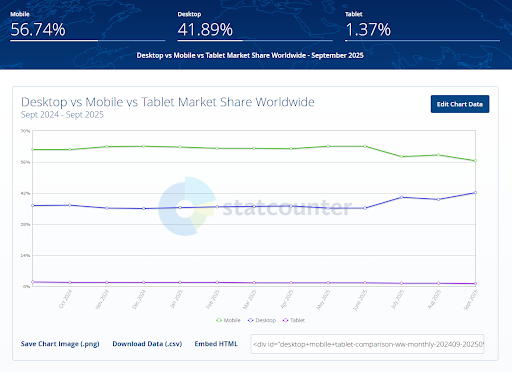
According to StatCounter, mobile traffic accounts for more than 55% of global web traffic. That’s more than half of the world that is using mobile apps on a daily basis, meaning mobile ads are a go-to if you want to sell your product or monetize your website successfully.

Roman
Business Development Manager at HilltopAds
Why are mobile ad networks special, what are the main factors contributing to their popularity, and will they remain popular in the future?
In my opinion, mobile ad networks are special because they sit exactly where people spend most of their digital time – desktop ad traffic and CR keep decreasing. Here it’s all about precise tracking and metrics, so both the tech and pricing models are tuned for performance. I think this is the key success factor. The popularity comes from scale, flexible targeting, performance-friendly buying models, and the ability to monetise ‘difficult’ traffic with formats like pops and push. I think the popularity remains, but networks have to keep evolving alongside privacy regulations and tougher demands for traffic quality and transparency.
How Mobile Ad Networks Work
Mobile ad networks appear differently for users, advertisers, and publishers. Specifically, ordinary users are typically unaware of their existence and only see relevant ads. For instance, if someone browses a fitness-related website that is connected to an ad network, they will see health, nutra, beauty products, and similar ads.
Advertisers and publishers usually have two dedicated dashboard versions. The former upload the creatives, set up ad campaigns, narrow down targeting settings, top up their accounts, check their campaign stats, and so on. The latter are preoccupied with their website performance and payout collection.
Any ad network relies heavily on a set of algorithms to track ad performance, process payments, and provide insights into what’s working and what isn’t. This creates a system where everyone wins: publishers earn revenue, advertisers reach the right audience, and users see relevant ads.
But that’s just the tip of the iceberg; let’s see what lies underneath it and take a dive right in.
Ad Request
It all begins when a user opens an app or website. Instantly, the integrated ad network or SDK (Software Development Kit) identifies available ad spaces (like a banner or video slot). It sends an anonymous ad request to its servers, broadly detailing the offer, as the app category, device type, location, and user’s context, without leaking sensitive or personal data.
Bid Request
After the offer has been found, it is then broadcast to a real-time bidding (RTB) marketplace, where multiple advertisers compete. This bid request is the digital equivalent of announcing: “We have a user who loves fitness on their phone right now. Who wants to show them an ad?”
Digital Auction
In under 100 milliseconds, automated algorithms from various advertisers assess the user, match with the affiliate’s target audience, as well as the suitability of their ad creative and subsequently place a bid. The highest bidder wins the right to display their ad. This process is called programmatic advertising, which ensures the most relevant ad at the best price.
Ad Placement
The winning ad creative is instantly fetched from the advertiser’s server and rendered within the app/website. During the process, viewability checks confirm the ad is displayed correctly, and tracking tags are put in place to measure user interaction.
Feedback
Finally, the network logs the result. It can be an impression, click, or conversion. This performance data is displayed in real-time on advertisers’ analytics dashboards, providing the insights they need to track revenue and strategically optimize ad placements for even better results. Typically, ad networks have their own tracking solutions, but using a third-party tracker on top of it is also welcome, as it improves accuracy.
Check out our recent article on optimizing In-Page Push Ad campaigns:
Payment Models in Mobile Ad Networks
Various ad formats feature different bidding models. For example, Pop ads typically involve a CPM commission, while Push notifications are charged on a CPC basis. However, there are more bidding models, and we’ll go through some of the most popular ones: CPM, CPC, CPI, CPA, and CPV.
CPM (Cost Per Mille)
When translated, CPM means “cost per thousand impressions.” It is a fundamental model where advertisers pay for every 1,000 (fr. mille) times their ad is displayed. For publishers, this is often the most reliable model, as it generates revenue from ad views alone, regardless of user clicks or actions. It’s ideal for apps with high, stable traffic, like news or utility apps, where users regularly see ads. This predictability allows for straightforward revenue forecasting. The potential downside for publishers is missing out on higher earnings if their audience is highly engaged and more likely to click. Besides, don’t forget about ad blockers, which… well… block the impressions.
CPC (Cost Per Click)
With CPC, advertisers pay only when a user clicks on their ad. This model shifts the risk, favoring advertisers who pay for engagement rather than just visibility. For publishers, this poses a risk: they can serve many ad impressions without earning anything if users don’t click. However, it can be highly profitable in apps where users are active and engaged, such as shopping or lifestyle platforms, especially when publishers optimize placements to boost click-through rates (CTR) – when it’s high, CPC becomes more profitable.
CPA (Cost Per Action)
CPA is a more advanced evolution of this performance-based concept. Here, advertisers pay only for a specific, valuable action within the installed app, such as a sign-up, subscription, or in-app purchase. This offers the lowest risk for advertisers and the highest potential payouts for publishers who can drive qualified users, though conversion volumes are typically lower.
CPI (Cost Per Install)
CPI is a specific form of CPA where payment is triggered only when a user installs the advertised app. It is the gold standard for user acquisition, particularly in the gaming industry, as it directly ties spending to new customer acquisition. However, marketers now look beyond the installation to post-install events like first purchases and retention to calculate true ROI.
CPV (Cost Per View)
Another particular case of CPA, CPV is thriving in the video ad market. Advertisers are charged each time a user views their video ad. This model is highly effective in apps with natural viewing breaks or high engagement, such as gaming, streaming services, or social media with short vertical videos (TikTok, Instagram, YouTube), because it rewards publishers for capturing and holding user attention.
Earn with the most profitable CPM, CPC, or CPA Goal rates with HilltopAds
Choosing the Right Model
The optimal model depends entirely on your app’s user behavior and your business objectives. Publishers with massive traffic may prefer CPM for stable income, while those with a highly engaged niche audience might profit more from CPA. Many advertisers are experimenting with hybrid models (CPM with a CPC bonus) to balance guaranteed revenue with performance upside. Ultimately, aligning your monetization strategy with how your users naturally interact with your app is the key to maximizing revenue.
From the advertiser’s point of view, the choice between the models typically comes down to preferred ad formats. If you target your audience with Pre-Rolls, then you’re likely to bid on the CPV basis. That’s why it’s important to know the ad formats available, as they can influence your commission structure.
Roman
Business Development Manager at HilltopAds
How can the payment model picked affect the media buyer’s performance and income? Please give some examples of when to use each model, e.g., CPM, CPC, CPI, CPA, CPV.
Payment models determine who bears the risk, which directly shapes a media buyer’s margins and stability. CPM requires the most attention to optimisation, but delivers the highest volumes. CPI and CPA imply more predictable results for the buyer, but higher competition and limited growth options. CPV is mainly for video storytelling and upper-funnel warming, so it demands a clear view of how views translate into conversions.
Ad Formats in Mobile Ad Networks
You can spot different ad formats in the field. Some of them can be more or less effective in different contexts. Here are some of the most popular ad formats that mobile ad networks can offer:
Banner Ads
Banners, a.k.a. display ads, are static or animated images placed right into the app’s interface. They are easy to implement and have a steady baseline revenue for many app types. This ad type is good for brand awareness and hassle-free monetization. But there are two main issues with display ads: ad blockers and banner blindness. The former is usually countered with anti-ad blockers, provided by reputable ad networks, such as HilltopAds. The latter boils down to being creative and hooking up the users with unconventional approaches.
Interstitial Ads
Interstitial ads are covering the entire website or app screen. They are usually shown in between pages in apps or between levels in mobile games. They are exclusive to mobile traffic. Although these ads can drive installs/conversions better than banners, have high visibility and CPM costs, they can be considered annoying and too intrusive for users. Place interstitial ads strategically and with due respect.
Video Ads
Video ads are short clips of up to 60 seconds. These are used to promote products and services within mobile apps, particularly in media apps. There are two main types: in-stream and out-stream. In-stream ads play full-screen before (Pre-Roll), during (Mid-Roll), or after (Post-Roll) video content that is streamed inside an app. While out-stream ads appear inline on app pages or feeds outside a video player, displaying alongside other content. A good example of an out-stream ad would be on a Wikia page.
Popunder Ads
Popunder is an ad that opens in a new tab/window beneath the current content or triggers from a click. It makes it less intrusive than popup overlays because it doesn’t interrupt the immediate session. The main advantage of popunder is it can deliver large volumes of impressions and visibility without immediately blocking the user’s view, getting more attention. Plus, its canvas is huge, and you don’t need a dedicated creative for it – your Pop-under is the creative (or pre-landing page, depending on how you look at it).
Offerwall Ads
Offerwalls are in-app marketplaces that offer users rewards for completing specific tasks, like installing another app, completing a survey, or watching a video. Users receive in-app rewards, advertisers pay for completed actions, and developers earn revenue. This format enables publishers to monetize their apps while often enhancing user engagement and retention. They are not as common as the ones mentioned above, but we can’t ignore them either when discussing mobile ad networks.
Roman
Business Development Manager at HilltopAds
Which ad formats work best within mobile ad networks and mobile apps in particular?
I would always go for popunders – they’re extremely strong in certain verticals, and the volume-to-price ratio is crazy compared to FB or PPC traffic in the same geos.
How to Choose the Right Mobile Ad Network
Every ad network has its unique range of applications, but generally, you can’t go wrong with HilltopAds. Some ad networks favor a broad approach, trying to encompass as many ad formats as possible, while others prefer a tall approach, capitalizing on a handful of formats. Besides, the choice depends on whether you’re an advertiser or publisher, as they have different aspirations and expectations. But one thing is for certain: a reputable ad network respects both parties.
For Advertisers
Traffic Quality
Check sample traffic reports, viewability rates, and post-install conversion metrics. High-volume impressions can be meaningless if users don’t engage or convert. Quality traffic protects your ROI and lowers spending.
GEO
Find out about geographical coverage. Look at regional fill rates, localized creatives, and average CPI/CPM by country. This can help when planning your campaigns. Don’t forget about the worldwide coverage, which is where HilltopAds excel, for instance.
Ad Formats
Learn about ad formats supported by the ad network and compare them with your intentions. The diversity of ad formats is beneficial for testing, so you can pick the one that works for you. Format specialization, on the other hand, might be more beneficial when you know your ad format of choice.
Targeting Possibilities
Targeting is necessary as it can significantly push your ad campaign. Before choosing a network, ensure it offers these options. Targeting can be done based on different criteria, such as geolocation, interests, gender, device, OS, and even mobile carrier.
Anti-fraud Protection
Transparency is key in this field. Ask about the network’s fraud-detection stack: real-time detection, postback validation, SDK-level checks, and cooperation with third-party anti-fraud vendors.
Analytics & Tracking
A mobile ad network should be able to help you with the data you gather. Utilize the network’s analytics tools to monitor key metrics, including impressions, clicks, and revenue. Based on these findings, direct your further actions towards optimizing your campaigns.
Why don’t you try HilltopAds? We have a great selection of ad formats, from classic pop ads to more progressive videos. Popunder is our go-to format: we know how to make these windows appealing and eye-catching so they don’t irritate users. But we also work with other formats when you want to spice things up or don’t want to put all the eggs in one basket.
Direct traffic, converting ad formats, anti-fraud algorithms, and dynamic optimization are only a handful of advantages we offer. Register now to get started and see why thousands of affiliates rely on our ad network.
Read our latest article on the 10 best dating CPA networks:
For Publishers
Integration Process
No one wants to spend lots of time integrating ads into the app. The process should be simple and transparent. Reliable mobile ad networks often use an SDK that eases integration.
Payout Frequency
Reliable, predictable payouts are essential for cash flow. Check minimum payouts, frequency, and payment methods.
Support
Whether you are a newbie in publishing or have experience, you may need some help from time to time. A great mobile ad network provides responsive technical support and assigns a dedicated account manager to guide you on your way to profit. This should apply not only to experienced partners, but also to aspiring advertisers and publishers. So think twice if you’re redirected to the FAQ or bot immediately after asking your question.
Reputation
Read recent publisher reviews and case studies about fill rates, ad quality, and payment reliability. Community feedback reveals real-world behavior that the company may hide. Prefer networks with transparent reporting and public references, verified by Trustpilot, Affpaying, or other review websites.
Whether you’re a publisher or advertiser, read the forums to figure out whether an ad network in question is for you or not. While maladvertising can be an issue, feedback from your peers is probably the best recommendation you can get.
Roman
Business Development Manager at HilltopAds
Name the common criteria when picking a mobile ad network as an advertiser and as a publisher.
A lot of things, I guess: traffic quality and anti-fraud measures, experience in the desired vertical, suitable pricing models, API capabilities, etc. Oh, and don’t forget about support and a good market reputation, too.
The Best Mobile Ad Networks in 2026
| Ad Network | Best For | Main Ad Formats | Pricing Models | Minimum Payout | Key Strength |
| HilltopAds | Performance marketing, affiliate traffic monetization | Popunder, In-Page Push, Display Banners, VAST Video | CPM, CPC, CPA | $20 | Flexible targeting (GEO, device, OS), weekly payouts and strong performance traffic |
| Unity Ads | Mobile gaming monetization | Rewarded Video, Interstitial | CPM, CPI | $100 | Deep integration with Unity engine and strong engagement in gaming apps |
| Google AdMob | App developers and large mobile publishers | Banner, Native, Interstitial, Rewarded Video | CPM, CPC | $100 | Access to Google Ads demand and strong analytics ecosystem |
| InMobi | Global brand campaigns and large publishers | Native, Video, Interstitial, Rich Media | CPM, CPC | $50–$300 | Global reach with strong advertiser demand and AI-driven targeting |
| Smaato | Programmatic monetization and RTB marketplaces | Display, Native, Video | CPM | $100 | Large programmatic exchange with global demand partners |
| AppLovin | Gaming apps and user acquisition campaigns | Rewarded Video, Interstitial, Banner | CPM, CPI, CPA | varies | AI-driven bidding and strong monetization for gaming |
| PubMatic | Premium publishers and programmatic monetization | Display, Native, Video, Rich Media | CPM | varies | Advanced SSP infrastructure and header bidding support |
HilltopAds
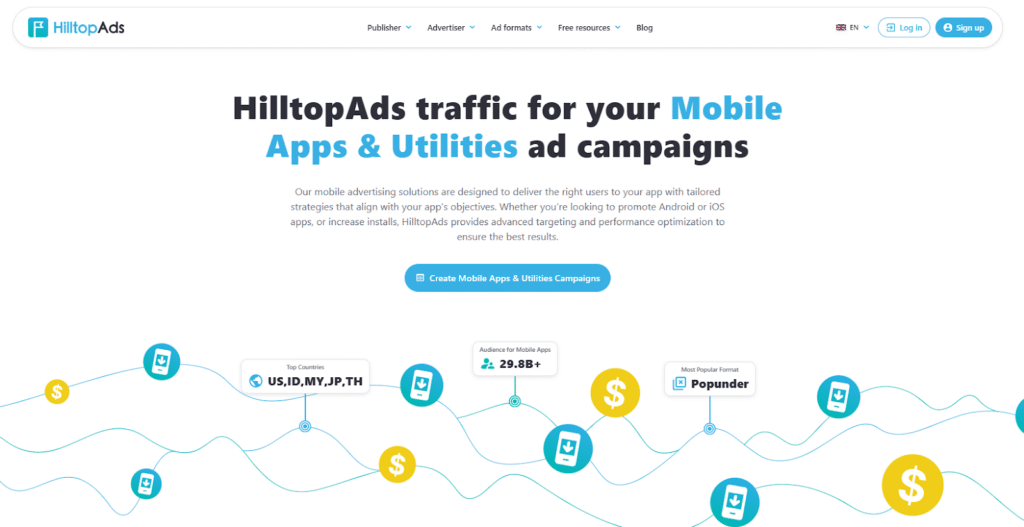
HilltopAds has been a big player in the mobile ad networks niche since 2013. For more than 10 years, HilltopAds’ mobile advertising solutions have been designed to deliver the right users to your app with tailored strategies that align with your app’s objectives. HilltopAds offers advanced targeting and performance optimization to ensure optimal results, regardless of whether the app is designed for iOS or Android.
HilltopAds specializes in all kinds of niches, but primarily the mainstream ones. Some of them are: Games, Mobile Apps, iGaming, Pin-Submits, E-commerce, Streaming Dates, Sweepstakes, and many more.
From a publisher’s point of view, HilltopAds offers features relevant to monetizing mobile traffic, including anti-ad-block solutions, weekly payouts, low minimum payout thresholds, and support for both apps and mobile sites.
Pros
- Vast ad inventory
- A diverse range of ad formats
- Advanced mobile targeting
- Low minimum payout
- Global reach
- Personal manager support
Cons
- Rigorous approval process (which is not that long, but still)
- Monetization is GEO-sensitive
- Some ad formats can be intrusive
Start working with the top mobile ad network today
to achieve maximum results
Unity Ads
Originally, Unity is a game engine that allows the creation of both PC and mobile video games. The company itself was founded in 2004 in Denmark, and Unity Ads was launched in 2015. Given its significant experience in the gaming business, Unity Ads is ideal if you are looking to monetize mobile games. They seamlessly integrate ads into gameplay, especially video ads that reward players.
Basically, if you work with mobile games, this is the definite choice for you. It covers most of the niches on the market: rewarded videos, interstitial, playable ads, banners and so on.
Pros
- Made specifically for mobile games
- Support for both iPhone and Android
- High player engagement and retention
- High-quality videos
- Unintrusive when it comes to gameplay
Cons
- Limited if you’re not making games
- Focused mostly on video ads
- Works better in some countries than others
- Not many traditional ad options
Google AdMob
AdMob was founded in April 2006. Later in 2009, Google purchased AdMob, and it has since been integrated into Google’s ecosystem, representing the mobile ad market. AdMob is used by top-tier mobile apps, such as Duolingo, Clash of Clans, and Pokémon GO.
By leveraging Google’s extensive network, AdMob can deliver a significant reach and improved conversion rates. The setup is simple, and you can start with small apps. The only downside is that, due to the size of the network, support is mostly provided by chatbots that may not be able to assist in some specific situations.
Pros
- Has a huge database of advertisers
- Provides exact stats
- Easy to get started
- Maintains ad quality
Cons
- Not available everywhere
- Support is mostly automated
- Some settings are too general
- Tools can be limited
InMobi
InMobi is a global mobile ad company that originated in India in 2007. It focuses on helping brands engage with their audiences through mobile ad platforms. The company has been recognized for its innovative and impactful work in mobile advertising. It offers its customers in-app inventory reach, DSP services, and targeting to enlarge their campaigns.
The ad network mostly works with native ads. It has advertisers and ad buyers worldwide. InMobi has a smart system that matches ads for every user, based on their activity. It may take a while for the algorithms to learn, but eventually, the network will display only relevant ads.
Pros
- Works with advertisers and ad buyers worldwide
- Specializes in native ads
- Has a smart targeting system
Cons
- Takes time to reach maximum performance
- Setup might be tricky
Smaato

Smaato is a mobile ad network that boasts its omnichannel ad server and monetization capabilities. The network offers a variety of services both for advertisers and publishers. One of the features is a platform for managing and optimizing ad inventory.
Smaato was founded in 2005. Since then, it has become a strong player in the arena. 20 years of experience make it a trustworthy choice. The network supports native ads, OTT/CTV ads, video ads, and display ads
Pros
- Supports apps and ad inventories across many countries
- Offers a wide variety of ad formats
- Has a strong anti-fraud system
- Omnichannel support
Cons
- Performance may vary significantly depending on the region
- Precise setup and active support needed
AppLovin
AppLovin was founded in 2012 by Adam Foroughi, Andrew Karam, and John Krystynak. It started as a mobile game-related company. Now it is a respectable mobile ad network that specializes in the mobile games niche. It supports the most popular ad formats (banners, interstitials, rewarded videos, native, and even newer placements like lock-screen ads).
One of the main features is their monetization platform called MAX. For publishers, MAX offers mediation, in-app bidding, and automation. For advertisers, AppLovin provides AI tools and extensive data sets to enhance targeting and performance.
Pros
- Has a wide selection of ad formats
- Allows live bidding
- Worldwide coverage
- Keeps ads brand-safe
Cons
- Takes time to set up
- Lots of settings to learn
- Needs traffic to start
- Extra cost for access to better tools
PubMatic

PubMatic is a publicly traded ad‐technology company that operates a supply-side platform (SSP) for digital publishers, helping them monetize their inventory programmatically. In 2025, PubMatic launched a unified platform combining AI-driven yield optimization, first-party data monetization, and omnichannel demand access.
19 years of experience have brought the network to an astonishing nearly 75 trillion impressions in Q1 2025. The company has its own data centers and infrastructure to support real‐time bidding at scale.
Pros
- AI-driven tools give potential for higher revenue
- Only premium ads
- Global reach
Cons
- Complicated setup
- Inconvenient UI
Choose HilltopAds and
make the most of the benefits offered by a mobile ad network
Trends in Mobile Ads
Last but not least, let’s talk about what to expect from mobile ads and ad networks in the future.
Growing Role of AI
AI can power ad campaigns by using dynamic creative optimization, predictive bidding, and targeting refinement. Mobile ad research indicates that 70% of marketers now use AI for ad optimization and real-time creative adjustments. It means that while sticking to the proven ad formats and channels, you should definitely try AI tools to improve performance.
Interactive Ads
Throughout the extensive history of mobile app ads, users have become increasingly blind to traditional banners, often skipping them. This is where interactive ad formats take the stage; they can be represented by short-form videos, AR filters, polls, playable ads, and in-app experiences. By making ads interactive and immersive, you enhance users’ engagement and, consequently, increase revenue.
Privacy First
Mobile devices are becoming the center of the digital experience, and users are increasingly aware of personal data privacy and the extent of tracking in mobile apps. A survey revealed significant privacy risks in mobile-targeted advertising, prompting advertisers to adopt privacy-safe methods. To comply with local regulations, such as GDPR, it’s best to store only the necessary data for targeting or opt for alternative targeting methods, like S2S, instead of cookies.
Anti-Fraud Battle
Mobile ad fraud remains a significant threat to both companies’ budgets and users’ trust. Recent research has found that the growing number of fraud schemes results in companies losing substantial volumes of revenue. To safeguard your campaigns, stick to quality vendors and verified platforms, and stay current with fraud-defense technologies.
Roman
Business Development Manager at HilltopAds
What are the current trends within the realm of mobile ad networks and the mobile market in particular? Perhaps there are dead-end trends that lead nowhere, like maybe affordable VR and AR?
Good points about VR and AR. Push notifications are a dead end now, too, I think. Among trends: AI-driven creative development and optimisation, as well as automated tools for whitelisting the feeds.
Conclusion
Mobile ad networks are expected to be dominant in 2026, as mobile devices are ubiquitous. Even when users research a topic using a PC, they might close the deal using their smartphone. Various verticals work with mobile traffic, including iGaming, adult, nutra, finances, travel, and more. That’s why mobile ad networks are best friends for advertisers, willing to tap into large audience segments.
When choosing your mobile ad network, pay attention to its GEO coverage, ad types, supported devices, OS, and niches. We invite you to join HilltopAds to receive ongoing support, tap into premium traffic, and capitalize on flexible targeting settings.