


Learn how to create effective banner ads, choose the right targeting, and optimize campaigns for better performance.
Banner ads are visual display advertisements shown on websites, apps, and mobile games. Their main purpose is to increase brand awareness, generate clicks, or drive conversions. Effective banner ads usually include: one clear message; a visible CTA; simple design; audience targeting; ongoing A/B testing.
What are Banner Ads
Banner ads are a type of display advertising used to promote a brand, product, or service across websites, mobile apps, and other digital platforms. They typically appear as rectangular image or HTML creatives in standard ad placements and are designed to attract attention and encourage users to visit a landing page. Common banner ad placements include:
- Website headers, sidebars, and footers
- In-content (in-article) placements
- Mobile apps and games
- Display advertising networks and publisher websites
Banner ads are commonly used to increase brand awareness, generate website traffic, support retargeting campaigns, and drive conversions. Their effectiveness depends on several factors, including creative quality, audience targeting, placement, and the relevance of the landing page.

Dood
Afflift community leader
website: affLift
Most beginners think banner ads work like billboards – just display your message and people will click. The reality is, banner ads require compelling offers and understanding user intent at different stages of the funnel.
Launch your first banner ad with HilltopAds!
How do Banner Ads Work
Banner advertising connects advertisers with publishers through advertising platforms or ad networks.
- Advertisers (brands, marketers, affiliates) create campaigns to promote their offers, disseminate their marketing messages, and reach their target audience.
- Publishers (website owners, app developers, and media companies) provide ad space and monetize their traffic.
Ad networks act as the link between them, matching advertisers with suitable publishers based on targeting criteria (audience demographics, interests, geography, and browsing behavior).
Banner advertising typically works as follows:
Campaign setup
Advertisers upload banners to an ad network, specifying their target audience, budget, and bidding strategy.
Auction & delivery
When a user visits a participating website or app, the advertising platform selects an eligible ad based on targeting settings and the campaign’s bidding model. In programmatic advertising, this often happens through a real-time auction.
User interaction
The banner’s job is to:
- Grab attention,
- Deliver a clear, compelling message,
- Stand out from surrounding content,
- Encourage clicks via a strong CTA.
Conversion
If the user clicks, they’re directed to a landing page where the targeted action (purchase, sign-up, download) happens.
Banner advertising can be purchased using different pricing models, such as CPM, CPC, or CPA. Each model is designed for different campaign objectives. Learn more in our detailed guides on advertising pricing models.

Register with HilltopAds and get:
- Advanced targeting options
- Direct traffic sources
- Self-serve platform
- Fully-managed service
- Postback tracking
Banner Ads Examples that We can all Learn from
Theory is great, but to truly understand the details of a strong banner ad, let’s examine some well-built banner ads as references. All of them are part of marketing campaigns by major brands that have proven design templates and clear rules for creating effective CTAs. We have analyzed in detail what exactly makes them good and identified their weaknesses in order to learn from the experiences of colleagues.
Apple
A global technology company with premium smartphones, computers, and ecosystem of devices and services.

- Benefits: Instant value proposition: “Get $160–$600 in credit” (clear financial incentive); specific eligibility: Targets owners of “iPhone 12 or higher” (avoids confusion); low-effort CTA: “Get your estimate” (simple next step)
- Clarity of message: Strong idea: The message is concise and scannable; visual hierarchy: Dollar range stands out (bold text, top placement); trust-building: Apple’s milimalistic design and logo show that it can be trusted
- Disadvantages: Missing urgency – no campaign’s time limit to prompt action; сonfusing footnote – small “4” disclaimer in likely fine print can frustrate users; too broad value range ($160–$600) – may cause uncertainty for users unsure about the exact cost of their iPhone model
- Potential improvements: Add a deadline: “Offer ends July 31” or “Limited-time offer” to create urgency; include a device image or trade-in icon for visual appeal, move the footnote disclaimer to a tooltip or expandable section
Adobe Creative Cloud
A content creation tool by Adobe, contains access to Adobe’s design tools to help users quickly create graphics, videos, and documents.
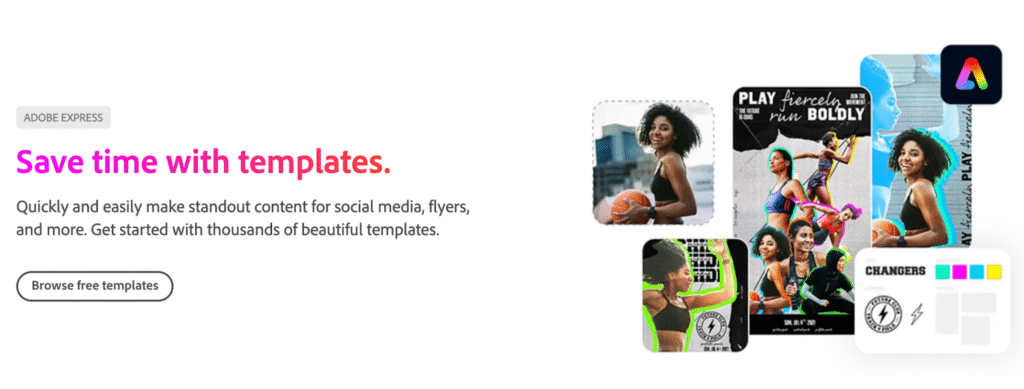
- Benefits: Time-saving promise. “Quickly and easily make standout content” (appeals to efficiency), versatility. Covers “Flyers, social media, and more” to show broad use cases, free entry point. “Browse free templates” (low-risk CTA)
- Clarity of message: Strong headline. “Save time with templates” promotes clear value; supporting details. Explains how it works (“thousands of beautiful templates”); сlean design. Nice white space, readable font
- Disadvantages: visual clash – the lower section (“fiersly run…”) is distracting and unrelated, generic CTA – “Browse free templates” could be stronger (e.g., “Start Designing Now – Free”), no social proof – missing user stats or ratings (e.g., “Used by 10M+ creators”)
- Potential improvements: Remove the unrelated “fiersly run” template example to avoid confusion, strengthen the CTA with action-oriented phrases: “Create Free Designs in Minutes”, add trust elements: Logos of well-known brands using Adobe or a testimonials
WeCanTrack
An affiliate marketing platform that helps publishers track, analyze, and optimize their performance across multiple ad platforms.
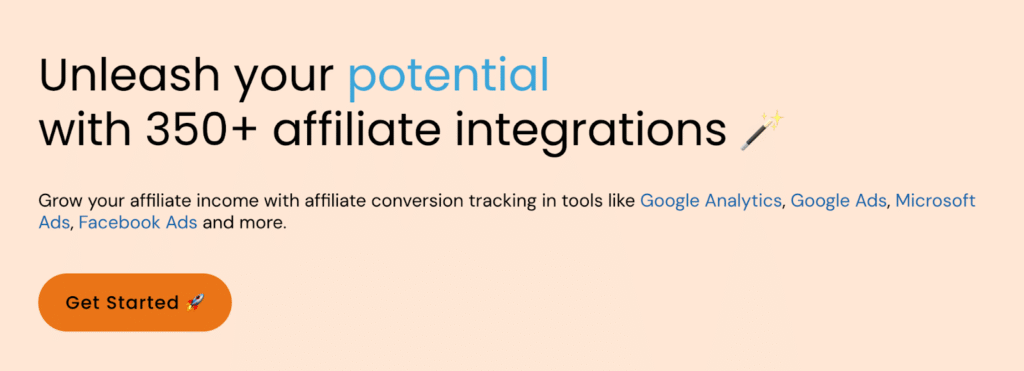
- Benefits: Scale potential.“350+ affiliate integrations” (shows vast network), tool compatibility. Name-drops major platforms (Google/FB/Microsoft Ads) for credibility, clear value proposition. “Grow your affiliate income” (direct benefit)
- Clarity of message: Strong headline.“Unleash your potential” (aspirational yet relevant), technical specificity. Lists exact integrations (appeals to pros), minimalist design. Clean layout with focused CTA
- Disadvantages: Overly technical – may confuse beginners (no explanation of “affiliate conversion tracking”), weak CTA – “Get Started” is vague (no urgency or incentive), no cases – missing the product representation – no dashboards, reports, or UI previews
- Potential improvements: Simplify the subhead: “Track commissions from 350+ partners–automatically”, supercharge the CTA: “Start Free Trial” or “See Live Demo”, add trust badges: “Used by 10,000+ marketers” or integration logos
Monday
A work operating system (Work OS) for teams to manage workflows, data, and projects through customizable dashboards.
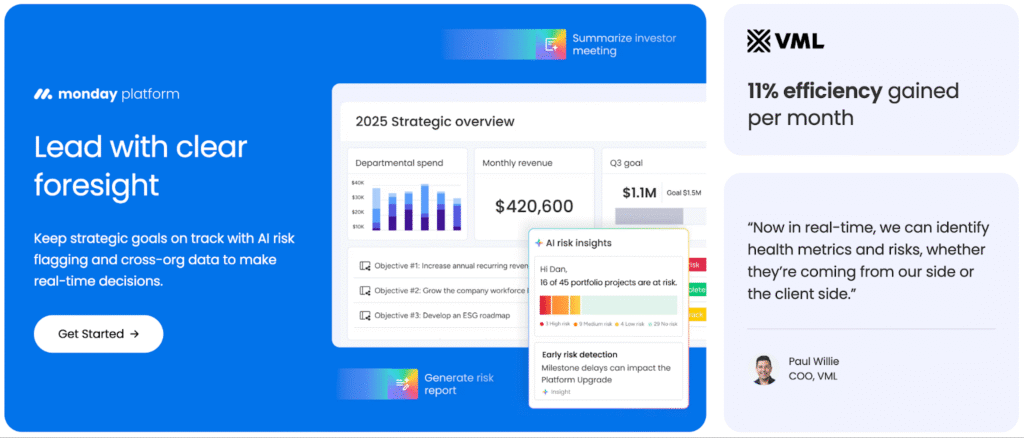
- Benefits: Clear visual representation of performance metrics. Monthly revenue, departmental spend, and project health show the real value of the service; real-world statistic featured. “VML reports an 11% monthly efficiency gain using the platform.” (numbers represent efficiency); client testimonial with photo. Adds trust and credibility
- Clarity of message: focus on benefits. “Lead with clear foresight” ties directly into the platform’s data visibility tool and AI-powered decision-making; supporting copy. Explains the use case (strategic goal tracking, cross-org data, risk detection); a look inside. The dashboard visual illustrates the concept by showing live data, alerts, and performance indicators
- Disadvantages: Monday.com brand name is missed – some users may not connect “monday platform” with it; too detailed dashboard – hard for a quick glance and could overwhelm; no clear pricing or entry-level hook – mentioning a free trial or plan might increase engagement
- Potential improvements: Boost brand recognition and trust: add the full Monday.com logo or include a short descriptor like “by Monday.com”; simplify the visual focus: highlight one or two key metrics; try more action- and benefit-driven CTA: “Start Tracking Risks Now” or “See AI Insights in Action”
Grammarly
An AI-powered writing assistant to improve grammar, clarity, tone, and correctness in real-time in emails, documents, or messages.
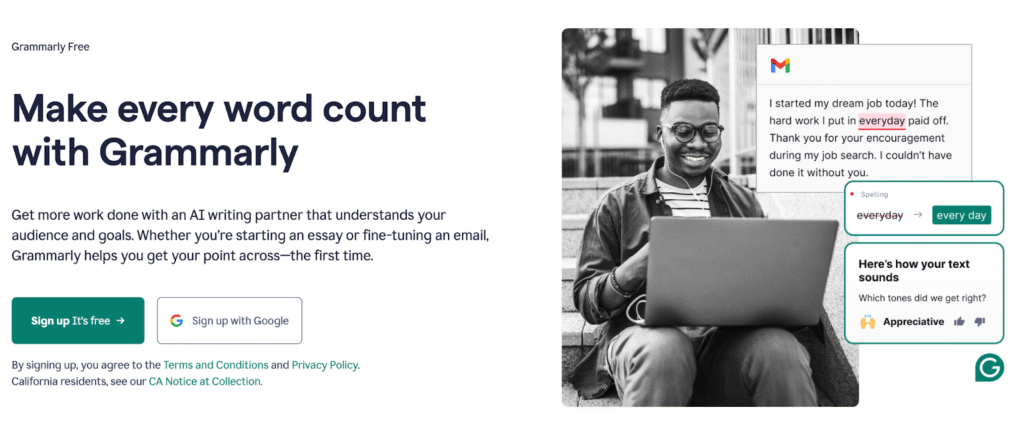
- Benefits: Real-world example. Shows Grammarly correcting a common error (“everyday → every day”); emotional resonance; Uses a personal success story (“dream job”) to connect; Tone analysis. Highlights detected tones (Appreciative) to showcase advanced features
- Clarity of message: Strong hook. “Make Every Word Count” (clear value proposition); Demonstration > explanation. The corrected text proves utility instantly; Friendly design. A conversational tone with emojis feels approachable
- Disadvantages: No clear CTA – missing a direct next step (e.g., “Try Free Now”); Overly subtle branding – Grammarly’s logo/name is small (easy to miss); Niche appeal – focused on jobseekers – could broaden to “emails, essays, posts”
- Potential improvements: Add a bold CTA button: “Grammarly – It’s Free”; Increase brand visibility: Larger logo or “As used by 30M+ people”; Broaden the use case: “Perfect your writing–for work, school, or life”
Dood
Afflift community leader
Use the Facebook Ad Library to see what kind of banners competitors are making, and browse websites in your niche to see what banner ads are currently displayed. This steps will inspire you for fresh ideas or campaign angles.
All banners aren’t absolutely perfect, but you can get closer to the ideal
by starting working with HilltopAds right now.
Key Points for Creating Successful Banner Ads
A banner that is both memorable and effective for your business and marketing goals is more than just a picture. Actually it is a picture, but it’s important to be strategic about filling it with content both visual and textual. We’ve put together some tips for creating your own formula of the perfect banner.
Set clear goals
Before designing, define what you want to achieve:
— Brand awareness? (Focus on visuals + logo)
— Traffic? (Strong CTA + click incentive)
— Conversions? (Discounts, free trials, urgency)
Example: a travel agency might prioritize “Book now–30% off!” over a general and unclear “Explore destinations”
Choose the right format & size
— Standard sizes (e.g., 300×250, 728×90, 320×50 for mobile) perform best
— Animated banners (GIFs, short videos) attract ~41% more attention than static ones
— Responsive design ensures visibility on all devices
Pro tip: make sure your banner complies with the technical standards of the ad network you’re partnering with (HilltopAds, Google Display Network, or another one).
Design a banner itself
Pay attention to all of its necessary parts:
Headline & text
— <5 words for quick readability
— Highlight a benefit, not just features (e.g., “Save your time” vs. “Advanced software”)
— Power words like “Free,” “Now,” “Exclusive“
Visuals
— High-quality images/videos (no pixelation!)
— Minimal clutter – focus on one key message
— Contrasting colors to stand out (e.g., bright CTA button on dark background)
CTA (Call To Action)
— Action-oriented (“Shop now,” “Get started,” “Claim offer”)
— Urgency/scarcity, play with users’ FOMO (“Limited time,” “Only 5 left”)
— Bad vs. Good CTA: “Click here”→ “Get 50% off today”
Dood
Afflift community leader
Try to avoid common mistakes in banner ads design like too much text, weak call-to-action buttons that don’t stand out, and trying to say everything instead of focusing on one compelling benefit. Also, using stock photos that look generic instead of showing actual product benefits will not help you to stand out.
Target the right audience
— Demographics (age, location, gender)
— Interests/behaviors (fitness fans for sports outfit offer)
— Retargeting (showing ads to users who already visited your site but didn’t made a purchase)
Example: a gaming app should target mobile users who installed games in similar genre.
Dood
Afflift community leader
Audience targeting is the biggest factor – the right message to the wrong audience will always fail. Design and placement matter, but even low-quality creative will convert if you’re reaching people actively looking for your solution.
Test & optimize
— A/B test different designs, CTAs, and placements
— Track necessary metrics (CTR, conversions, bounce rate)
— Refresh creatives every 2–4 weeks to avoid banner blindness
Dood
Afflift community leader
Start with simple A/B tests on headline variations using the same design template. Test one element at a time – colour, headline, or CTA – and use platforms’ built-in split testing features rather than running separate campaigns.
Now you know how to create an effective banner ad
so don’t delay, start right now.
Pros and Cons of Banner Ads
Like any marketing tool, banner ads come with their strengths and limitations. Understanding both will help you set realistic expectations and use this format more strategically.
Pros
Promotes brand awareness
Banner ads are top for getting your brand name, logo, and message in front of a wide audience, even if users don’t click.
Drives truly targeted traffic
If designed well, banner ads can direct users to specific landing pages, special offers, or lead magnets = bringing in traffic that’s already warmed up.
Flexible in design and message
Static images, animated HTML creatives, interactive ads – you are free to choose any format that you see suitable for the campaign.
Scalable across platforms
Banner ads can be sold through networks like HilltopAds, which makes fast scaling available for any niche.
Cons
Low CTR
One of the most common problems is banner blindness – users who are tired of the content all around, subconsciously ignoring ad placements.
Limited conversions
Your conversion rate may be low even if a lot of people click on your well-designed banner – if it doesn’t lead to a landing page with a strong offer and good optimization.
Not effective for all niches
Some products or services – especially those that require complex explanations or high trust – don’t perform well with banners alone.
No immunity to AdBlocker
42.7% of users have ad-blocking software installed, and this number is still growing, which can prevent banners from being shown at all.
How to Work with Banner Ads on HilltopAds
If you’re looking for an effective banner advertising platform, HilltopAds offers powerful tools to launch, optimize, and scale your campaigns. Why choose HilltopAds for banner advertising?
CPC (Cost Per Click) model available
Advertisers pay only for clicks, not just impressions, making the budget work harder.
Personal manager support
Get expert help with campaign setup, optimization, and scaling.
Advanced targeting (10+ parameters)
Reach the right audience with precision.
High-quality traffic
Premium placements with real user engagement.
How to get started
Step 1: Register & set up your campaign
- Sign up for a HilltopAds account
- Choose “Banner Ads” as your campaign type
- Select a traffic channel and frequency cappings.
Step 2: Set up targeting
Choose among specific targeting options that HilltopAds offers:
- GEO (countries, cities)
- Device and OS (mobile, desktop, iOS, Android)
- Interests and keywords
- Languages, browsers, IP, and more.
Pro tip: start with broader targeting, then refine based on performance data.
Step 3: Upload your banners
- Use high-converting creatives (see our previous design tips)
- Recommended formats: JPEG, PNG, GIF
- 300×250 size to maximize reach.
Step 4: Launch & optimize
- Monitor CTR, conversions, and ROI in real-time
- A/B test different banners to find the best-performing creatives
- Adjust bids, targeting, and placements based on analytics
Learn more about banner advertising in our Help Center

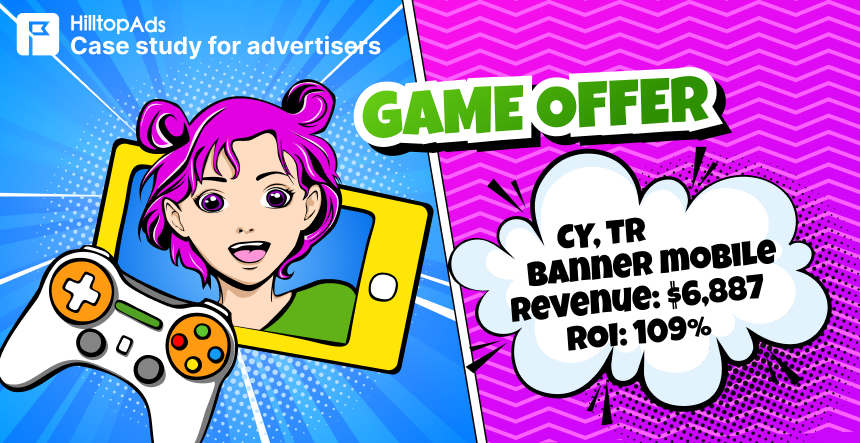
Check out our real case study – HilltopAds partners achieve high ROI by working with us and using this advertising format:
Conclusion
Banner ads remain one of the most popular forms of display advertising. They help increase brand awareness, attract targeted traffic, and support conversion-focused campaigns. Of course, like any advertising tool, banners have their limitations: users may ignore banner ads, and some of the audience uses ad blockers. However, with the right approach, these factors do not become critical and can be offset by high-quality creatives, precise targeting, and regular optimization.
The success of a banner ad campaign rarely depends solely on an attractive design. It’s much more important to clearly understand the goal of the campaign, show ads to the right audience, use a clear call to action, and constantly analyze the results. Regular A/B testing, optimizing landing pages, and data-driven campaign optimization help achieve significantly better results than simply trying to improve a single element of the banner.
If you’re planning to launch or scale up your banner ad campaigns, it’s worth paying attention to your choice of advertising platform. For example, HilltopAds provides tools for precise targeting, flexible campaign setup, and ongoing optimization, which helps you manage your advertising budget more effectively and reach the audience most interested in your offer.