


The right video ad network can make a major difference in revenue and ROI. Compare the leading platforms of 2026 and find the best fit for your business.

Video continues to play a central role in digital advertising. Industry research estimates that video accounts for around 82% of global internet traffic, while 93% of marketers consider it an essential part of their marketing strategy. As adoption grows, choosing the right video ad network becomes increasingly important for both publishers looking to maximize revenue and advertisers aiming to reach the right audience.
This guide compares leading video ad networks in 2026, highlights their strengths, and explains what publishers and advertisers should consider before choosing a platform.

Start working with the best video ad network HilltopAds today
so you don’t waste your budget on low-quality networks tomorrow.
What is a Video Ad Network
A video advertising network is a platform that connects publishers with available video materials on websites, apps, or streaming services for advertisers who want to promote their products or services through video.
Acting as an intermediary, the network helps publishers access requests from multiple advertisers, allowing advertisers to reach the appropriate audience without direct negotiations with individual publishers.
Video advertising networks are an important part of the programmatic advertising ecosystem. They collect materials from multiple publishers, sort them by audience, content, or targeting criteria, and provide them to advertisers through real-time auctions or direct purchases.
For publishers, from individual authors to large media companies, connecting to the video advertising network simplifies monetization by providing access to a wider base of advertisers. At the same time, advertisers benefit from scalable reach, enhanced targeting capabilities, campaign reports, and automated purchases.

Mike
Adv Manager HIlltopAds
Video tells a story in seconds and drives stronger recall. With better mobile internet and autoplay formats, it’s often the most efficient way to capture attention.
Video has become one of the fastest-growing digital advertising formats because it combines visual storytelling with measurable campaign performance. Compared with traditional display ads, video often delivers higher engagement and gives brands more opportunities to communicate complex messages in a short amount of time.
According to Statista, global spending on digital video advertising is expected to exceed $210 billion, reflecting continued growth in online video consumption and advertiser demand for high-impact, measurable formats.
Read our recent article about the VIP Referral Program:

Benefits of Using Video Ad Networks
Video ad networks benefit both publishers and advertisers. Publishers can monetize their inventory more effectively, while advertisers gain broader reach and simplify campaign management. Here are the main advantages for each group.
For publishers
Higher revenue potential
One of the main advantages for publishers is the ability to increase revenue through stronger advertiser demand and automated optimization. Competition between multiple advertisers can improve eCPM and overall yield.
Even mid-sized and niche publishers can access global demand that would otherwise be difficult to secure through direct partnerships alone.
Access to more advertiser demand
A single integration can provide access to advertisers across multiple industries, including eСommerce, finance, gaming, and entertainment. This helps publishers make better use of their inventory while serving more relevant ads to their audience.
Ease of integration
Most platforms offer plug-and-play SDKs, ad tags, or APIs, making integration straightforward even for smaller publishers. As a result, publishers can start monetizing their inventory without significant development effort.
Diverse video ad formats
Besides default in-stream video ads, networks usually have out-stream video placements, rewarded videos, interactive video ad formats, and native video ad types on board.
This diversity allows publishers to align video ad experiences with content strategy and user expectation maximizing both engagement and revenue potential.

Den
Pub Manager HIlltopAds
All in all, publishers get access to premium demand that’s hard to reach directly, plus higher eCPMs compared to banners. Many video ad networks also offer one-tag integration, which saves publishers time and resources.
Sign up on the HilltopAds platform and start earning like never before!
Get paid every Tuesday through convenient payment methods.
For advertisers
For advertisers, one of the biggest advantages is broader reach. Instead of negotiating with each publisher individually, they can access inventory on websites, mobile apps, and streaming platforms through a single network. This makes it easier to scale campaigns by reaching the relevant audience across multiple channels.
Targeting
Modern video ad networks offer advanced targeting options based on location, device, interests, behavior, and contextual signals. This helps advertisers reach more relevant audiences, reduce wasted impressions, and improve campaign performance.
Better budget control
Managing campaigns from a single platform makes it easier to test creatives, adjust bidding strategies, and allocate budget based on performance.
Built-in analytics provide insights into metrics such as viewability, completion rate, and conversions, helping advertisers make more informed optimization decisions.
Mike
Ad Manager HIlltopAds
To be successful, you need all three components – reach, targeting, and analytics. Quality reach is the baseline, but without accurate targeting and transparent reporting, even the biggest reach won’t deliver real ROI.
Ability to refine constantly
Many video ad networks use AI to optimize targeting, bidding, frequency, and delivery in real time. This allows advertisers to improve campaign performance while directing more budget toward placements that deliver the best results.
Mike
Ad Manager HIlltopAds
For advertisers, AI already personalizes creative variations and automates bidding video ad strategies. In a couple of years, it will likely run most of the optimization loop with minimal human input.

Launch video ads with HilltopAds and enjoy:
- Advanced targeting options
- Direct traffic sources
- Self-serve platform
- Fully-managed service
- Postback tracking
Top-10 Video Ad Networks in 2026
| Video Ad Network | Supported Video Ad Formats | Monetization Model | Publisher Access Level | Best For |
| HilltopAds | VAST video (pre-roll), in-stream video, video slider | CPM, CPC, CPA | Open self-serve platform | Small-to-mid publishers and affiliate traffic |
| OpenX | In-stream video, outstream video, CTV video | Programmatic RTB auctions, private marketplaces | Premium / managed publishers | Programmatic monetization with RTB demand |
| ExoClick | In-stream video (pre-roll), outstream video | CPM, CPC, CPV | Self-serve ad network | Non-mainstream and entertainment video traffic |
| Primis | In-stream video, outstream video, in-feed video discovery | CPM | Premium publishers via partner onboarding | Publishers monetizing video content |
| Teads | InRead (outstream), in-article video, CTV video | CPM, CPCV | Premium publishers | Brand-safe video campaigns |
| SelectMedia | Cross-screen video (desktop, mobile, CTV) | CPM, CPV | Mid-to-large publishers | Large publishers with premium inventory |
| Clickadu | Pre-roll video, outstream video | CPM, CPC, SmartCPA | Open self-serve platform | Monetizing international traffic |
| Clickadilla | In-stream video, video ads, pop, native | CPM, CPC, CPA | Open self-serve platform | Affiliate marketers and arbitrage traffic |
| Equativ | Instream video, CTV video, programmatic video | Programmatic CPM (RTB and deals) | Premium publishers and broadcasters | Advanced programmatic monetization |
| Google AdX | In-stream video, outstream video, CTV | Programmatic RTB auctions and private deals | Google-approved premium publishers | Large media companies and top publishers |
With hundreds of platforms competing for popularity, it is hard to decide which video ad network is most suitable. A summary of ten best video ad networks in 2026 is provided below along with their benefit to both advertisers and publishers. Select a network that best aligns with your goals.
HilltopAds
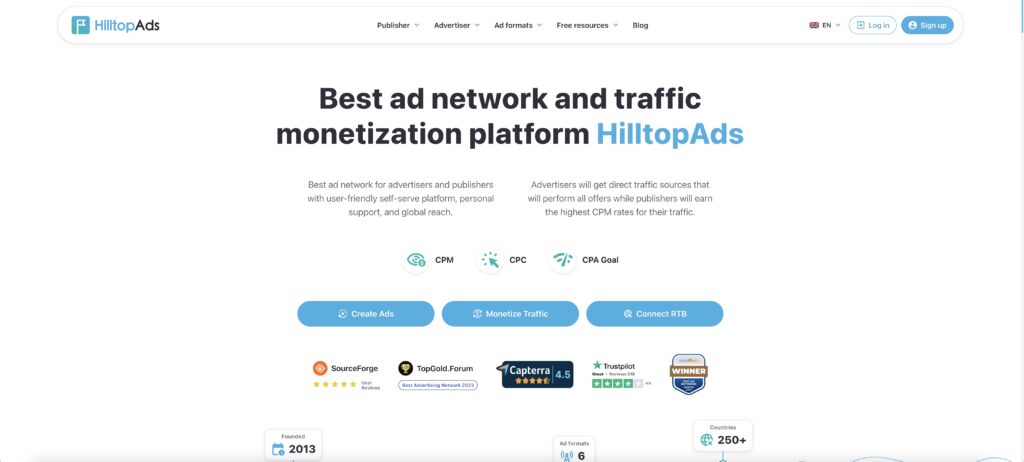
HilltopAds is a global performance-based ad network with open tools for efficient traffic monetization. Diversity of ad formats – Popunder and In-Page, Video VAST, Slider, Banners, and MultiTag – offer creative freedom to reach users across channels.
Auto-optimization intelligence with White/Black List functionality ensures campaign performance and gives you full control.
Publishers benefit from Anti AdBlock, advanced APIs, and weekly Net7 payouts. Only clean, pre-approved ads with smart link support ensure secure, optimized monetization.
Postback tracking and an intuitive dashboard let publishers monitor ad performance in real time.
Advertisers gain advanced targeting, direct traffic sources, and flexible campaign management. Combined with postback tracking, API integration, agency support, and clean traffic, these tools help maximize the efficiency and ROI of your video campaigns.
OpenX

As one of the oldest players in programmatic ad inventory, OpenX has built a strong reputation for high-quality video ad inventory and innovation.
Publishers get premium demand, strong brand safety, and flexible video integrations, with OpenX’s header bidding and mobile-optimized programmatic deals maximizing ad impression value.
Advertisers enjoy transparency, advanced targeting, and global reach through private marketplaces and real-time guaranteed programmatic buys. OpenX’s mobile-first exchange and sustainable, flexible buying models help brands achieve responsible advertising performance.
ExoClick
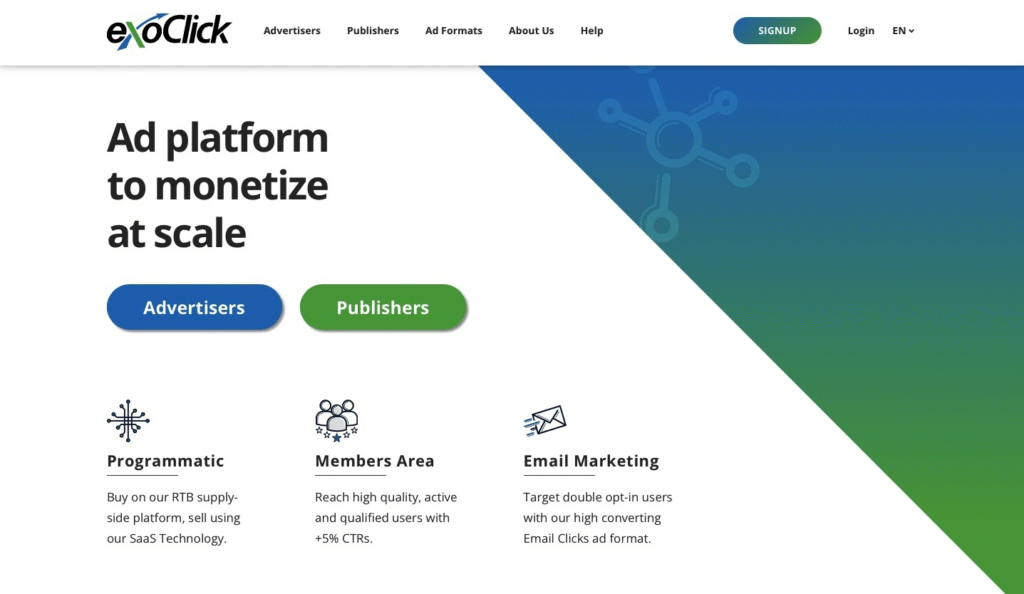
ExoClick combines global reach and flexibility, serving billions of daily video ad impressions.
Publishers value ExoClick’s global reach, reliable payouts, and 24/7 support. With diverse ad formats, instant stats, and smart tools like Campaign Manager, Adblock bypass, and Fluid Player, they optimize delivery and visibility across markets.
Advertisers benefit from precise targeting, smart bidding, and real-time optimisation that help boost video ad performance worldwide.
Primis

Primis is a publisher-first video discovery solution that specializes in native video ad placements.
Primis allows publishers to natively place any video ad without disrupting user flow, using an AI recommendation engine to deliver contextually relevant placements that maximize revenue and completion rates.
For advertisers, this results in a highly viewable, contextually aligned video ad that drives greater engagement and brand lift.
Teads

Teads invented out-stream video advertising and remains a leading provider of non-intrusive ad formats.
Publishers can earn from subtle video ads while leveraging Teads’ premium marketplace, safe environment, and worldwide reach for better results.
Advertisers access high-quality audiences across web, apps, and CTV, with impactful ad placements and streamlined access to premium supply, ensuring greater efficiency and results.
SelectMedia

SelectMedia offers a full-featured video ad monetization platform with a focus on Asian growth markets.
SelectMedia helps publishers boost revenue with flexible video ad formats, premium advertiser access, high fill rates, and advanced tools like real-time dashboards and Vidsplay units for optimal viewability.
For advertisers, the platform provides targeted distribution, ad campaign selection, and transparent video performance reporting. Its strength lies in bridging the gap for advertisers seeking scale and publishers in fast-expanding digital economies.
Clickadu

Clickadu is an international ad network offering advanced targeting and AI-powered rotation across multiple ad formats, including video.
Publishers enjoy competitive pricing, flexible banner placements, a Google-friendly format, and guaranteed 100% fill rate for optimized revenue.
Advertisers access rich traffic, wide geo coverage, CPC/SmartCPM/CPM pricing, audience optimization, and anti-fraud protection for high-quality, accountable ad campaigns.
Clickadilla

Clickadilla is a high‑volume ad network delivering flexible monetization for video content across mainstream and niche audiences.
Clickadilla provides publishers with live personal support, premium mainstream and non-mainstream traffic, real-time detailed statistics, and a single-tag setup for easy management of all ad formats.
For advertisers, it offers flat deals, guaranteed traffic volumes for specific GEOs, nonstop traffic flow, Traffic DSP integration, and API support for campaign management and analytics.
Equativ

Formerly Smart AdServer, Equativ is a full-stack ad tech company and a major player in video advertising.
Publishers benefit from Equativ’s all-in-one independent platform, combining advanced programmatic tools, yield optimization, and expanded CTV reach.
Advertisers access premium video inventory, advanced targeting, and brand-safe environments, while Equativ boosts campaigns with creative optimization, curated solutions, and sustainability-focused offerings for efficient global performance.
Google AdX

Google Ad Exchange remains one of the most powerful and largest video ad networks globally.
With Google Ad Manager integration and advanced yield tools, publishers reach top-tier demand and strong global fill rates.
Advertisers gain unparalleled reach, precise targeting, and dependable results across Google’s vast ecosystem.
Start working with the best video ad network HilltopAds right now
How to Choose the Right Video Ad Network
Choosing the right video ad network starts with understanding your goals. Publishers and advertisers evaluate platforms differently, so it’s important to focus on the criteria that matter most for your business.
For Publishers
When evaluating a video ad network, publishers should consider how effectively it can monetize their inventory without compromising the user experience.
Den
Pub Manager HIlltopAds
Publishers should first look at eCPM and fill rate – that’s their core revenue potential. It’s also important to check traffic requirements and network policies to avoid compliance issues later.
eCPM (effective cost per mille)
This is the key revenue metric that shows how much publishers earn per 1,000 impressions. The formula is:
eCPM = (Total Ad Revenue / Total Impressions) × 1,000
Example:
If a publisher earns $100 in revenue from 20,000 ad impressions, the calculation is:
($100 ÷ 20,000) × 1,000 = $5.00
This means the publisher effectively earns $5.00 for every 1,000 impressions.
eCPM is one of the most important video ad metrics because it allows publishers to compare across different ad formats, networks, and campaigns.
Higher eCPMs are often driven by strong advertiser demand, quality traffic, and effective optimization. When comparing networks, it’s also important to consider seasonal fluctuations, as rates can vary throughout the year.
Fill rate
It shows the percentage of ad requests that are successfully filled with a video ad. Low fill rates, even with a high eCPM, can lead to a significant loss of revenue from unsold impressions. Stable video ad networks aim for high fill rates to avoid wasted opportunity.
The formula is:
Fill Rate = (Filled Impressions ÷ Total Ad Requests) × 100%
Example:
If a publisher sends 100,000 ad requests and 70,000 of them are filled with video ads, the calculation is:
(70,000 ÷ 100,000) × 100% = 70%
This means that only 70% of available video ad inventory was monetized, while 30% of impressions went unfilled. A higher fill rate indicates more efficient use of ad space and less wasted revenue potential.
Multi-source demand video ad networks, advanced optimization, and programmatic bidding also contribute to higher fill rates.
For publishers, it’s as important to monitor this metric as it is to monitor eCPM because together they determine actual monetization potential for video ad inventory.
Video ad formats
A diverse set of video ad formats allows publishers to experiment and find what works best for their audience. Some video ad formats are more user-friendly and can increase engagement, while others generate higher revenue.
- Pre-roll video ad plays prior to playing the video content. It is highly visible and tends to gain high completion rates but can potentially cause drop-offs if they are long or repetitive.
- Mid-roll video ad is placed inside the video content. It basically has greater engagement since viewers are already invested in watching. However, poor placement or excessive ad frequency can also discourage viewers from video watching.
- Out-stream video ad appears outside of video content, for example, within feeds or articles. This ad is helpful to publishers who have limited ad inventory to monetize text pages, but the performance highly depends on the video placement and attention.
- Rewarded video ad is most prevalent in apps and gaming. Users receive rewards, such as additional lives or access to free content, for watching the video ad. This type of video ad is typically high in completion rate and has positive user attitudes.
- Native video ad that tries to blend in with the surrounding content. It’s less intrusive and more likely to build trust with the viewer and is well-suited to brand storytelling but may generate less short-term revenue than more obtrusive alternatives.
Using a mix of formats allows publishers to balance user experience and revenue. For advertisers, different formats provide more flexibility to match campaign objectives with the environments where their audience is most engaged.
Traffic requirements
Most networks also include minimums for monthly impressions or unique visitors. Smaller publishers often benefit from networks with lower traffic requirements, while larger media companies may qualify for premium platforms that offer exclusive demand and higher-value deals.
Sign up with HilltopAds and monetize your traffic at top rates
For Advertisers
For advertisers, the right video ad network is one that consistently delivers quality traffic and measurable campaign results.
Mike
Ad Manager HIlltopAds
Start by assessing inventory quality and fraud protection, then consider pricing models and targeting depth to reach the right audience efficiently without overspending.
Beyond traffic quality, it’s worth comparing the features that affect campaign performance, transparency, and long-term optimization.
Targeting options
Effective targeting helps advertisers reach the most relevant audience based on device, location, interests, demographics, and contextual signals. Some platforms also support behavioral, lookalike, or audience-based targeting, helping improve campaign efficiency and reduce wasted impressions.
Pricing models
Advertisers should carefully review a video ad network’s pricing structure before launching ad campaigns.
- CPM (Cost per Mille): Most common video ad model. Advertisers pay for every 1,000 impressions of the ad. Best for reach and brand awareness video ad campaigns.
- CPV (Cost per View): Payment is only activated when a user actually watches the video advertisement. This model is ideal for engagement-based video advertising campaigns.
- CPC (Cost per Click): Payment is made for each click on a video ad, regardless of whether the user takes any further action. This is a traffic-based system.
- CPA (Cost per Action): The advertiser pays only after a specific action has been executed, such as a sign-up, subscription, or a purchase. It is a purely performance-based system directly tied to conversions.
The best pricing model depends on your campaign objective–whether the goal is brand awareness, engagement, website traffic, or conversions.
Reach and scalability
A quality video ad network should provide both the depth and breadth of video advertising inventory. Global reach allows brands to access new markets, while specialty placements can provide higher engagement in vertical niches.
Quality of placements
All impressions are not created equal. Advertisers have to make sure that their video ads will appear on relevant sites and next to their preferred content. Video ad networks that partner with reputable publishers or use brand safety verification offer greater value.
Check out our recent article where we announced an Exclusive Playbook for launching ads:

Conclusion
When choosing a video ad network, it’s not so much about finding the platform with the highest cost per thousand impressions as it is about finding one that consistently delivers high performance for your traffic or campaigns. The same network can yield very different results depending on the audience, geography, ad formats, and business objectives.
Instead of relying solely on ratings, compare platforms using your own performance data. Conducting small-scale tests, monitoring key metrics, and analyzing results over time typically leads to more effective decisions than simply chasing industry averages.
If you’re evaluating different options, HilltopAds is one of the platforms worth testing alongside other networks to determine which one delivers the best results for your specific use case.