


Big sports events can bring massive traffic spikes – but only for a few valuable hours. See how two publishers monetized 2026 World Cup traffic and which ad strategies delivered the strongest results.

For most website owners, predictable traffic is a good thing. For sports publishers, the reality can be very different.

Turn your traffic spikes into revenue
join HilltopAds.
On a typical Tuesday, things might be quiet. But when a big football match starts, thousands of fans show up at once, traffic spikes, and those few hours can become the most valuable time of the month for making money. The 2026 FIFA World Cup was a perfect example.
We looked at two very different sports streaming sites that both used the tournament to test HilltopAds monetization with strikingly similar results, despite taking very different approaches to their websites.
Check out our guide on how to monetize your website with HilltopAds:

Live sports is moving online and bringing huge audiences with it
Live sports occupies an unusual place in today’s increasingly fragmented media landscape.
People may watch films and series whenever they want, but a football match is different. Fans want to know what’s happening right now.
Research on sports viewing shows that interest in live sports remains strong across generations, while younger audiences increasingly consume sports through digital and streaming platforms.
The State of Live Sports Streaming 2025, for example, highlights that sports represented 17% of live TV viewing among people under 35 in 2023, compared with just 7% in 2015. Streaming services are also particularly attractive to younger audiences across competitions including MLS, NHL, and UEFA Champions League.
Major events demonstrate just how large this digital audience can become.
During the 2024 Paris Olympics, NBCUniversal streamed 23.5 billion minutes of coverage more than 40% of the amount streamed across all previous Olympics combined. Warner Bros. Discovery reported more than 7 billion streamed minutes in Europe.
And by the 2026 World Cup, infrastructure providers were dealing with extraordinary levels of simultaneous demand. Digital platforms increasingly have to support millions of viewers arriving at almost exactly the same moment.
For independent sports publishers, the scale is obviously different. But the way traffic behaves can be surprisingly similar:
Kickoff approaches → fans arrive → traffic increases → the match ends → a large part of the audience disappears again
That last part is important. Research from Samba TV found that only 4% of viewers remained on the same platform after a live sports event, suggesting that live sports behaves strongly as “appointment viewing.” For publishers, that means there may be a relatively short window in which to monetize the audience.
Read our publisher’s recent case study:

Meet the publishers
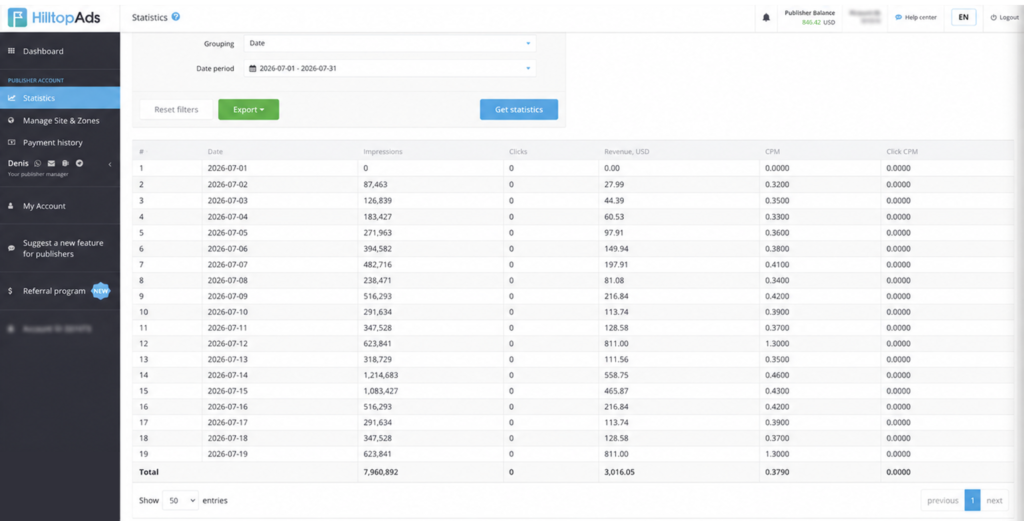
Site 1
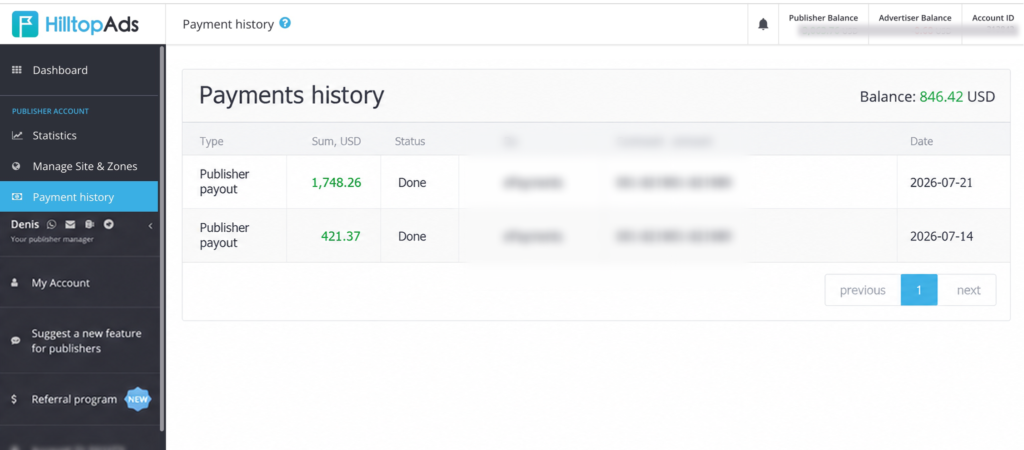
Site 1 is a good example of an “opportunity site.” The publisher built it specifically to capture World Cup traffic, and once the tournament ended, the site went unmaintained. As our Senior Publisher Manager Den put it:

Den
Senior Publisher Manager HilltopAds
Basically, this publisher spun up a temporary site just to cash in during the tournament, and the results were genuinely solid for a brand-new site. He tested pretty much everything: Popunder, Banner, In-Page Push, Video VAST, Video Slider. Popunder ended up earning him the most by far – every MultiTag format he ran had Popunder enabled inside it.
Site 2
Site 2 wasn’t a one-off project. The publisher has been actively developing it – to the point of building a dedicated mobile app – and continues posting football matches on the site today.
Den
Senior Publisher Manager HilltopAds
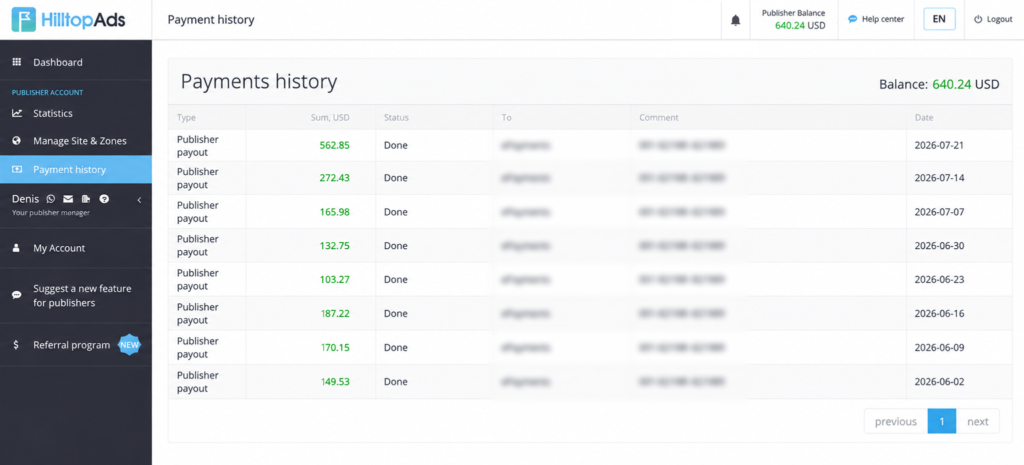
This is a site the publisher is actually investing in. He tested Popunder, Banner, and Video VAST, and just like with the first site, Popunder brought in the most revenue by a clear margin. All his MultiTag formats had Popunder switched on. The numbers here are a bit more modest than the temporary site, but still strong, and the difference is that this publisher is sticking around, not disappearing after the final whistle.
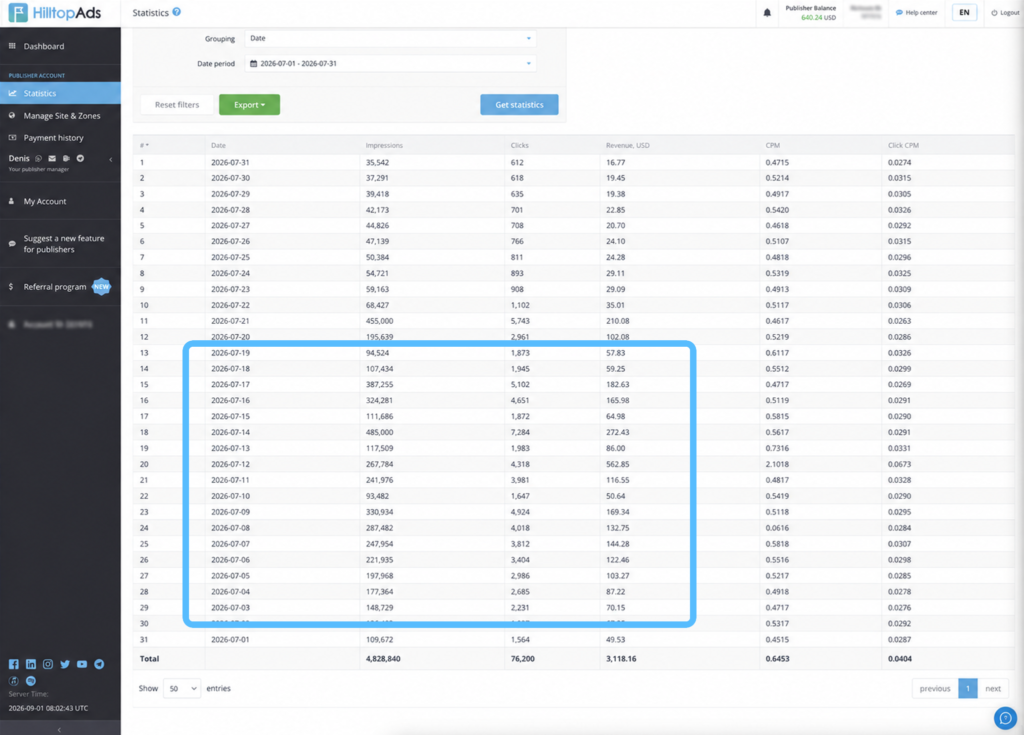
Both sites primarily attracted Arabic- and Southeast Asian-speaking football audiences. Traffic patterns closely tracked match schedules rather than remaining consistent day to day.
How the World Cup reshaped traffic?
The World Cup didn’t just attract large streaming audiences. It visibly changed Internet behavior around matches.
Cloudflare analyzed Internet activity throughout the tournament against a baseline based on the preceding four weeks and found significant changes around individual games. In some countries, matches played at unusual local hours pushed Internet activity to more than twice normal levels.
More importantly for streaming publishers, Cloudflare found markets where the increase during matches was heavily driven by multimedia and streaming traffic. In Algeria, for example, traffic increased sharply around kickoff, dropped at halftime, and returned to elevated levels during the second half.
Even individual matches mattered. Argentina vs. Switzerland produced the largest worldwide deviation from normal Internet activity in Cloudflare’s analysis, ahead of even the France vs. Spain semifinal.
This illustrates an important characteristic of sports traffic: not every day of a tournament is equally valuable. The teams playing, the stage of the tournament, the local kickoff time, and where your audience is from all affect how much extra traffic your sports website gets.
Both HilltopAds publishers performed similar event-driven patterns: low baseline activity between matches, pronounced spikes at kickoff, and peak boosts during high-interest games.
Finding the right formats
Both publishers tested a wide spread of formats during the tournament: Popunder, Banner, In-Page Push, Video VAST, and Video Slider. In both cases, Popunder came out clearly on top as the strongest earner, and both publishers ended up running it inside all their MultiTag placements.
But according to Den, running every available format side by side isn’t actually the best strategy going forward:
Den
Senior Publisher Manager HilltopAds
Combining every single format on one site isn’t the most effective approach, in my opinion. When you stack all formats on the same page, they start competing with each other, and that can drag down the CPM and revenue of each individual format. I always recommend publishers focus on 2–4 formats maximum, for example, Popunder plus Banner plus one other MultiTag format, like Video Slider. That combination tends to perform better than throwing everything at the page at once.
We recommend reading the article on how to increase website revenue without increasing traffic:

A smarter placement worth testing: DirectLink inside the player
One idea Den highlights as underused on streaming sites is placing a Direct Link directly on the video player itself:
Den
Senior Publisher Manager HilltopAds
A good approach on streaming sites is to place a Direct Link right inside the player. The user lands on the site, clicks play, and a new window opens with our ad similar to a popunder trigger. Non-mainstream tube sites do this a lot, often setting up 3–5+ Direct Link triggers on play, pause, and seek actions. Their audiences are highly motivated, they’re willing to tolerate a fair amount of ads just to get to the content they came for. Sports streaming audiences during a big match aren’t all that different.
This is a useful reminder that live-event audiences tend to be unusually tolerant of ad friction when the content itself is high-intent. A fan mid-match isn’t going anywhere.
Traffic spikes are also infrastructure tests
Sports publishers should know roughly when their largest traffic spikes are coming. You may not know which teams will reach the semifinal, but you do know when the semifinal will happen.
That makes sporting events unusual: they combine highly volatile traffic with a surprisingly predictable calendar. Publishers can therefore prepare before the users arrive.
Before a major event:
- check page and player loading performance;
- make sure hosting can accommodate additional surge in traffic;
- test ad placements on different devices;
- make sure that monetization scripts aren’t creating unnecessary loading problems;
- check mobile UX;
- confirm that analytics and ad tracking are working correctly.
The objective shouldn’t simply be to fit as many ads as possible onto the page. It’s to make sure the additional audience can actually access and use the website while the monetization setup continues working normally, and Site 2’s decision to build a dedicated mobile app is a good example of investing in that reliability ahead of time, rather than scrambling once traffic arrives.
For an ad-supported sports publisher, this also reframes the underlying question. Instead of only asking: “How do we increase average monthly traffic?” it may be equally useful to ask: “How much value can we generate from the traffic peaks we already know are coming?”
Got a big match coming up?
Sign up with HilltopAds and put your monetization setup to the test.
5 lessons for publishers with event-driven traffic
This case isn’t only relevant to football websites. The same traffic model can apply to publishers covering the Champions League, NFL, NBA, UFC, Formula 1, cricket, tennis, esports, award shows, breaking news, and other major live events.
Know your traffic calendar
Find out what events usually generate unusual traffic and get ready in advance.
Test broadly, then refine
Both publishers evaluated multiple formats and identified Popunder as the top performer. Broad initial testing followed by consolidation around proven formats is more effective than relying on assumptions.
Don’t run every format at once
Stacking too many formats on the same page makes them compete. Two to four formats, for example, Popunder plus Banner plus one supporting MultiTag format, tends to outperform running everything simultaneously.
Treat website performance as part of monetization
An ad impression can only be monetized if the user successfully reaches the page. During a major live event, loading issues can turn a once-a-year traffic opportunity into lost revenue.
Define your time horizon
Site 1 demonstrates that temporary, event-focused sites can generate meaningful returns. Site 2 illustrates the benefits of ongoing investment and sustained revenue beyond a single event.
Below you can find HilltopAds payout history for both publishers, confirming successful withdrawals of the revenue generated from their sports traffic.
Read the successful cases of our publishers:


The final whistle isn’t the end of the strategy
The World Cup may be over, but event-driven traffic isn’t.
Sports publishers operate in an environment where some of their most valuable traffic can arrive suddenly, remain for only a few hours, and disappear after the event. The sporting calendar makes many of those spikes predictable, so the key is to be ready for them.
Keep the website fast. Test your format mix rather than assuming one setup fits every site. Know which formats are actually earning versus just filling space. And when thousands of fans arrive at once for the next big match, make sure your website is ready to turn that attention into revenue.