


Discover how HilltopAds helped an iGaming advertiser achieve 2.6M+ impressions and 90 registrations in Indonesia using mobile Popunder traffic, smart targeting, and zone-level optimization.

For iGaming advertisers, Indonesia can look like a dream GEO at first glance: huge mobile reach, active digital users, and enough traffic volume to test casino and slots funnels at scale.
But that is also where the problem starts.
When the traffic pool is big, the budget can disappear quickly. Some zones bring volume but no value. Some languages dilute the signal. Some browsers look fine on paper but underperform in the funnel. And if the campaign is launched too broadly, advertisers may spend money before they understand which traffic slices are actually worth scaling.
This case is about that exact challenge: how to work with a high-volume mobile GEO without buying traffic blindly.
Together with Rob, the HilltopAds manager supporting this advertiser, we launched and optimized a casino & slots campaign in Indonesia using Popunder Mobile traffic. The goal was to collect enough volume to identify strong-performing traffic zones while keeping the setup narrow, controlled, and easy to optimize.
Let’s break down how the campaign was set up, what was adjusted during the launch with Rob’s support, and why the best results came from zone-level control – not from simply increasing the budget.

Sign up for HilltopAds today
and maybe next time we’ll tell you about your successful campaign.
Key Points
Offer: iGaming / Casino & Slots
GEO: Indonesia (ID)
Traffic: Mainstream + Non-mainstream High/Medium levels
Ad Format: Popunder Mobile
Campaign period: May 1-15
Impressions: 2,666,497
Average CPM: $0.71
Target Actions: 90 registrations
Spend: $1,904.97
The Challenge
Indonesia is a strong GEO for advertisers who need mobile scale. DataReportal’s Digital 2026 report shows that Indonesia had 230 million internet users at the end of 2025, with internet penetration at 80.5%. The same report counted 331 million cellular mobile connections, equal to 116% of the country’s population.
For a mobile-first vertical like iGaming, that scale is valuable. But it also creates a very practical media-buying problem: when there is a lot of traffic available, not all of it deserves a budget.
The broader online gambling market is also becoming more mobile-driven. Mordor Intelligence reports that mobile and tablet platforms accounted for 57.14% of the global online gambling market in 2025, with this segment expected to grow faster through 2031. Grand View Research also estimates that the Asia-Pacific online gambling market generated $21.4 billion in 2025 and is expected to grow at a 13% CAGR from 2026 to 2033.
So the opportunity was clear: Indonesia had enough mobile volume to test a casino and slots campaign properly.
The risk was just as clear: without tight source-level control, the advertiser could spend across too many zones before finding the ones that actually brought valuable users.

Rob
Sales Advertising Manager at HilltopAds
For this launch, we didn’t try to buy Indonesia as one broad traffic pool. The strategy was to isolate the strongest zones, keep the campaign structure narrow, and adjust bids based on real volume.
That became the core idea of the campaign: do not chase all available impressions. Find the traffic pockets that deserve to be scaled.
Also read our recent article on the difference between mobile and desktop traffic:

Why Indonesia + Mobile Popunder
Indonesia was chosen because the campaign needed scale, and mobile traffic was the natural fit for this GEO.
According to DataReportal, Indonesia’s median mobile internet download speed reached 45.01 Mbps by late 2025, after growing by 53.1% over the previous twelve months. This matters for casino and slots funnels because mobile users need pages to load fast and move smoothly from click to registration.
Popunder Mobile was a practical format for this kind of launch because it gave the advertiser three things at once:
- enough reach to test the GEO properly;
- access to both mainstream and non-mainstream traffic;
- room for strict optimization by zones, browsers, OS versions, language, and time.
Indonesia was not treated as a “launch wide and wait” market. It was treated as a competitive and highly sensitive GEO where traffic quality depends on how precisely the campaign is filtered.
That is why the setup focused on local-language traffic, selected browsers, proxy blocking, WebView allowance, and a whitelist-based structure from the beginning.
Register with the best ad network for advertisers HilltopAds
Campaign Setup in HilltopAds
Before you can start your advertising campaign on HilltopAds, you’ll need to sign up as an advertiser.
Once your account is ready, here’s how to create a similar campaign:
- Go to the Manage Campaigns section.
- Click the Add Campaign button.
- In the campaign creation area, choose the Popunder Mobile ad format.
- In the Traffic Channels section, select Mainstream and Non-Mainstream traffic with High and Medium activity levels.
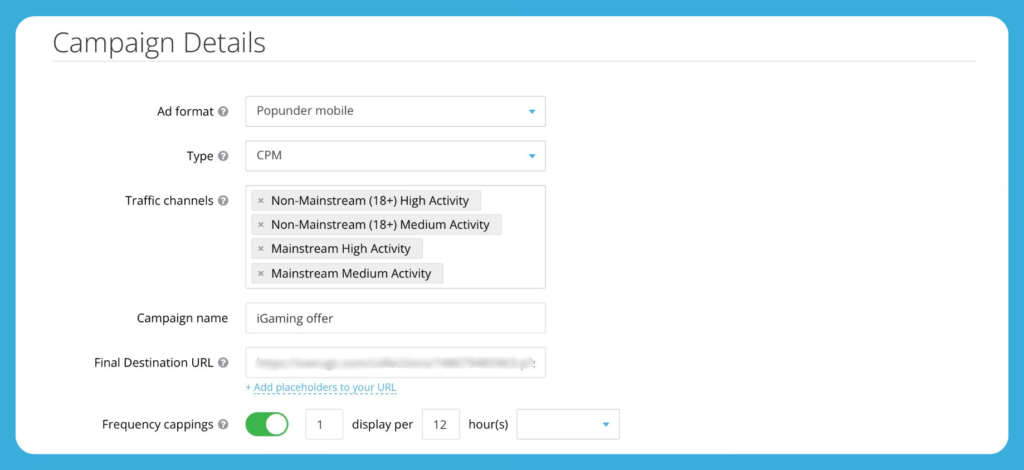
We also set frequency capping at 1 display per 12 hours (1/12h). For a high-volume GEO like Indonesia, this was a balanced setting: it allowed the campaign to collect enough mobile traffic for testing while reducing repeated exposure to the same users. For iGaming offers, this matters because aggressive frequency can quickly create user fatigue, while too strict a cap may slow down data collection and make optimization less accurate.
To analyze ad campaign performance, we recommend setting up Postback before launch. It helps track target actions and understand which traffic segments bring valuable users. To learn more, please check out our full tracking guide.

Next, we set the necessary targeting settings:
- GEO – Indonesia (ID)
- Devices – Mobile / Tablet
- Language – Indonesian only
- Browsers – Chrome, Safari, Brave
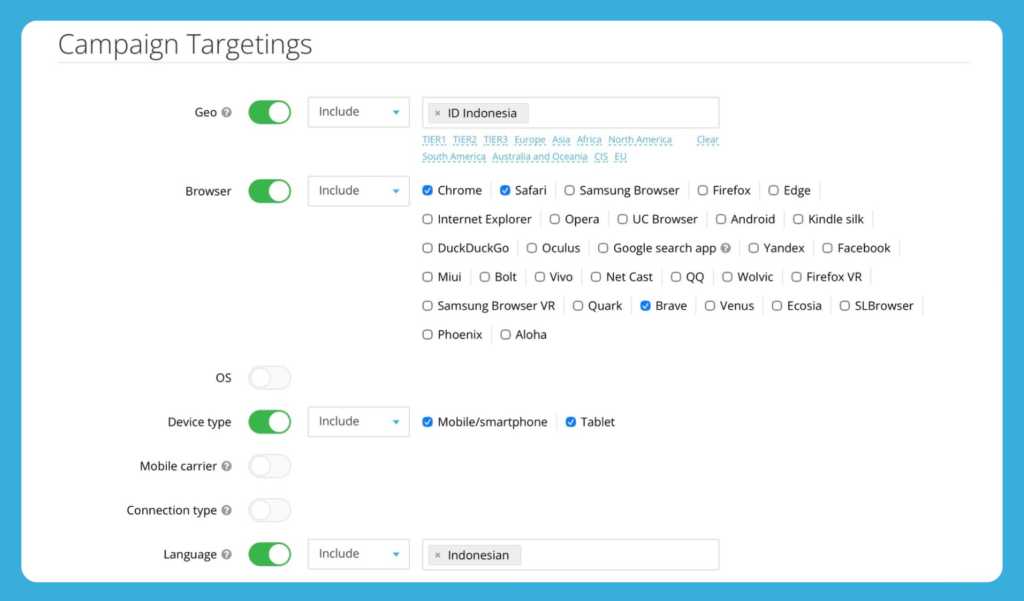
The Indonesian language filter was especially important for this campaign. According to Rob, other languages showed weaker performance, so keeping the campaign focused on local-language traffic helped make the data cleaner and easier to optimize.
You can also configure campaign filters to manage Proxy and WebView traffic. In this case, we used the following settings:
- Proxy – Disallow
- WebView – Allow
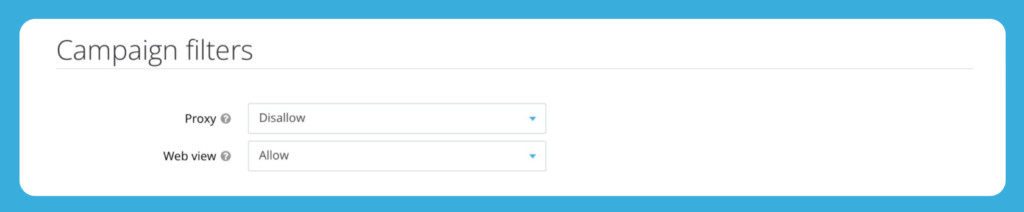
Proxy traffic was blocked to keep the audience cleaner and reduce low-quality visits. WebView traffic, on the other hand, was allowed because mobile in-app environments can provide additional volume for iGaming offers.
We also excluded the 2 AM-8 AM time window, as this period showed weaker traffic quality. OS versions were adjusted during the campaign based on collected performance data.
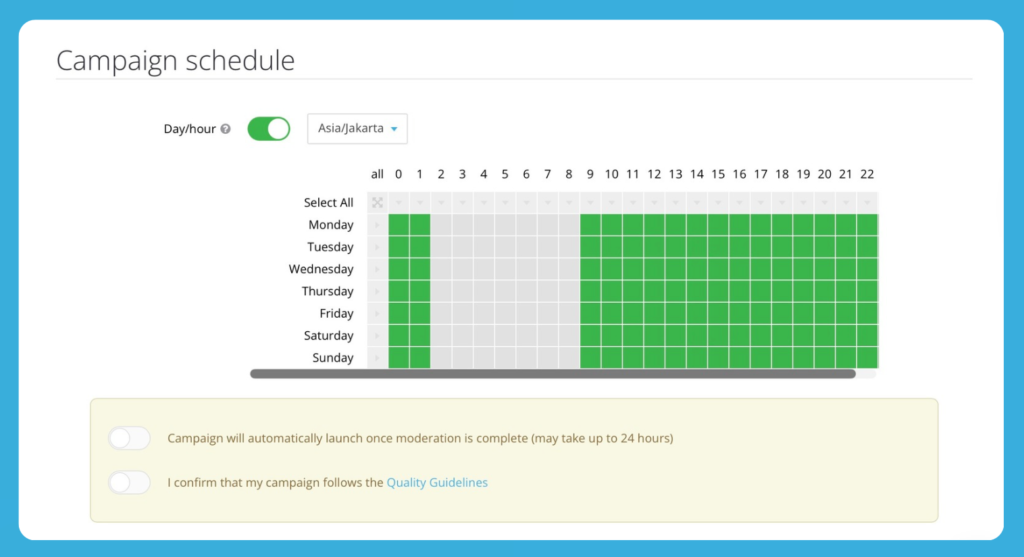
You can cap both your daily and total spend in HilltopAds. For this launch, the campaign spent $1,904.97 over the May 1-15 period and generated 2,666,497 impressions.
Next, choose your CPM. In this campaign, the average CPM based on campaign statistics was $0.71. This gave the advertiser enough traffic volume to test the GEO properly and identify which zones were worth scaling.
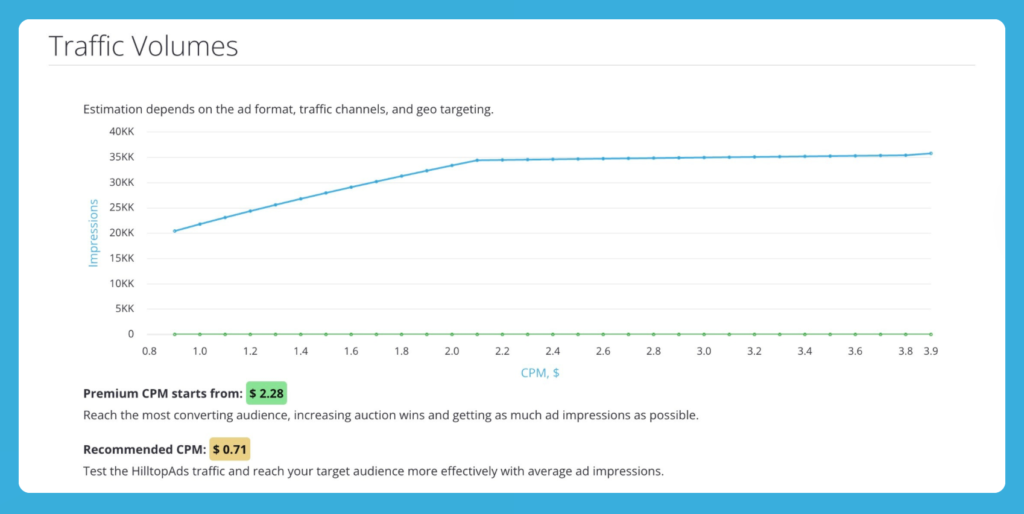

Advice from HilltopAds: as a starting point for a new iGaming offer, use a CPM that gives you enough volume to evaluate the GEO properly. In high-volume markets like Indonesia, the first goal is not just to buy cheap impressions, but to collect enough data to identify the zones, browsers, languages, and time windows that deserve further scaling.

Register with HilltopAds and get:
- Advanced targeting options
- Direct traffic sources
- Self-serve platform
- Fully-managed service
- Postback tracking
- Direct traffic sources
Optimization Strategy
The main optimization principle was simple: the campaign should not stay wide open.
Throughout the launch, Rob, the HilltopAds manager supporting this advertiser, worked closely with the client to keep the campaign structure narrow and data-driven. Instead of treating Indonesia as one large traffic pool, the team used a whitelist approach and separated traffic into smaller, easier-to-control segments.
In practice, this meant building campaigns around one or two selected zones. This structure helped both the advertiser and the HilltopAds team understand where the strongest volume was coming from, which sources showed better user quality, and where bids needed to be adjusted before the budget spread too thin.
Rob
Sales Advertising Manager at HilltopAds
For this launch, we didn’t try to buy Indonesia as one broad traffic pool. The strategy was to isolate the strongest zones, keep the campaign structure narrow, and adjust bids based on real volume.
Bid management was also an important part of the process. Together with the advertiser, Rob monitored available volume and adjusted bids depending on how each zone performed. When a source showed stable traffic and stronger quality signals, it could receive more room to scale. When the signal became weaker, the bid was tightened or the budget was redirected to better-performing zones.
Rob
Sales Advertising Manager at HilltopAds
I adjusted bids according to the volume we were getting. If a zone could bring more traffic and still keep the quality, we gave it more room. If the signal became weaker, we tightened the bid or moved the budget elsewhere.
The optimization process included several layers:
- building traffic around whitelisted zones;
- changing bids based on available volume;
- keeping campaigns narrow, usually one or two zones per campaign;
- filtering browsers to Chrome, Safari, and Brave;
- adjusting OS versions based on collected data;
- keeping only Indonesian-language traffic;
- excluding the 2 AM-8 AM time window;
- comparing mainstream and non-mainstream traffic separately.
This last point was especially important. The campaign did not treat all traffic types as equal.
Non-mainstream traffic brought more volume, while mainstream traffic converted better on average. That meant the team had to balance scale and quality instead of optimizing only toward the biggest traffic source.
Rob
Sales Advertising Manager at HilltopAds
Non-mainstream sources brought more volume, but mainstream traffic showed stronger average conversion quality. That’s why we kept optimizing at the zone level instead of treating all traffic types the same.
We recommend reading our article on comparing advertising networks and direct traffic purchas:

Results
During the May 1-15 launch period, the campaign generated:
- 2,666,497 impressions;
- 90 target actions / registrations;
- $1,904.97 total spend;
- $0.71 average CPM;
- 15 days of campaign statistics.
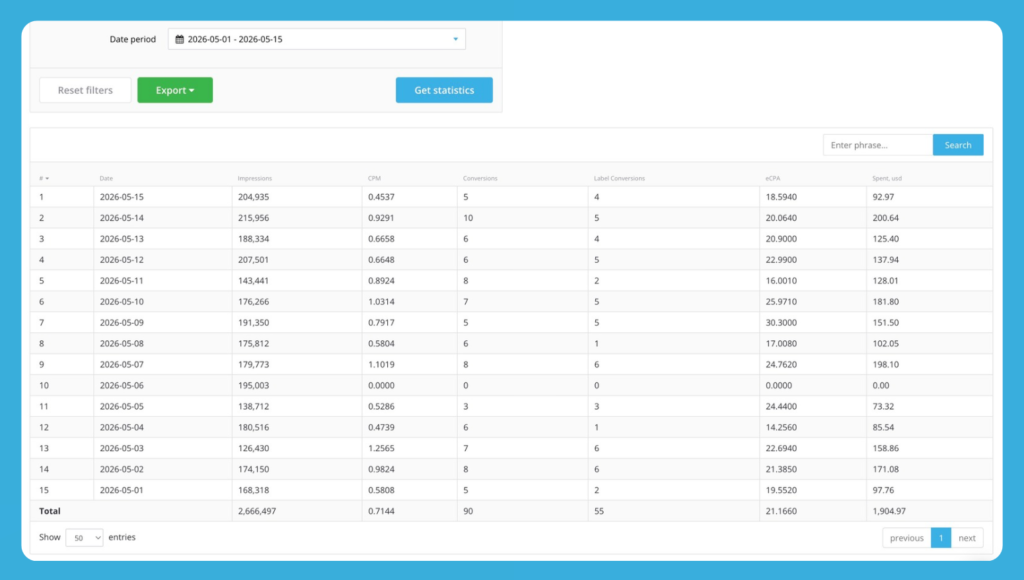
The campaign kept a steady volume across the launch period. Several days passed 190,000 impressions, and the strongest day by target actions was May 14, when the campaign generated 10 registrations from 215,956 impressions.
Other strong days included May 2, May 7, and May 11, each bringing 8 registrations.
But the most important result was not just the final number of registrations. The campaign gave the advertiser enough data to understand which traffic zones were worth keeping and which segments needed to be filtered out.
For iGaming, that matters a lot. A small test can easily make a good GEO look weak if the advertiser stops before enough data is collected.
Rob puts it directly:
Rob
Sales Advertising Manager at HilltopAds
In iGaming, the result is often visible only after enough volume. Some advertisers test too little, stop too early, and never reach the point where the best zones show themselves. Here, the advertiser gave the campaign enough room to work.
What Worked Best
Several decisions made the campaign stronger.
The first one was the whitelist strategy
Instead of buying all available Indonesian mobile traffic, Rob focused on the zones that showed stronger signals.
The second was local-language targeting
Indonesian-only traffic helped reduce noise and made performance data easier to read.
The third was time filtering
The 2 AM-8 AM window was excluded because it did not match the traffic quality Rob wanted for this setup.
The fourth was separating traffic types
Non-mainstream traffic helped with volume, while mainstream traffic showed better average conversion quality. This gave the team a clearer understanding of where to scale and where to stay careful.
The fifth was active bid management
The team did not simply increase bids to get more traffic. Bids were changed according to the volume and behavior of specific zones.
Rob
Sales Advertising Manager at HilltopAds
The goal was not to chase the cheapest impressions. The goal was to find zones where the advertiser could keep buying and still see valuable users deeper in the funnel.
That is also why the campaign was not judged only by CPM. A low CPM is useful only when the traffic can move users further through the funnel. In this case, the strongest zones were the ones that combined volume with better downstream quality.
We recommend that you read other successful cases of our advertisers:


Conclusion
This campaign shows that iGaming performance is not won by volume alone.
Indonesia can deliver serious mobile reach, but a casino and slots campaign needs structure: clean targeting, whitelisted zones, flexible bids, and enough testing volume to separate strong traffic from noise.
With HilltopAds Popunder Mobile, the advertiser reached 2,666,497 impressions and generated 90 registrations in 15 days. The campaign worked because it combined scale with control – and because the optimization was handled at the level where performance actually changes: traffic zones, browsers, OS versions, language, and time.
Want to test your own casino, slots, betting, or other iGaming offer with HilltopAds? Register as an advertiser, launch your Popunder Mobile campaign, and work with our team to find the traffic zones that can help your offer scale.