


Learn how marketplace sellers can use external traffic to increase product page visibility, support organic growth, and create more sales momentum with HilltopAds traffic.

Marketplace sellers often ask the same question: “Why would I buy external traffic if the sale happens inside the marketplace?”
The answer is simple: because the direct sale is not always the whole story.
A product page on a marketplace is not only about getting a sale. It also shows the platform how people react to the product.
When users view the page, save the item, place an order, or leave a review, the listing starts to gain traction. That is why some sellers drive traffic to their products from outside the marketplace. They are not always expecting every visit to turn into a sale right away. Often, the goal is to make the product more active, more visible, and easier to discover inside the platform.

Promote your brand with HilltopAds
Buy high-quality traffic at a bargain price.
This can be especially useful for new products or sellers who are just starting out. External traffic can give the listing the first push it needs, and if the product page is strong enough, that activity can turn into more attention, more trust, and more organic growth over time.
Of course, this is not about bots, fake orders, or fake reviews. The point is to bring real users to a product page that is well enough prepared to hold attention and convert.
Let’s break down how this strategy works, when it makes sense, and how to launch the first test with HilltopAds.
Why Sellers Send External Traffic to Product Pages
Sellers do not always buy external traffic for direct ROAS only. In many cases, the bigger goal is to create more activity around a product card: more visits, more product views, more engagement, and eventually more organic visibility inside the marketplace.
This logic is especially important in competitive categories. Product pages on marketplaces compete for attention every second, and the products that already have traffic, recognition, and sales momentum often have an advantage. In our Tokopedia and TikTok Shop case, we used Popunder mobile campaigns to drive marketplace traffic and boost brand awareness, measuring the result not only by direct clicks but also by wider marketplace signals such as product-page views, followers, organic/direct traffic, and units sold.
Read the full Tokopedia & TikTok Shop case study here:
In this guide, we will focus on the strategy behind that logic: how external traffic can help a marketplace product page gain traction, what needs to be prepared before launch, and how to measure the result properly.
How Marketplace Visibility Usually Works
Marketplaces do not usually push a product just because it exists. They need to see that people are actually interested in it. If users open the listing, spend time on the page, save the item, buy it, or leave positive reviews, the product has a greater chance of appearing more often on the platform.
Every marketplace has its own ranking system, so external traffic cannot guarantee top positions. But it can help bring more real activity to a product page that is already ready for buyers.
Amazon, for example, explains that product and brand visibility can be improved through listing optimization, including search terms, titles, descriptions, photos, and price points. Amazon Best Sellers Rank is also based on real-time sales performance within product categories. Amazon also notes that listing quality and account health can influence search rankings.
Etsy describes a similar marketplace logic. Search first matches listings to the shopper’s query, then ranks them by relevance using information such as the listing title, tags, attributes, description, first photo, reviews, and other factors.

Rimma
Chief Operating Officer at HilltopAds
Marketplace algorithms are built to keep users interested in products and to generate sales. The more sales a popular product gets, the more both sides benefit: the seller and the marketplace.
For sellers, this means that traffic alone is not enough. A product page needs to look relevant, trustworthy, and ready for purchase. Views can create the first layer of activity, but orders and positive reviews usually become much stronger signals.
Why External Traffic Can Support Organic Growth
When people from outside the marketplace visit a product page, it helps the product get more attention. This is called external traffic. When real people look at the product page, they can do a few things: check out the item, compare prices, add it to their favorites, put it in their cart, come back later, or even buy it right away. This can be really helpful for sellers who want their products to be seen by more people.
That activity can help the product keep moving inside the marketplace. Paid traffic might not always look like it is working perfectly if you judge it only by ROAS, especially when people finally buy something inside the marketplace and it is hard to track. But if the campaign helps the product get seen more, get more interest, and get more sales from the marketplace, then it can still be a good result overall.
Rimma
Chief Operating Officer at HilltopAds
The main goal of this type of campaign is to increase views on the product card. This supports visibility inside the marketplace and can also bring sales from incoming traffic. All activity works together and can help organic growth inside the marketplace.
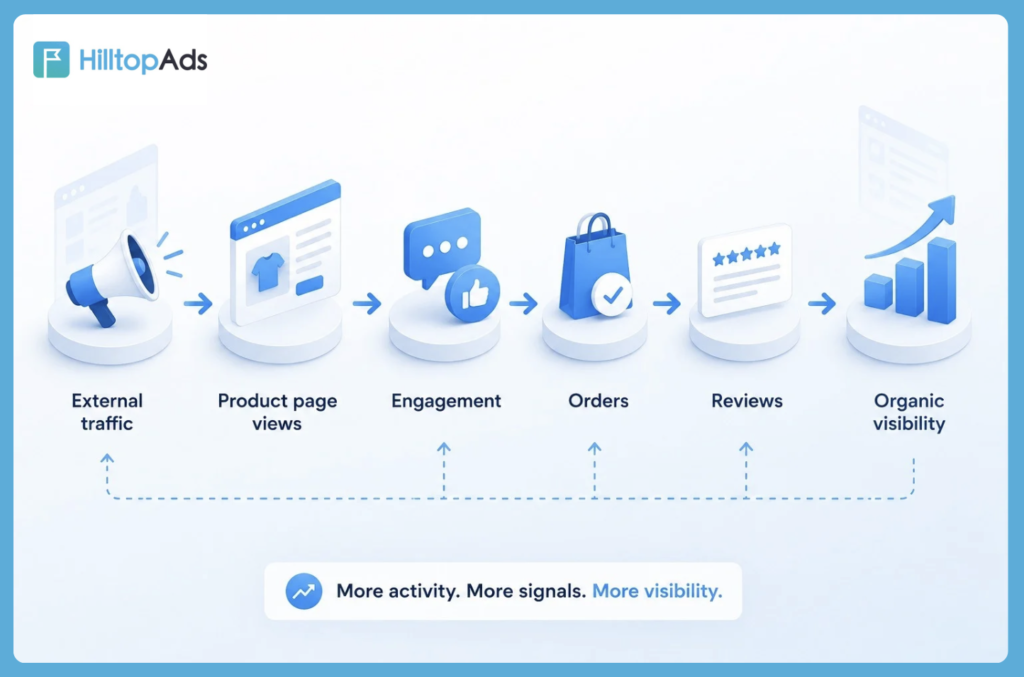
Think of it as a marketplace flywheel:
- External traffic brings users to the card.
- Some users engage with the product.
- Some of them buy.
- Some buyers leave reviews.
- The product becomes more active and more trustworthy.
- That can help the card receive more organic attention inside the marketplace.
Again, this is not a guaranteed algorithm trick. It works best when the product is relevant, the page is prepared, and the traffic matches the marketplace audience.
When This Strategy Makes Sense
This approach is especially useful when a product needs a visibility push, but the seller does not want to rely only on internal marketplace ads.
For example, it can work well for a new product that needs first traffic, an existing product that has potential but not enough visibility, or a product that needs extra attention before a sale event. It can also be useful in competitive categories where internal ads are expensive and sellers want to support organic ranking, not only buy direct paid sales.
The strategy is also relevant for sellers who are building recognition on platforms such as Tokopedia, TikTok Shop, Shopee, Lazada, Amazon, Ozon, Wildberries, or other marketplaces where product cards compete heavily for user attention.
But the main condition is this: the product page must be ready. External traffic does not fix a weak card. It amplifies what already exists.
Read our article on how to increase conversions:
Before Launch: Prepare the Product Page
This is the most important part of the whole strategy.
Directing potential customers to a page with low quality images or vague details is the quickest way to see a budget disappear. When visitors encounter confusing pricing or a lack of clear shipping info, their first instinct is to leave. This lack of engagement prevents any real momentum from building up in the marketplace.
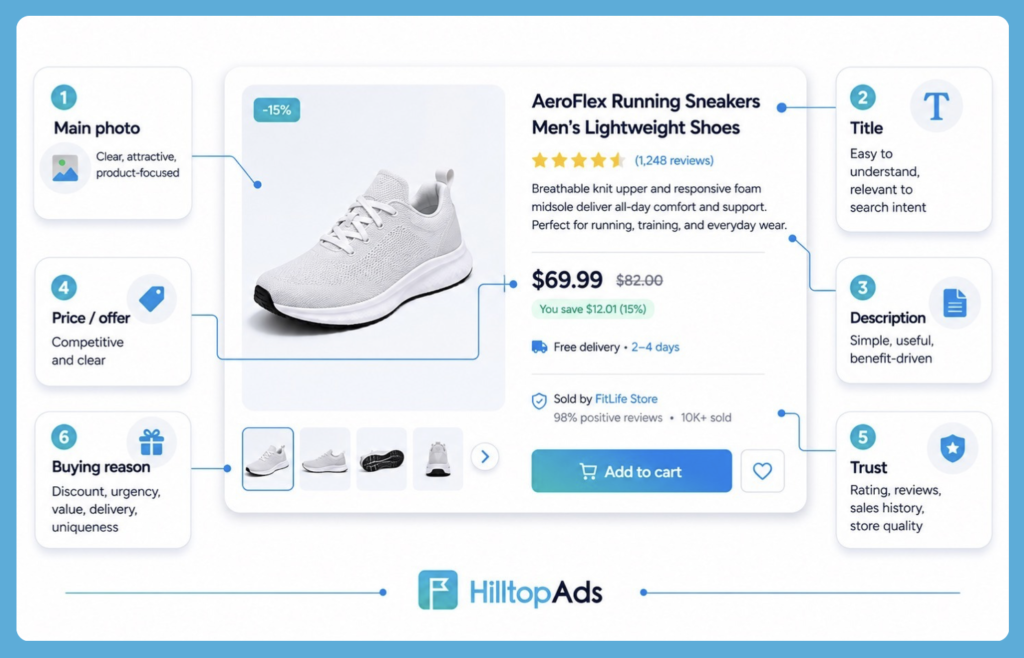
Before launching traffic, make sure the product page has a strong main image, a clear title, an understandable description, competitive pricing, enough stock, delivery information, and a clear reason to buy now. Reviews and rating also matter a lot if the product already has them.
Rimma
Chief Operating Officer at HilltopAds
The biggest mistake is an unprepared product card or store. The visual appearance, main photos, and description need to be optimized before traffic starts, so the page can hold the user’s attention.
Choose the Right HilltopAds Format
For this type of campaign, the strongest starting format is usually Popunder.
The reason is simple: with Popunder, the product page opens directly for the user. This gives the product card immediate exposure. The user can look at the item, save it, add it to favorites, compare it later, or return when they are ready.
Rimma
Chief Operating Officer at HilltopAds
The best way to promote this type of campaign is Popunder. The product card opens directly for the user, so they can immediately view it and add it to favorites if they are interested.
Popunder works well when you need many people to actually open the product page, not just see a creative somewhere. In our Tokopedia and TikTok Shop case, we chose Popunder mobile for this exact reason: it could bring a lot of affordable traffic, and the product page opened in a background tab. So the user could notice the product after finishing what they were doing, instead of being forced to switch right away.
Other formats can also work, but usually with a slightly different role. Banner, In-Page, and other creative-based formats are stronger for awareness, repeated exposure, and brand recognition. They require more creative work, but they can help users remember the product or store before they see the listing again.
A simple way to choose:
Use Popunder when you want to bring people straight to the product card.
Use Banner ads, In-Page, or other formats when you want people to see the product or store more than once, remember it, and maybe come back later as part of a wider campaign.
Basic Campaign Settings for the First Test
On our platform, the first test should be simple enough to read and broad enough to collect traffic.
Start by creating a campaign in Manage Campaigns → Add Campaign. Then move through the settings in the same logic you see in the campaign creation flow.
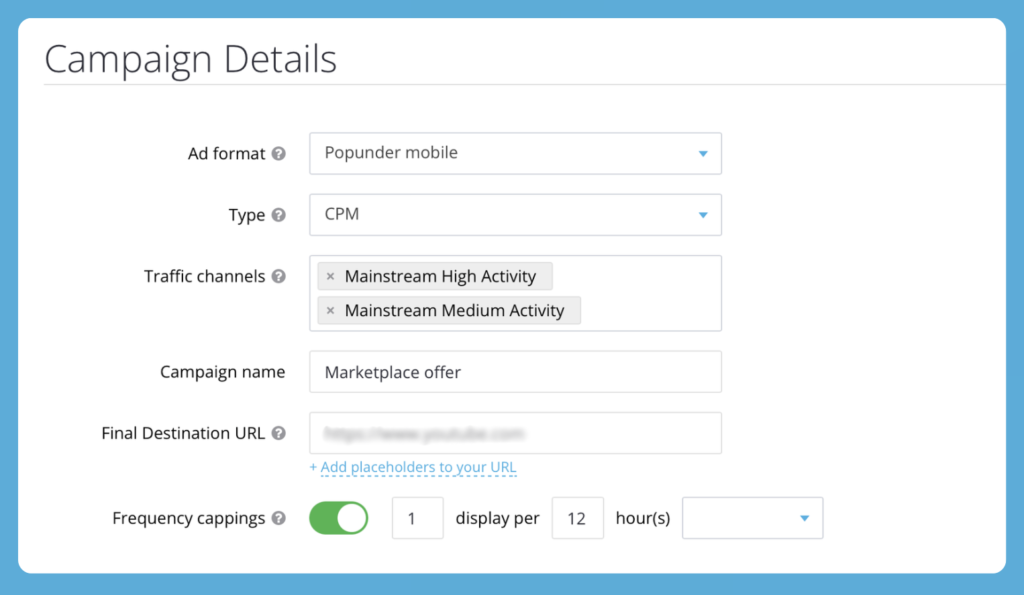
Ad format
Choose Popunder if your goal is to drive users directly to the marketplace product page. For marketplace traffic, mobile often deserves priority because many users browse and buy through mobile apps or mobile web.
Pricing model
For large-scale product page exposure, CPM is often a practical choice because the campaign goal is reach and volume. The exact model should still match your objective, GEO, and expected traffic cost.
Traffic channel
Choose the traffic type based on your product and marketplace rules. If the product is mainstream, start with mainstream traffic. If the product belongs to an 18+ or non-mainstream category, use the appropriate traffic channel.
Frequency capping
For global sale periods, Rimma recommends 1/12 — one impression per user every 12 hours. For regular periods or limited budgets, a more careful option is 1/48.
This matters because the goal is not to annoy the user. The goal is to create enough product exposure without burning the audience too quickly.
Targeting
Start with the country where you want to receive sales. This is the first and most important decision. A bigger country usually needs a bigger budget because the available audience is larger.
At the beginning, you do not need strict OS or browser limitations. Keep the campaign broad enough to collect data, unless you already know that the marketplace or product has specific technical restrictions.
Proxy and WebView
Proxy traffic is usually cheaper, but it is not something to turn on automatically. First, check how the marketplace works. If it accepts users from many countries or works almost globally, Proxy traffic can be tested. But if the marketplace only works in certain countries, it is safer to turn Proxy off and keep this traffic separate from your main campaign.
There is no universal rule for WebView either. Before launch, it is better to check how the product card opens on mobile. If the page loads normally inside an app and the buyer can view the item, add it to cart, and go to checkout without problems, WebView can be tested. If the page opens badly, redirects in a strange way, or makes the buying path harder, it is better to turn WebView off.
Budget and limits
A realistic first test starts from $100–200 total and around $30–50 per day. If the product page has almost no organic traffic yet and you are worried about a sudden spike, start with a smaller limit during the first week and scale gradually.
Why Sale Events Can Make the Strategy Stronger
This strategy can be especially effective around high-intent shopping periods. During major sale events, users are already in browsing and buying mode. They compare products, save items, check discounts, and return to carts more often.
Good timing for this type of campaign can include:
- Black Friday;
- 11.11 and 12.12 sales;
- seasonal demand peaks;
- local shopping festivals;
- payday periods;
- marketplace-specific sales and promo weeks.
The goal is to push the product card into the attention wave before or during the moment when users are already more likely to shop. In the Tokopedia and TikTok Shop case, the campaign was connected to the 11.11 shopping period, and we measured the effect not only through impressions but also through marketplace engagement and sales-related signals.
We recommend you to read our new article about optimizing your banner advertising campaign:
What to Measure: Do Not Look Only at Direct ROAS
For this strategy, direct paid ROAS is not the only KPI. Sometimes it will look modest because the real value appears later, inside the marketplace: in organic traffic, product page views, saves, carts, orders, reviews, and better visibility.
A better way to read the campaign is through three layers.
| Layer | What to watch | Why it matters |
| Traffic input | delivery, volume, spend, CPM/CPC, GEO quality | Shows whether the campaign is bringing enough relevant users to the product page |
| Marketplace reaction | product page views, organic impressions, saves, carts, followers, search visibility | Shows whether the product card is receiving more interest inside the marketplace |
| Business result | orders, units sold, reviews, organic sales growth, repeat activity | Shows whether the traffic push is turning into real marketplace momentum |
Amazon Attribution uses a similar cross-channel measurement idea for Amazon sellers: it helps measure how non-Amazon channels such as search, social, display, video, email, affiliate, and influencer campaigns affect discovery, consideration, and purchases on Amazon. Its reported metrics include detailed page views, add-to-cart actions, purchases, units sold, product sales, and new-to-brand activity.
The key question is not only: “Did the paid traffic pay for itself today?”
The better question is: “Did the product page become more active, more visible, and more likely to generate marketplace sales after the traffic push?”
How to Reduce Risks
The biggest risk is not external traffic itself. The biggest risk is sending the wrong traffic to the wrong product page too aggressively.
Do not send traffic to a weak card. Do not use irrelevant GEOs. Do not use bot traffic, fake activity, fake orders, or fake reviews. Do not mix Proxy traffic into a country-limited marketplace without checking whether the platform can accept that traffic properly.
At HilltopAds, we actively filter and monitor traffic quality, and our platform gives advertisers targeting controls to manage GEO, traffic type, Proxy, WebView, limits, and frequency. But the seller still needs to match the campaign with the marketplace reality: where the product can be sold, where delivery works, and where the audience can actually buy.
Rimma
Chief Operating Officer at HilltopAds
Risks usually appear when traffic includes bots. HilltopAds actively filters and works on traffic quality, which helps minimize problems from the marketplace side. But Proxy traffic should still be handled carefully if the marketplace works only with certain countries.
If the product page has very low organic traffic, do not push too hard from day one. Start with a smaller limit during the first week, watch the marketplace analytics, and then increase traffic gradually.
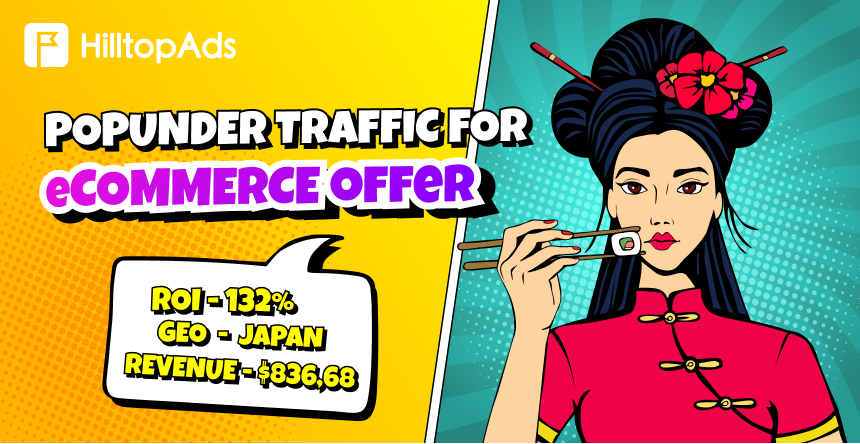
Discover how our advertisers successfully launched their eCommerce campaigns:

How to Optimize After the First Data
This type of campaign does not always need heavy optimization like a classic CPA campaign. You are not only chasing one immediate conversion event. You are watching whether the product page becomes more active inside the marketplace.
After the first data, check whether the traffic is going to the right GEO, whether the product makes sense for that audience, and whether marketplace metrics are moving. If users visit the card but nothing improves inside the marketplace, review the product page first: photos, price, offer, delivery, reviews, and product-market fit.
Rimma
Chief Operating Officer at HilltopAds
Campaigns of this type usually do not require heavy optimization. But depending on the country, the product may be less relevant or less clear to users, and this should be taken into account.
Optimization here is less about cutting zones every hour and more about reading marketplace signals. If the card starts receiving more views, saves, orders, or organic attention, the campaign is moving in the right direction. If not, adjust the GEO, budget, product page, or offer before scaling.
Final Takeaways
External traffic can help marketplace sellers create momentum around a product page, especially when the card is ready and the traffic is relevant.
The strongest starting format for direct product page exposure is usually Popunder, while creative-based formats can support awareness and long-term recognition.
Do not judge the campaign only by direct paid ROAS. Watch what happens inside the marketplace: product page views, organic visibility, saves, carts, orders, reviews, and total sales growth.
Most importantly, scale gradually. A prepared product card, relevant GEO, clean traffic, controlled frequency, and marketplace analytics are what turn an external traffic push into a real growth tool.
Want to give your marketplace product page more visibility? Sign up or log in to HilltopAds and launch your first external traffic campaign today.