


Getting conversions doesn’t mean your affiliate campaign is profitable – especially when your CPA is higher than the payout. See how real campaign data can reveal where your budget is leaking and which traffic segments are actually worth scaling.

In Part 1 we walked through the preparation steps: setting up a tracker, adding a traffic source, choosing an offer, and launching the campaign. If you missed the beginning, here is the first part.
If you are ready to continue, let’s go. Earlier, we have launched an mVAS campaign. Here are the offer details:
Offer name: PA Sweepstakes PIN C&W
GEO: Panama (PA)
Offer category: Sweepstakes (mainstream)
Carriers: Cable & Wireless, Claro, WiFi
Conversion flow: Pin submit
Device: Mobile
Got an mVAS offer ready to go?
Sign up with HilltopAds and put it in front of the right mobile audience.
Sometimes a campaign starts converting immediately. However, it often takes time. Give it at least two or three days before you judge anything. For this experiment we let it run for a full week, which is actually longer than we would recommend in real life. In practice, you should check and optimize campaigns more frequently.
Campaign status after 7 days:
Spend: $64.74
Conversions: 7
CPA: $9.248
Offer payout: $0.55
At this point we can already conclude that we pay for the conversion much more than the offer payout is. It might be acceptable if you have just started out and need to collect data before making conclusions. For us it is fine too, because our goal here is to show the process, not to print money. But the campaign has been running long enough that it is time to look at it properly.
Note: The offer and campaign settings featured in this guide are used for demonstration and educational purposes only. We recommend choosing offers, targeting, and campaign settings based on your own experience, goals, and testing results. Digital advertising is highly competitive and performance can vary significantly, so neither HilltopAds nor the other participants in this guide can guarantee specific results.
Why Optimization Matters
Every affiliate campaign aims for the same goal: conversions. No conversions – nothing to optimize. One or two conversions mean the offer has some potential in this network. But conversions alone are not enough for a campaign to be considered successful. We should look deeper and keep the conversion price at a reasonable level so we can cover spending and also earn above it.
The market keeps moving, and a setup that works for one offer today may become outdated tomorrow. That’s why we need to optimize campaigns – by optimizing we find and disclose traffic segments that will match your offer. You raise bids where you win cheaply and cut off traffic that isn’t generating conversions.
Our BizDev, Jake Elm has worked in this industry for more than ten years and has experienced different scenarios.

Elm
Business Development Manager HilltopAds
My first question is always the same: is the CPA acceptable? If not, the next question is where the conversions come from. The overall CPA tells you that something is wrong. It does not tell you what is wrong. To find out, you break the traffic into smaller pieces, by traffic source, by campaign path, by operating system, and compare the pieces against each other.
And one more rule: never make a big change on a small sample. A zone with a few hundred clicks and zero leads is not proof of anything yet.
Also, check out our article on the best traffic sources for affiliate marketing in 2026:

Where are the Conversions Coming from?
The overall CPA is a starting point, not an answer. To understand why the campaign performs the way it does, we need to break the traffic into segments and see which ones actually produce conversions. This is where the tracker earns its keep. Binom lets us slice the campaign by traffic source parameters, campaign paths, operating systems, and other dimensions.
Check the campaign overview
Open the Campaigns section in Binom and find our campaign.
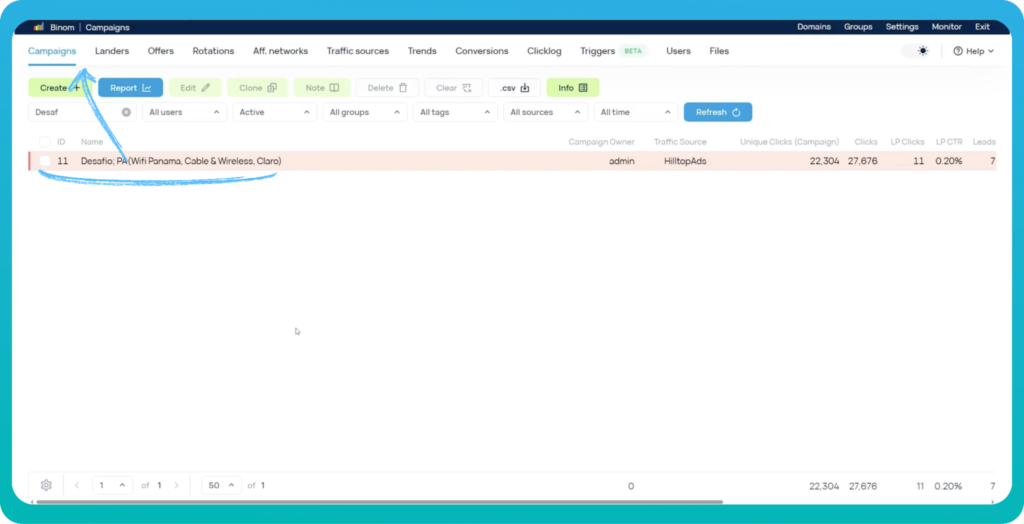
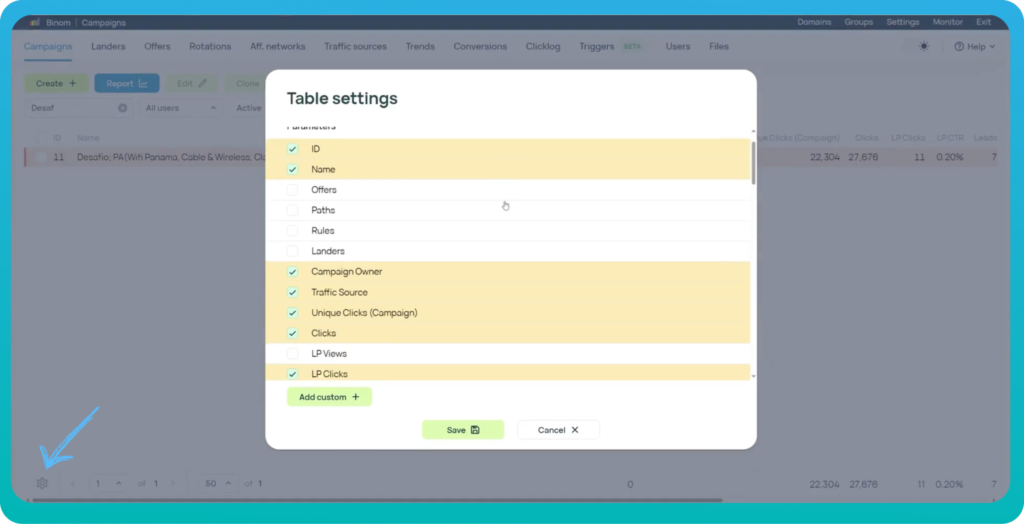
The campaign table already gives us a useful first-level overview. Depending on the columns you’ve enabled, you can see metrics such as:
- Clicks and unique clicks
- LP Clicks
- Leads
- Revenue
- Cost
- Conversion Rate
- Revenue per Click
- Traffic Source
- Bot-related data
You can customize the columns, so you do not need everything on screen at once. For a first pass, focus on traffic volume, conversions, cost, and revenue.
What does LP Click mean?
There’s one metric worth explaining separately: LP Clicks.
If you remember the setup from Part 1, our original campaign contained two paths:
Unique click → Offer
Non-unique click → Pre-landing page → Offer
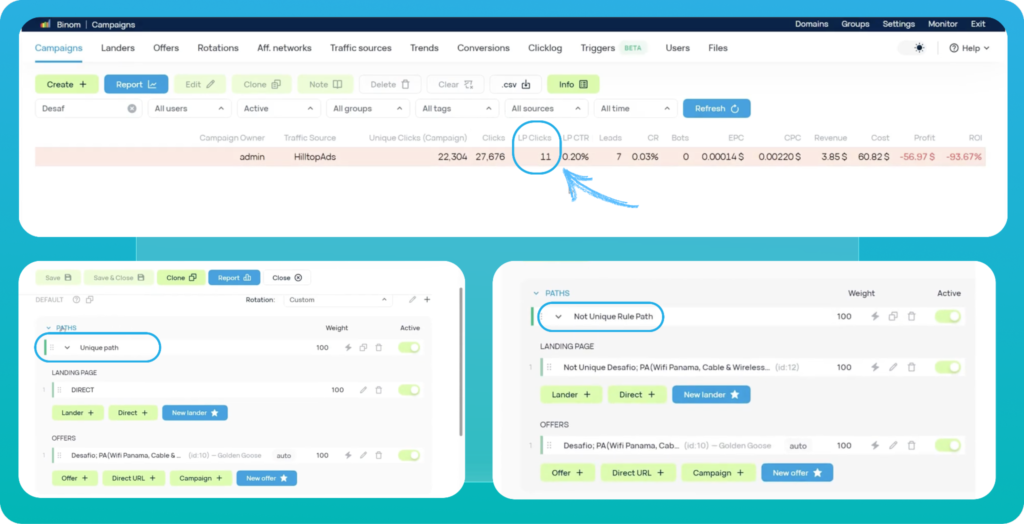
An LP Click is recorded when a visitor moves from the landing page to the offer. Binom picks this up through the offer link on the landing page, which gives us an extra look at what happens between the first visit and the final offer.
Analyzing the campaign report
Open the campaign and go to Report.
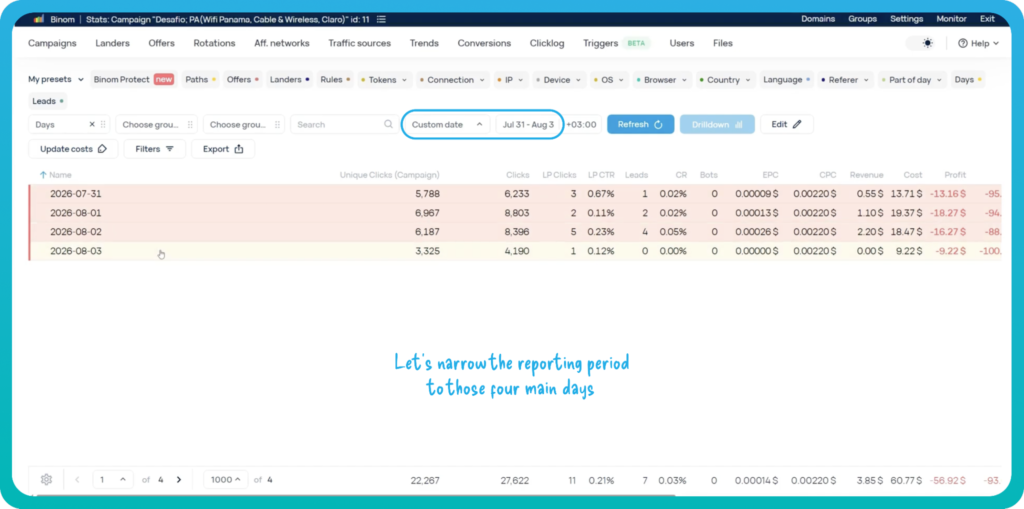
The first useful grouping is Day. In our experiment, most of the meaningful traffic was concentrated within four days: from July 31 to August 3 while several other days contained too few clicks to be particularly useful for this analysis.
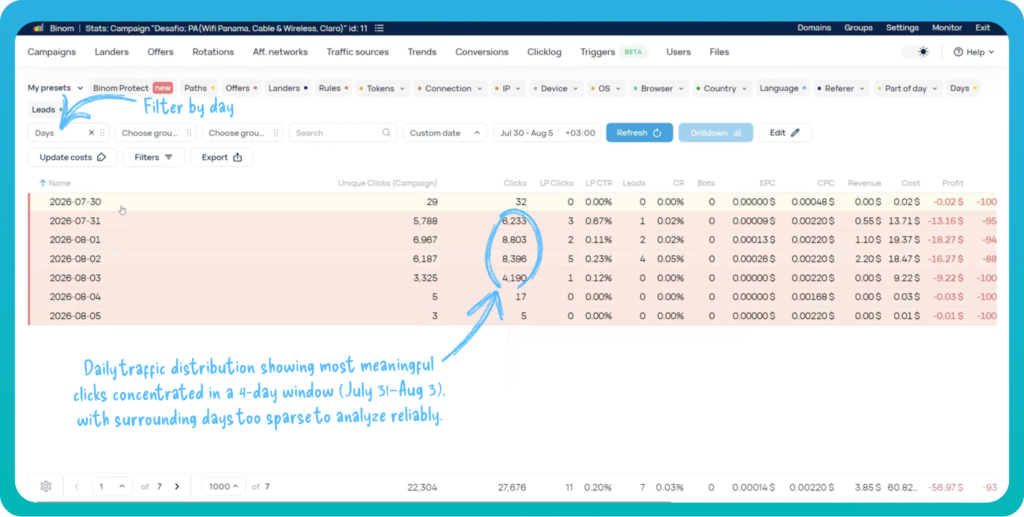
So, let’s exclude the days with insignificant information and choose only the particular period:
Unique vs. returning traffic
Next, let’s revisit one of the experiments we set up in Part 1.
Next, back to the experiment we set up in Part 1: separate paths for unique and non-unique clicks. Group the report by campaign path and the picture gets interesting.
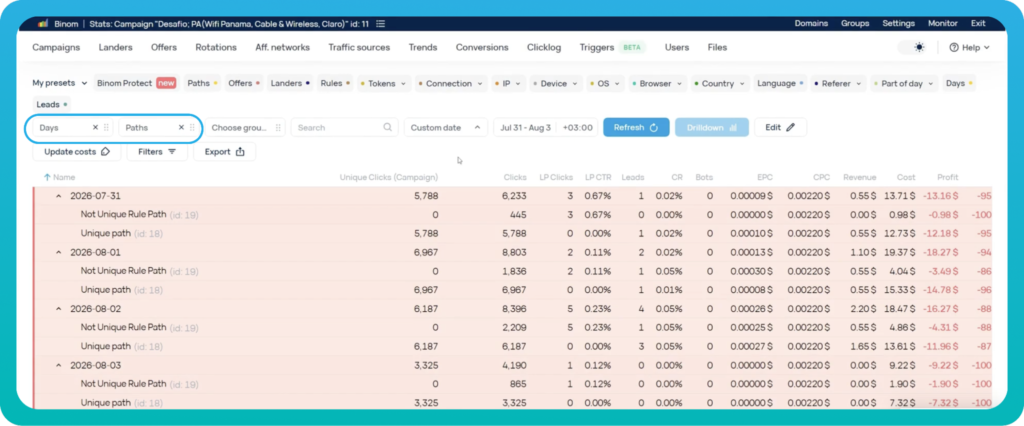
On July 31 the campaign recorded 6,233 clicks:
- 5,788 took the unique-click path;
- 445 took the non-unique path;
- 3 visitors from the non-unique path clicked through from the landing page to the offer;
- We received 1 lead in total for the first day.
The takeaway: raw traffic volume does not show the entire picture. The tracker shows how each segment moves through the funnel, and whether the extra landing-page step actually helps.
For our next optimization round, however, we want to go even deeper.
Which HilltopAds zones are generating results?
One of the most useful dimensions for optimizing a traffic source is Zone ID. HilltopAds passes the Zone ID into Binom through the traffic-source token we configured in Part 1, so we can group the report by it and compare individual sources side by side.
Sort the report by Clicks and compare traffic volume against leads and other performance metrics.
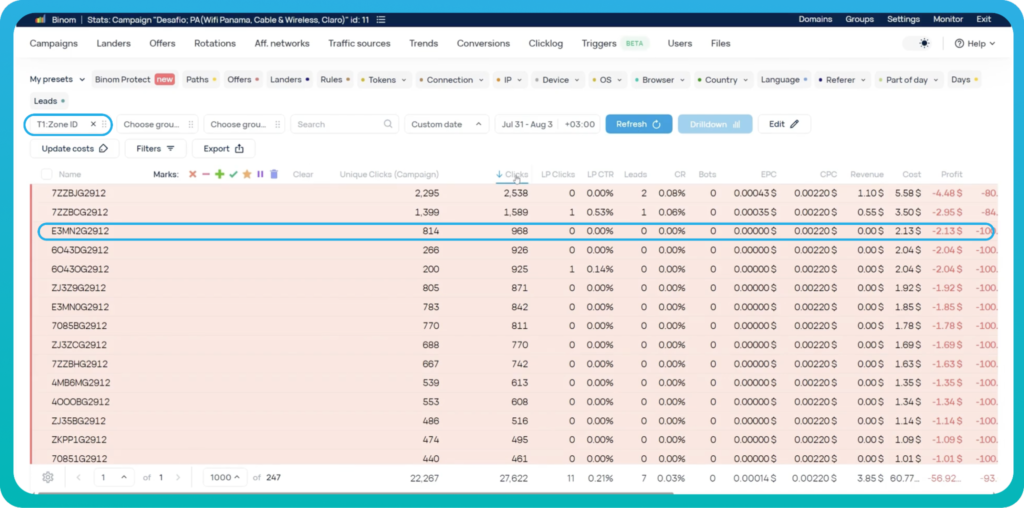
The difference jumps out quickly: some zones delivered a lot of clicks and not a single lead, while other zones converted on a fraction of the traffic. That is our first first optimization opportunity.
Read also the successful case of our advertiser to promote the Tango Live offer:

Blacklisting an underperforming zone
If a zone has enough data and still doesn’t perform, cut it off. You can do this with traffic-routing rules in the tracker, but in our case we make the change directly in HilltopAds. Open the campaign, go to Blacklist/Whitelist settings, add the Zone ID, save. Future traffic from that zone will not be purchased by this campaign.
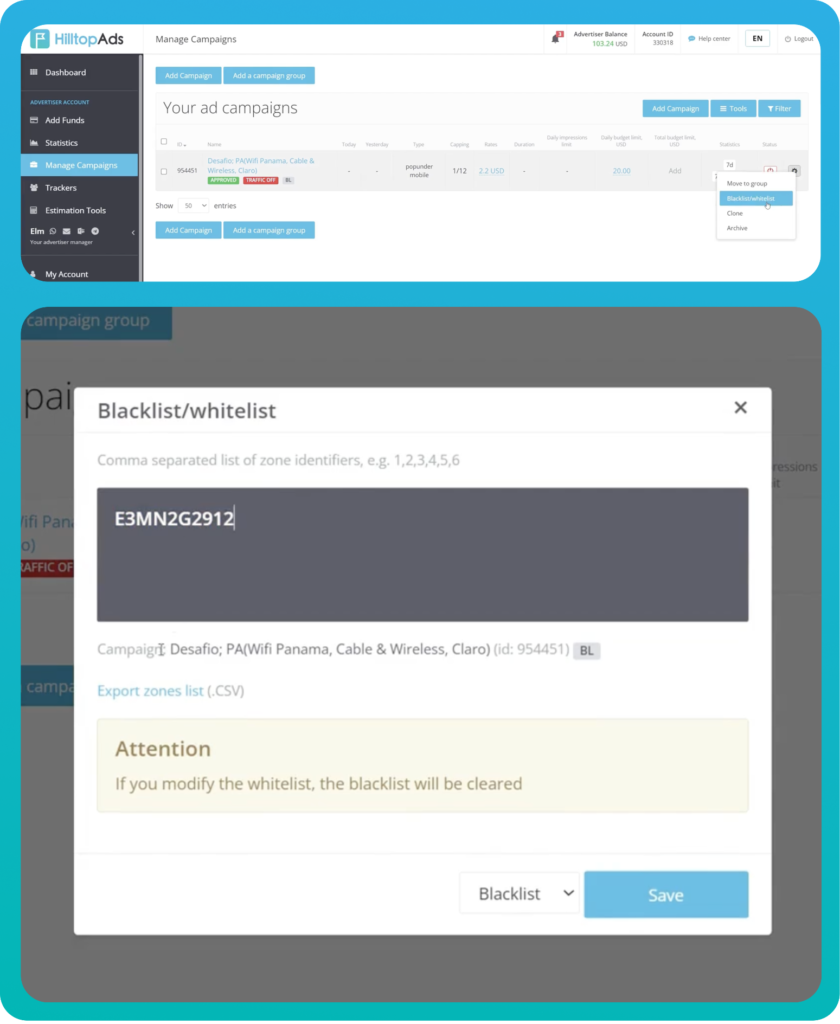
Important: A high number of clicks without a conversion isn’t automatically enough to declare a traffic source ineffective. Consider the amount spent, expected CPA, conversion flow, and the amount of data collected before making an exclusion decision.
Also keep in mind that a campaign uses either a Blacklist or a Whitelist for this type of targeting configuration. Switching to a Whitelist will replace the existing Blacklist configuration, so plan your traffic segmentation accordingly.

Register with HilltopAds and get:
- Advanced targeting options
- Direct traffic sources
- Self-serve platform
- Fully-managed service
- Postback tracking
Does the operating system make a difference?
Zones aren’t the only dimension worth analyzing.
Our campaign targets mobile traffic and initially included both Android and iOS, so let’s group the report by operating system.
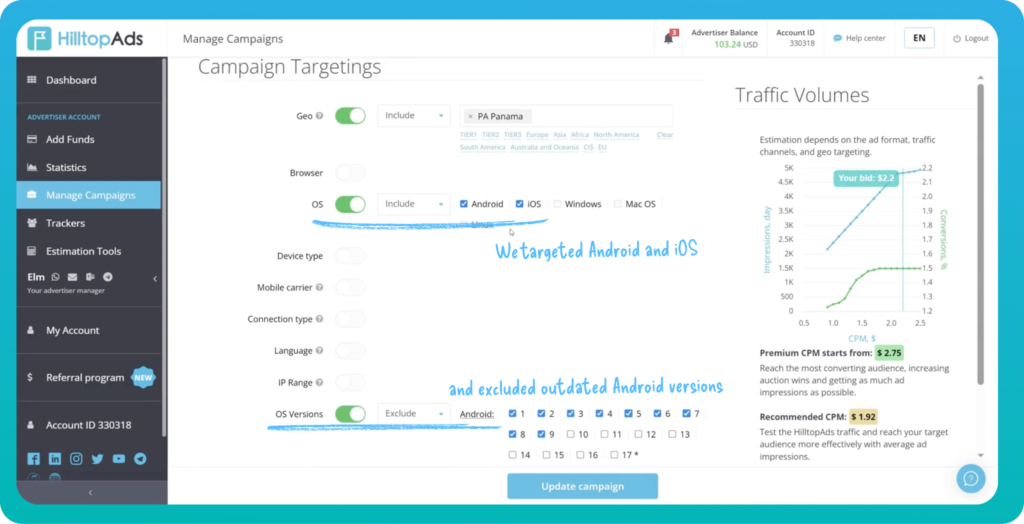
The result is clear in our data: most of the traffic was Android, and every lead came from an Android device. iOS brought some volume but zero leads in this period.
We can then go one level deeper and group Android traffic by OS version.
Android 10 stood out, biggest volume and most of the leads. Android 15 produced one more lead. So instead of treating all mobile traffic as one audience, we now have a basis for deciding which segments deserve more budget.
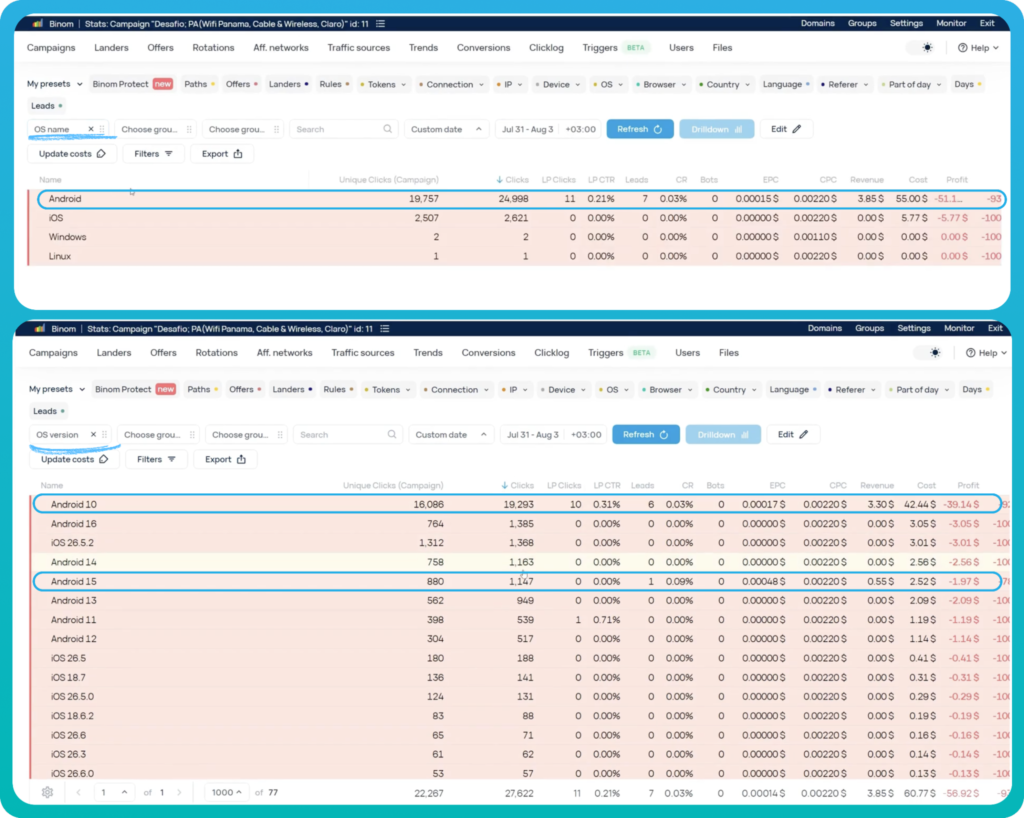
Again, this doesn’t mean that Android 10 is universally better for mVAS campaigns, or that iOS traffic should always be excluded. These findings apply specifically to the traffic and offer analyzed in this experiment.
From analysis to optimization
By now we have a list of patterns from the first run:
– individual HilltopAds zones performed very differently from each other;
– some high-volume zones did not convert;
– we received all leads from Android traffic and Android 10 specifically;
– the experiment with a prelander gives us insight into how visitors move through the funnel.
Based on these findings, we can make real changes to the campaign now.
Optimization: Refine the traffic in HilltopAds
The Zone ID analysis showed us traffic sources that ate budget and gave nothing back. Straightforward fix: add the underperforming Zone ID to the campaign Blacklist. We could apply the same logic to other targeting dimensions, but only where the data justifies it. The goal is not to cut as much traffic as possible. It is to slowly concentrate the budget on segments that prove themselves.
What are we changing before the next run?
Our first traffic run wasn’t just about generating conversions. It gave us the data needed to make the next iteration more informed.
Based on the analysis, we’re making several changes:
Traffic level
Remove a selected underperforming HilltopAds zone from the campaign.
Device leve
Use the OS and OS-version data to evaluate which mobile segments deserve further testing.
Funnel level
Replace the original unique/non-unique routing experiment with a new setup informed by Binom Protect data.
Basically, the successful campaigns go through the same cycle again and again: you start broad to collect data → use different filters to research stats from different angles → compare results of each segment → make conclusions & optimize → run again with updated setup.
A segment that performs poorly in one campaign may perform very differently with another offer, GEO, funnel, or bid. That’s why optimization should be treated as an ongoing testing process rather than a fixed set of rules.
Optimization is a cycle
We’ve now moved from simply collecting traffic to making decisions based on what the data tells us.
But this isn’t where optimization ends. A good marketing conclusion is usually still provisional until you’ve validated it with a live test, not just an endpoint. The next step is to run the updated campaign, collect a new data set, and ask the same questions again: Where are the conversions coming from? Is the CPA acceptable? Which segments deserve more budget, and which ones are holding the campaign back?
Each new round gives you more information. Ad campaigns that succeed without optimization are more the exception than the rule. The campaigns that deliver strong, stable results test different approaches and find the traffic segments that truly convert.
And that’s also where we’ll leave this experiment. Across these two guides, we’ve gone from building the complete HilltopAds x Binom x Golden Goose setup to reading real campaign data and turning it into practical optimization decisions.
Register with the best ad network for advertisers HilltopAds
What is crucial in optimization: questions for Jake
Elm
Business Development Manager HilltopAds
How much data do you need before you cut something?
The crucial metric we should pay attention to first of all is the price of the final target action after optimization, your real CPA after you disable irrelevant traffic. A cheap source that never converts might cost you more than an expensive one delivering conversions. That is why we evaluated our Panama campaign results not on cost per click, but on cost per conversion, then dove deeper to see which traffic segments generated those conversions.
What does a winning setup look like before launch?
We should understand that popunder ads are to be considered as a testing tool, not an instant money printer. People with stable, high ROI prepare several prelanders before launching a campaign and set a realistic testing budget. They also break traffic down by zone, device, OS, browser, language, etc. They test different approaches: with and without a prelander, refreshed creatives, and regularly maintained blacklists, plus extraordinary sources in a whitelisted campaign.
Setting up postback tracking is essential: running campaigns without a tracker significantly reduces your chances of getting meaningful results. Without a tracker, traffic optimization becomes nearly impossible and turns into blind guessing. Connecting a postback also lets you benefit from auto-optimisation tools: such tools keep adjusting campaigns while advertisers sleep and switch off sources that no longer hit the eCPA they need.
What do the people who burn money usually do wrong?
If you don’t want to burn your budget, never launch a campaign on a broad GEO without segmentation, prelanders, or postback tracking and expect instant ROI. A decade ago, this approach might have worked, since traffic was cheap and competition was low. But today’s traffic requires precision. Advertisers who lose money make the same mistakes: ignore trackers, finish tests too early, rely on gut instinct instead of data, and buy low cost traffic without understanding its true value.
Stick to a disciplined, data-driven process if you want to see real returns.
If you had to sum up the guide in one sentence for someone just starting?
Every step in this guide is built on disciplined, data-driven logic. We ran campaigns for a full week before making any decisions, because we know that cold traffic needs volume to reveal patterns. We segmented results by day, path, zone, and OS, because a high CPA only signals a problem. We blacklisted zones that drained budget without results and doubled down on Android segments that delivered conversions, but because the data proved their value for this specific offer and geo.
If you remember one thing, let it be this: your pop campaign’s results depend on your full process and how disciplined you are with data, not just the traffic source itself or quick wins. Optimize by segment, set a realistic testing budget, track everything, and treat each campaign as a chance to learn and improve your next one. That’s how you get real growth and ROI.