


See how a Tier 1 AI Dating advertiser used a large creative pool, realistic mobile banners, and CPM traffic to reach 7.5M impressions and 81 subscription purchases in 14 days.

AI Dating is a visual sell.
Before users read about features, open a chat, or reach the subscription page, they have already reacted to the character in the ad. One face may get attention. Another may be ignored. A banner that works today may start losing users after a few days.
That makes this vertical difficult to test with five nearly identical creatives and a small budget.
In this campaign, the settings were fairly simple. The creative work was not. The advertiser ran hundreds of banner variations across its active setup, kept the stronger ones in rotation, and removed the banners that failed to bring subscription purchases.
The result was a useful look at what it really takes to run AI Dating traffic across Tier 1 markets – and why the creative pool can matter more than another targeting adjustment.
Ready to test your AI Dating creatives at scale?
Register as an advertiser at HilltopAds.
Key Points
Offer: AI Dating / AI companion platform
GEO: Tier 1
Traffic: Non-mainstream High and Medium Activity
Main campaign format: Banner Mobile
Selected period: June 10-23 (14 days)
Target action: Subscription purchase
Impressions: 7,517,828
Advertiser’s target CPA: $40
Subscription purchases: 81
CPM rate: $0.43
Spend: $3,232.66
A Note on the Reporting Period
The campaign remained active after June 23. We isolated these 14 days to get a clear snapshot of delivery, spend, and subscription purchases.
The ROI figures later in this case refer to the advertiser’s full activity period by format, not only to June 10–23. Revenue and ROI for the selected 14-day window were not provided, but the observed CPA for this period was $39.91, almost exactly in line with the advertiser’s $40 benchmark.
The period shows how the advertiser bought scale, tested a large number of creatives, and kept the cost per subscription within the target range.
Read our article on how to launch CIPIAI offers with HilltopAds:
The Challenge: Creative Fatigue in AI Dating
The product was an 18+ AI companion service built around realistic characters, personalized conversations, and paid subscription access. Platforms in this category often sell the experience through the character first: appearance, personality, mood, and the promise of a more personal conversation.
That puts a lot of pressure on the banner.
In a standard offer, the creative may only need to communicate a discount, bonus, or practical benefit. In AI Dating, the character itself is part of the product. If the visual does not feel appealing or believable, the user may never reach the landing page.
The 300×100 format makes this even harder. There is little room for copy, several benefits, or a detailed explanation. The banner needs to work almost immediately.
There was another problem: repetition.
The campaign focused on reaching lots of people in Tier-1 by showing an ad every six hours.This meant people saw the ad multiple times. But it also meant that using only a few different ads could get old fast. If we kept showing the same few ads for too long, it would be hard to tell if we were reaching people who weren’t interested or if they were just tired of seeing the same banners.
The real challenge was therefore not only buying impressions. It was keeping enough fresh creative material in rotation while the campaign continued to scale.
Why Realistic Creatives Worked Best
Across the advertiser’s active campaigns, around 300 creatives were used.
This was not one batch of 300 banners uploaded and left untouched. It was a large working pool that gave the advertiser room to test different characters, appearances, messages, and visual approaches without depending on one early winner.
According to Elm, realistic banners performed best.

Elm
Business Development Manager HilltopAds
Around 300 creatives were used across the advertiser’s campaigns. Realistic banners showed the best results.
It made sense for this offer. The banner had to show users what chatting with a realistic AI companion might actually feel like. If the image looked too generic, too artificial, or did not match the landing page, it was much easier to ignore.
“Realistic” did not mean making hundreds of copies of the same image. A large pool made it possible to change the character, expression, setting, composition, copy, and emotional tone while keeping the product promise clear.
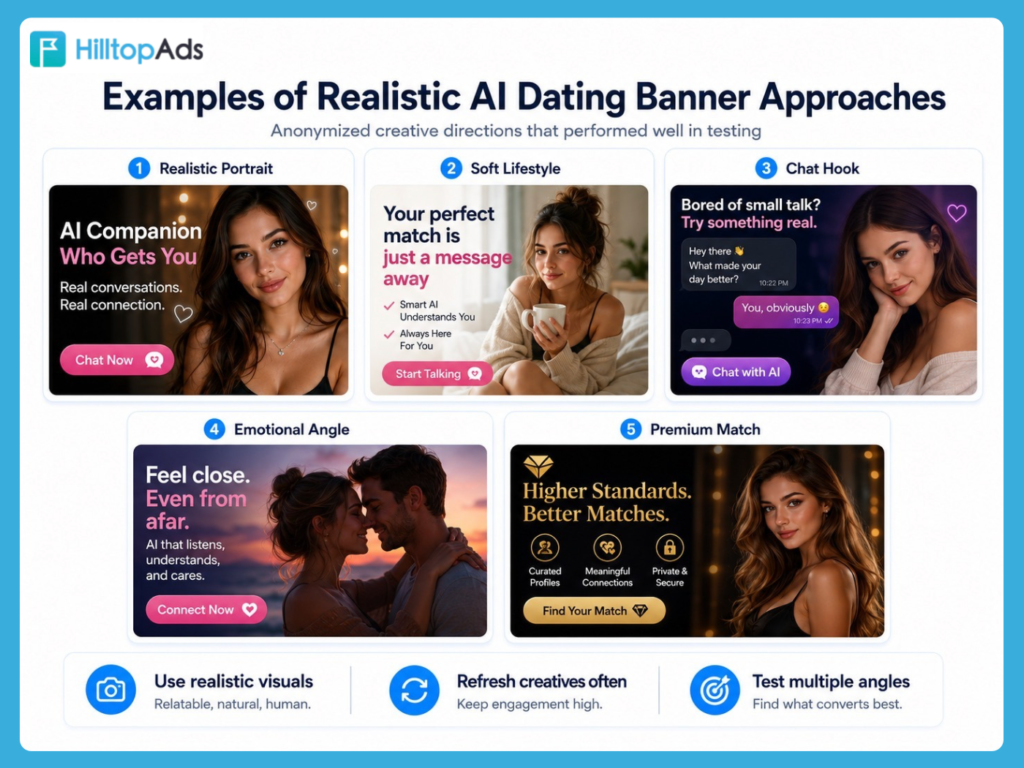
The campaign also showed why one winning banner is rarely enough. A creative may work for one audience slice and fail for another. It may perform well for several days and then slow down. It may bring attention without bringing paid users.
The advertiser did not try to protect every creative. Weak banners were switched off, while stronger ones stayed active and continued collecting traffic.
Which Ad Format Fits AI Dating Best?
Mobile Banner was the focus of the selected campaign, but it was not the only format tested by the advertiser.
Over the full account activity period, the advertiser also worked with Desktop Banner, Video VAST, and Popunder traffic. Elm shared the following format-level figures from the advertiser’s internal reporting:
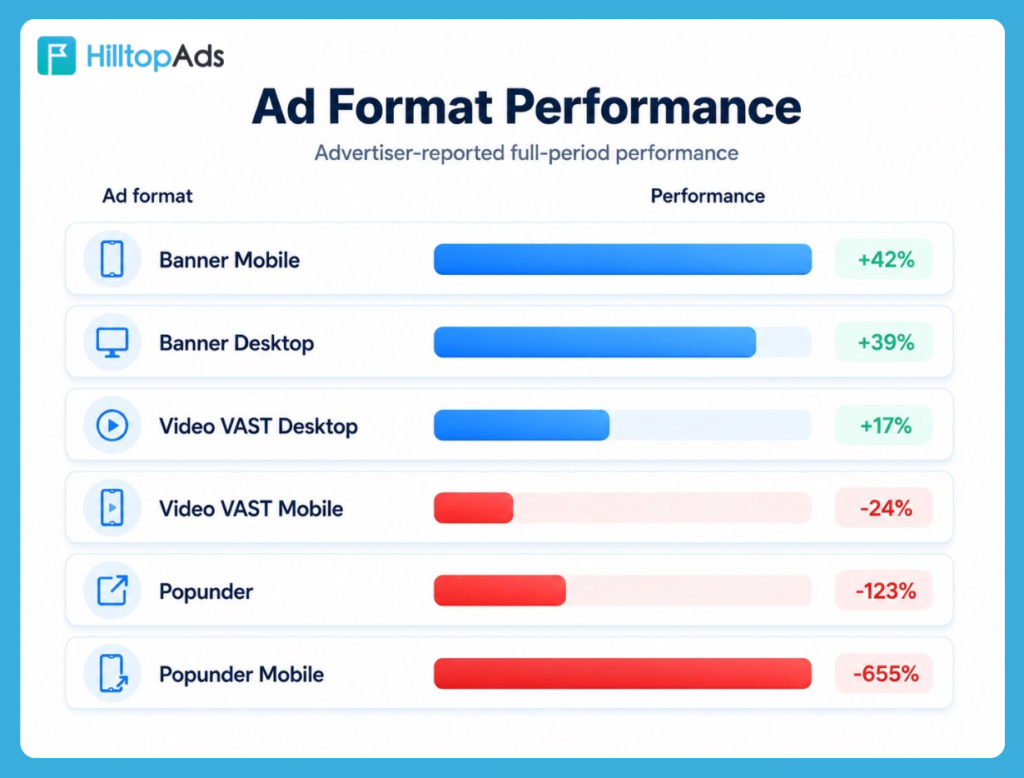
Important: these numbers cover the advertiser’s full activity period, not just June 10–23. We do not have the exact ROI formula or the revenue period behind them, so it is safer to use the figures only to compare formats, not as a final ROI calculation.
Even with that limitation, the direction is clear: banner formats performed best in the advertiser’s own reporting.
That is useful because Popunder is often treated as the automatic choice for non-mainstream campaigns. This account showed that format selection cannot be based on vertical alone. The product, funnel, conversion event, and creative approach all matter.
Register with the best ad network for advertisers HilltopAds
Why Mobile Banner Took the Lead
For this offer, the ad needed to show the product before asking the user to pay attention to it.
A mobile banner could introduce the character directly on the publisher’s page. The user did not need to open a new tab before seeing the main visual idea. That gave the advertiser a way to test many characters and concepts while keeping the message short.
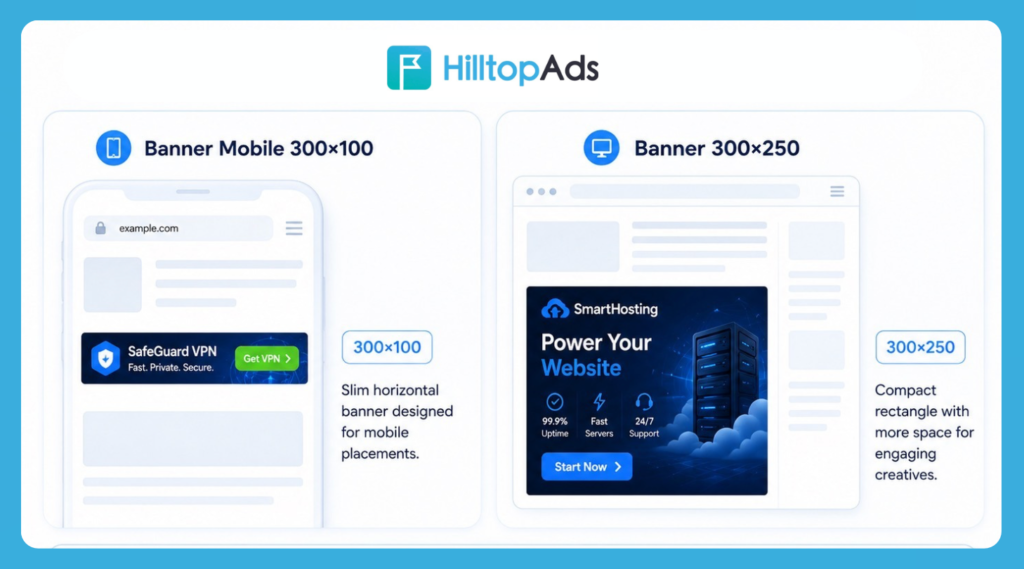
The 300×100 size also worked naturally with mobile placements. It was compact enough to appear inside the page without taking over the whole session, but still gave the creative room for a character, a short hook, and a CTA.
There is also a practical advantage to banner testing: each creative has its own performance history. When one banner stops working, it can be removed without rebuilding the whole campaign.
Across the advertiser’s broader setup, both 300×100 and 300×250 banners were active. This case focuses on the 300×100 Mobile Banner campaign, while the wider size test gave the team more ways to compare creative performance.
Campaign Setup in HilltopAds
Before starting an advertising campaign on HilltopAds, sign up as an advertiser.
Once the account is ready:
- Go to the Manage Campaigns section.
- Click the Add Campaign button.
- Start with the Campaign Details section.
Campaign Details
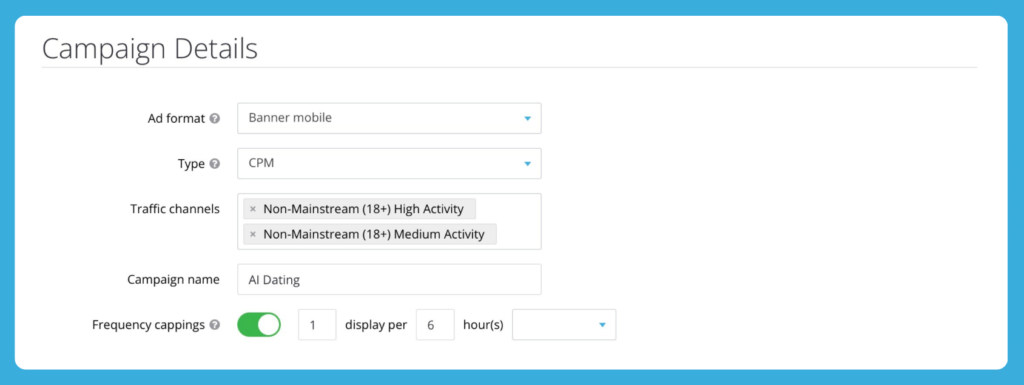
For this campaign, the following settings were selected:
Ad format: Banner Mobile
Pricing model: CPM
Traffic channels: Non-Mainstream (18+) High Activity and Non-Mainstream (18+) Medium Activity
Frequency capping: 1 display per 6 hours
The advertiser evaluated the campaign on a CPA basis, with a subscription purchase as the target action and $40 as the preferred CPA benchmark. At the same time, the traffic itself was purchased on CPM.
In other words, CPM was used to buy traffic, while CPA was used to evaluate the acquisition result.
The selected traffic channels matched the offer, as the product was intended for an adult audience. High and Medium Activity traffic also provided enough volume to test a large number of creatives.
Frequency capping at 1 display per 6 hours allowed the campaign to reach users more than once without showing the banners too frequently. This setting also worked well with the large creative pool: the advertiser could rotate different visuals and remove banners that started losing performance.
To evaluate subscription purchases and compare traffic performance, it is also recommended to set up Postback before launch. It helps track target actions and identify which traffic segments and creatives bring paid users.
Campaign Targetings
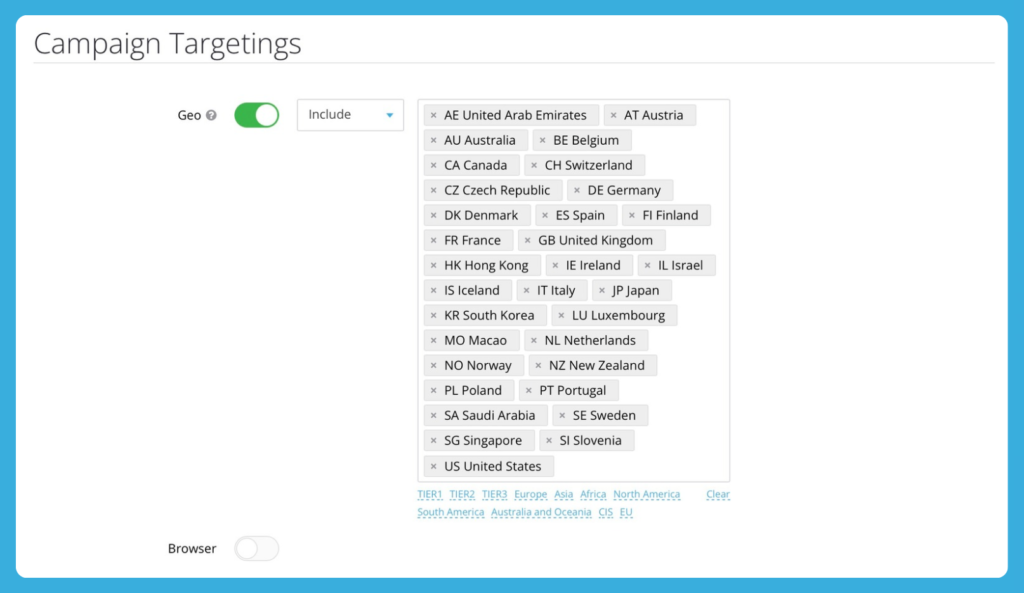
Next, the campaign targeted Tier 1 GEOs.
The strongest countries were:
- United States
- France
- Canada
No country had to be fully removed during the reported optimization period. The targeting remained broad enough to continue collecting data, while the main optimization work focused on the banners.
No additional browser or OS restrictions were reported for this campaign.
Campaign Filters
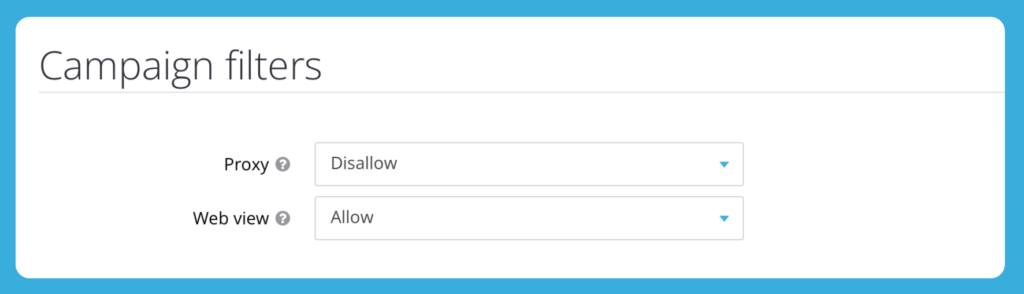
The campaign filters were configured as follows:
- Proxy – Disallow
- WebView – Allow
Proxy traffic was disabled to keep the Tier 1 setup focused on users whose location could be identified more directly.
WebView remained enabled, allowing the campaign to receive traffic from mobile in-app environments as well as standard mobile browsers.
Automatic Optimization
Automatic Optimization was not enabled for this campaign. The advertiser optimized the campaign manually by reviewing creative performance and disabling ineffective banners.
Around 300 creatives were used across the advertiser’s campaigns, so the main optimization work focused on comparing banners and removing weak variations rather than excluding entire GEOs.
Campaign Schedule
The campaign remained active beyond the period selected for this case. For the analysis, we used the 14-day period from June 10 to June 23.
No additional day or hour restrictions were reported for this setup.
Traffic Volumes and CPM
At the final stage, the CPM rate was set to:
$0.43 per 1,000 impressions
The daily budget limit was:
$230
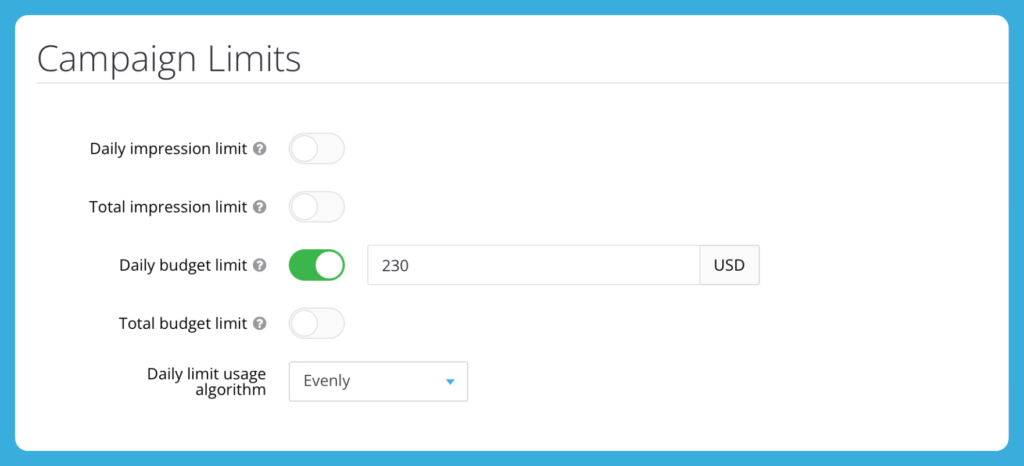
During the selected 14-day period, the campaign spent $3,232.66 and generated 7,517,828 impressions. The effective CPM was approximately $0.43, which matched the configured rate.
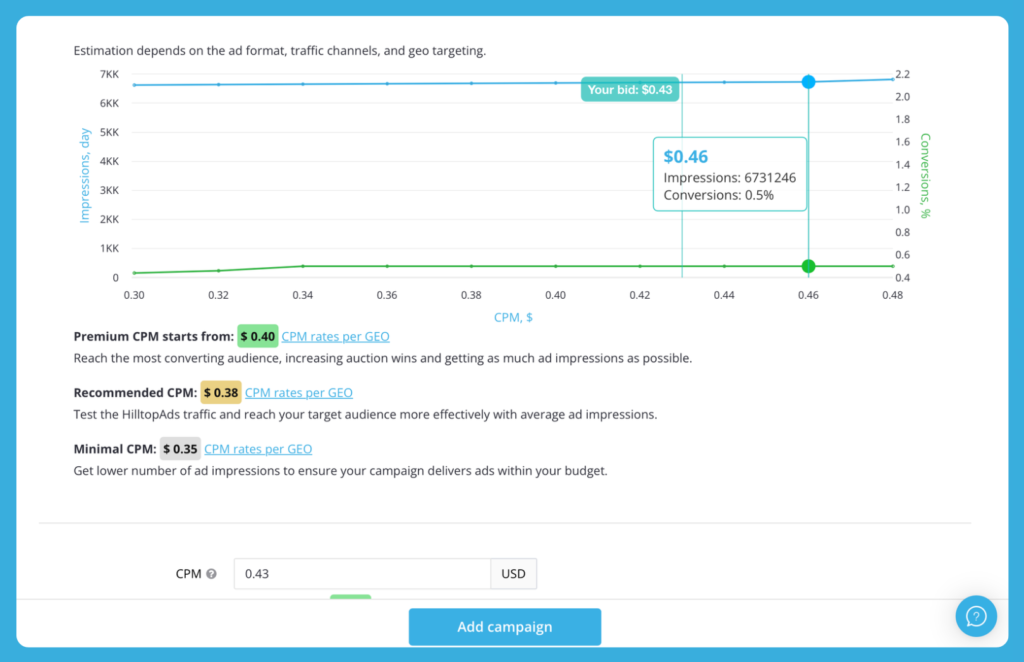
After checking all settings, click Add Campaign to submit the campaign for moderation.
Advice from HilltopAds: for an AI Dating campaign, the starting budget should provide enough traffic to compare creatives properly. With hundreds of banners and several Tier 1 GEOs, the first goal is not only to buy impressions, but to collect enough data to understand which characters, visual approaches, and formats are worth keeping.

Register with HilltopAds today and get
- Advanced targeting options
- Direct traffic sources
- Self-serve platform
- Fully-managed service
- Postback tracking
Creative Testing and Optimization
The confirmed optimization action in this campaign was straightforward: ineffective creatives were disabled.
The team did not report removing any Tier 1 country entirely. Instead, the advertiser used the large creative pool to keep testing the part of the campaign that mattered most for this product – the banner itself.
That distinction matters.
If a campaign has only five creatives and performance drops, it is easy to blame the GEO, traffic channel, or placement. With around 300 creative variations available across the wider setup, the advertiser had a much better chance to see whether the problem was really the audience or simply an image that had stopped working.
The optimization process followed a practical pattern:
- Run enough creatives to collect a useful comparison.
- Identify banners that were not producing subscription purchases.
- Disable weak creatives.
- Keep realistic, better-performing banners active.
- Continue testing other formats and banner sizes.
The team did not rely on one “hero” creative. That would have made the account too dependent on a single image and left little protection against fatigue.
Elm
Business Development Manager HilltopAds
The biggest challenge was the volume of creatives. The volume and variety of the creative pool also had the strongest effect on the result.
Check out our affiliate marketing events calendar for 2026–2027:
Results for the Selected 14 Days
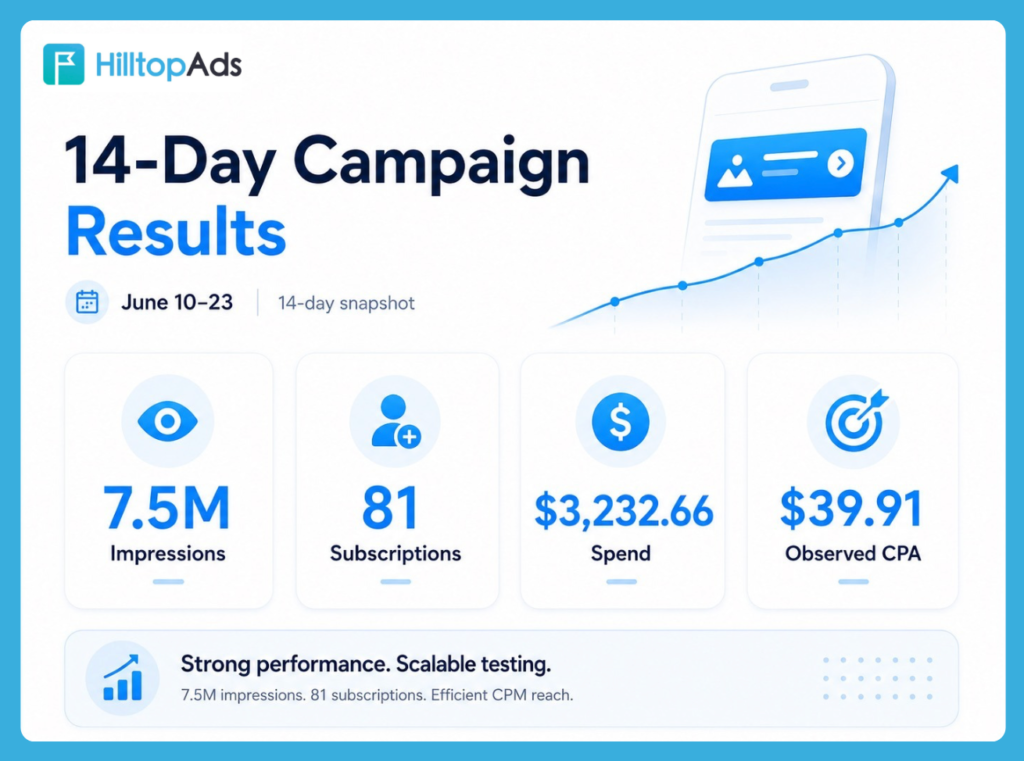
From June 10 through June 23, the campaign produced:
- 7,517,828 impressions
- 81 subscription purchases
- $3,232.66 in spend
- $0.43 effective CPM
- $230 daily budget limit
Based on spend and subscription purchases, the observed CPA for this window was:
$3,232.66 ÷ 81 = $39.91 per subscription
This was almost exactly in line with the advertiser’s $40 target CPA.
Revenue and ROI for the selected 14-day window were not provided, so the result should not be presented as a final profitability calculation. Still, the campaign reached the advertiser’s acquisition-cost benchmark while delivering more than 7.5 million Tier 1 impressions.
The period also gave the advertiser enough traffic to compare a large number of creatives and continue testing the formats and visual approaches that worked best.
What Had the Biggest Impact
A Large Creative Pool
Around 300 creatives gave the advertiser more room to test and reduced dependence on one banner.
Realistic Visuals
Banners that looked closer to the actual AI companion experience performed better than less realistic approaches.
Testing More Than One Format
Mobile Banner led the advertiser’s full-period comparison, but Desktop Banner and Desktop Video VAST also produced positive internal results. Without testing, that format difference would have remained invisible.
Enough Budget to Collect Dat
Tier 1 traffic and a paid subscription event need room to run. A tiny test may stop before enough creative or format data appears.
Removing Weak Creatives Instead of Cutting GEOs Too Early
The strongest GEOs were the United States, France, and Canada, but none of the active countries had to be removed entirely. The main confirmed optimization happened at the creative level.
Elm’s Advice for AI Dating Advertisers
Elm’s recommendation is direct: do not launch an AI Dating campaign with a few generic banners and expect a reliable conclusion.
Elm
Business Development Manager HilltopAds
Launch unique creatives and try different ad formats. Prepare enough budget for a proper test. For this vertical, around $10,000 gives the campaign more room to test.
The $10,000 figure is not a required platform minimum. It is Elm’s recommended testing budget for advertisers who want to work seriously with Tier 1 traffic, multiple formats, and a large creative pool.
A larger test budget makes it possible to:
- compare more than a few banners;
- test 300×100 and 300×250 placements;
- run Mobile and Desktop separately;
- compare Banner with Video or Popunder;
- avoid judging a subscription funnel from a very small sample;
- keep successful tests running long enough to see whether performance holds.
The budget alone will not fix weak creatives. But without enough runway, even a good product may be stopped before the advertiser learns what works.
We recommend other cases involving our advertisers promoting dating offers:
Conclusion
This campaign did not depend on complicated targeting or aggressive GEO cuts. Its main working tool was the creative pool.
Across the advertiser’s wider activity, banner formats showed the strongest direction, with Mobile Banner taking the lead. During the selected 14 days, the 300×100 campaign delivered more than 7.5 million impressions and 81 subscription purchases at a $0.43 CPM.
The observed CPA was $39.91, almost exactly matching the advertiser’s $40 benchmark. This showed that the campaign could combine high Tier 1 traffic volume with an acquisition cost that stayed within the target range.
For AI Dating, five similar banners are rarely a full test. The advertiser needs enough visual variety to find the characters and messages that users respond to, enough budget to collect real data, and enough discipline to remove weak creatives without rebuilding the whole campaign after every change.
Ready to test an AI Dating offer with our traffic? Sign up or log in to HilltopAds, launch a Banner Mobile campaign, and work with our team to build a creative test that has enough room to produce useful data.