


Cheap casino registrations look great in reports – until those users never deposit. See how we balanced CPA and real player value to generate 105 registrations in Indonesia at a $13.55 CPA while identifying the traffic actually worth scaling.

A registration is not a player. That sounds obvious, but it is one of the easiest things to forget when optimizing casino traffic. One user can register and disappear. Another can register, make a first deposit, and continue playing. On paper, both start as one conversion. For the advertiser, however, their value is completely different.
This creates a familiar problem for casino campaigns. If you optimize only for FTDs, you may not collect enough events for the system to learn quickly. If you optimize only for cheap registrations, you can end up scaling traffic that looks efficient at the top of the funnel but brings very little value further down.
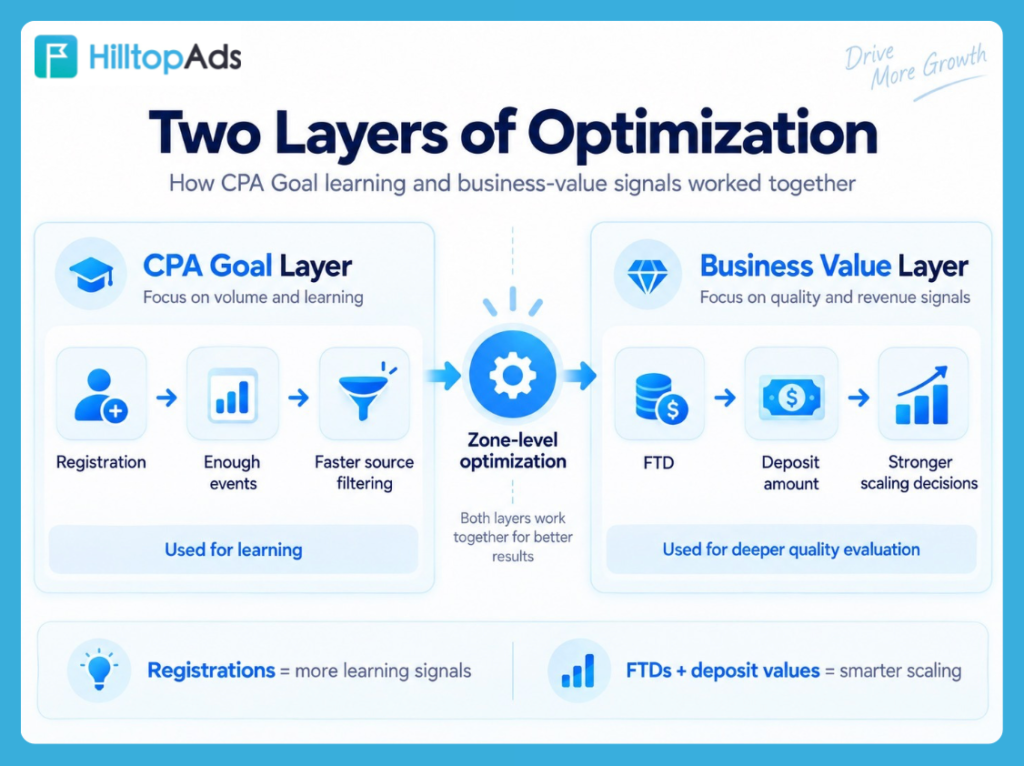
For this Indonesia campaign, we used both signals for different jobs. Registrations gave CPA Goal enough conversion data to optimize traffic quickly. FTDs and deposit amounts then helped us understand which zones were bringing more valuable players and deserved further attention.
The advertiser has been running with HilltopAds since March 2026. For this case study, we isolated a two-week period from August 1 to 14 and looked at how this two-layer approach worked in practice.

Want better results from your casino campaigns?
Sign up with HilltopAds and start testing.
Key Points
Offer: Casino
GEO: Indonesia (ID)
Traffic: Mainstream/Non-mainstream
Ad Format: Popunder Mobile
Campaign Type: CPA Goal
Devices: Mobile / Tablet
Campaign period: August 1–14
CPA Goal: $14 for the campaign analyzed
Impressions: 2,074,303
Conversions: 105 registrations
Average CPA: $13.55
Spend: $1,423.18
Why Casino Campaigns Need a Different Optimization Logic
Casino campaigns have a slightly unusual optimization problem: the event you get most often is not necessarily the event that matters most to the business.
A registration is relatively frequent. That makes it useful for campaign learning: the more conversion feedback the system receives, the easier it becomes to distinguish traffic zones that consistently produce actions from those that simply consume budget.
But registration is only an early stage of the casino funnel. The advertiser ultimately cares about what happens next: does the user make a first-time deposit? How large is that deposit? Does one source consistently bring more valuable users than another? This becomes especially important once you start deciding what to scale.
Imagine two zones delivering registrations at roughly the same CPA. If one mainly generates very small deposits while the other consistently brings stronger FTD values, treating those zones as equally valuable would hide an important part of the economics. That is why it makes sense to use one event for faster optimization and another to understand what the traffic is actually worth.

Rob
Sales Manager at HilltopAds
For casino traffic, registration gives us a much stronger data stream because it happens more often. That makes it a practical event for optimization. But we still need to know what happens after registration, because that is where the real player value starts to appear.
Read our article about alternatives to RichAds:

What Makes a Casino User Valuable?
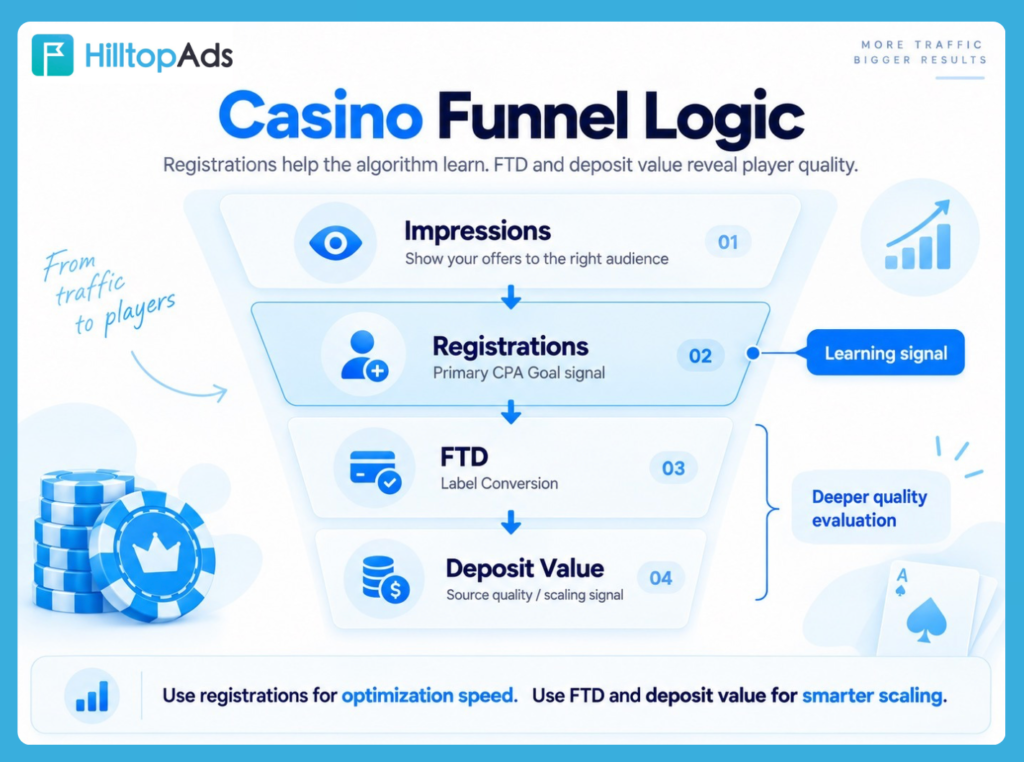
A registration is useful, but it only tells part of the story. In a casino funnel, the user moves from impression → visit → registration → FTD → deposit value → repeat activity, and each step adds more context. Registration shows that the traffic can move users into the funnel, while FTD confirms that those users are willing to deposit. Deposit value then helps show how valuable those players actually are.
That is why registration CPA alone can be misleading. A source may look efficient at the top of the funnel but still bring low-value users. For this campaign, registration was used as the primary optimization signal because it generated enough events for CPA Goal to learn from, while FTD and deposit value were used as deeper quality signals to decide which zones were worth scaling.
Why Indonesia for Casino Traffic
For this test, Indonesia gave us the traffic volume needed to evaluate a broad range of sources.
According to DataReportal’s Digital 2026 Indonesia report, the country had around 230 million internet users at the end of 2025, while internet penetration reached 80.5%. Indonesia also had 331 million active cellular mobile connections, equivalent to 116% of the population, and 96.6% of those connections were classified as broadband-capable.
Mobile connectivity itself has also improved. DataReportal reports a median mobile download speed of 45.01 Mbps at the end of 2025, up more than 50% year over year.
For a mobile casino funnel, those conditions matter. A user has to move from an ad to a landing page, through registration, and eventually into a deposit flow without unnecessary friction.
The wider online gambling market is moving in the same direction. Mordor Intelligence estimates that mobile and tablet accounted for 57.14% of global online gambling revenue in 2025, while casino was the largest game category with a 50.12% market share.
For HilltopAds specifically, Indonesia is also a GEO where we have enough Popunder inventory to test many different traffic sources instead of making decisions from a very small sample.
Rob
Sales Manager at HilltopAds
Indonesia has traditionally been a strong traffic GEO for us. With casino offers, the important part is testing enough sources, because there are usually relevant zones for very different products. You need enough volume to actually find them.
That is also why Popunder Mobile + CPA Goal made sense here.
Popunder provides the volume needed for source discovery. CPA Goal adds conversion-based rules on top of that traffic, allowing weaker zones to be filtered while the campaign keeps testing new opportunities.
We weren’t trying to find one perfect zone on day one. We wanted enough data to see which sources were actually worth keeping.
Register with the best ad network for advertisers HilltopAds
Campaign Setup in HilltopAds
Before you can start your advertising campaign on HilltopAds, you’ll need to sign up as an advertiser. Once your account is ready, here’s how to create a similar campaign.
First, go to Manage Campaigns and click Add Campaign. Start with the basic Campaign settings:
- Ad format – Popunder Mobile
- Type – CPA Goal
- Category – Mainstream + Non-mainstream
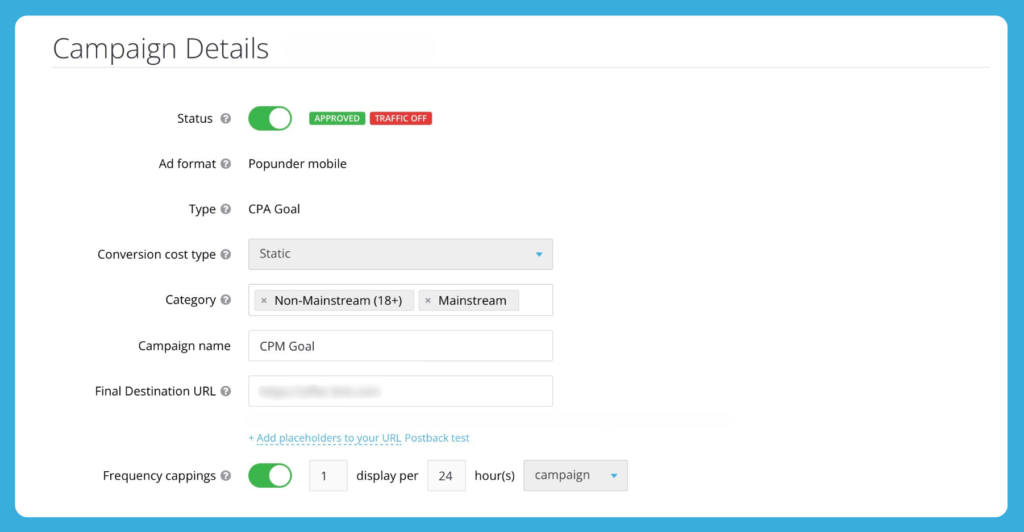
For this casino campaign, both traffic categories were used so the advertiser could test a wider pool of sources and later compare not only registration costs, but also the value users generated deeper in the funnel.
Before launch, we also recommend setting up Postback correctly. CPA Goal relies on conversion data to understand which traffic zones are generating the target action.
For this setup, registration was used as the primary conversion because it provided enough events for the system to learn and optimize traffic more efficiently.
Next, configure the Targeting settings.
For this campaign, the advertiser focused on:
- Device type – Mobile / Tablet
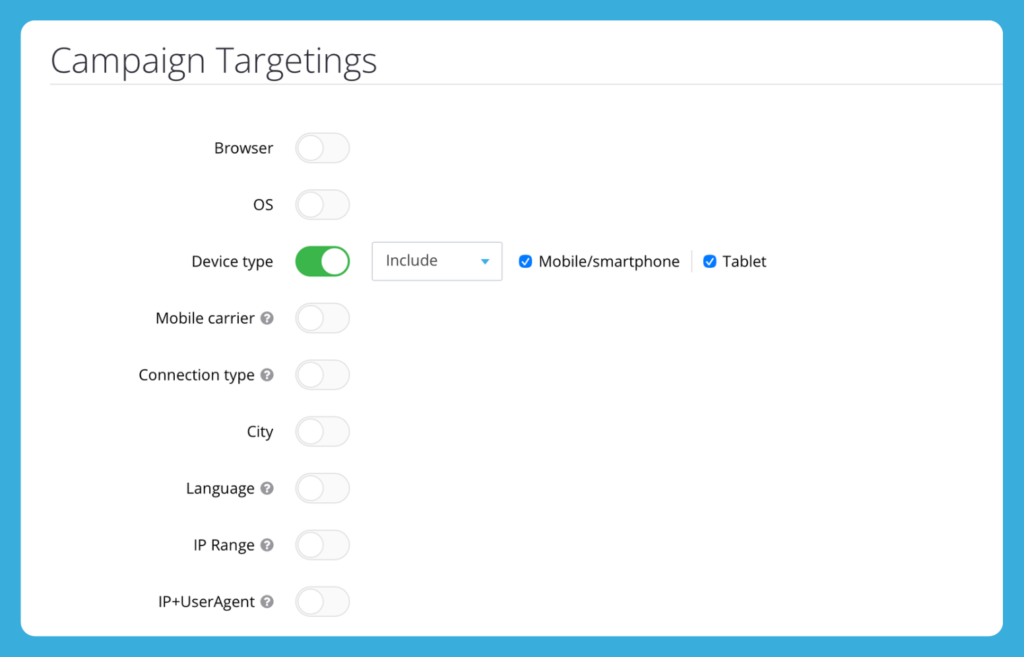
Mobile traffic ultimately performed better, while device, browser, and OS-version performance were reviewed further during optimization. Then configure the Traffic filters:
- Proxy – Disallow
- WebView – Allow
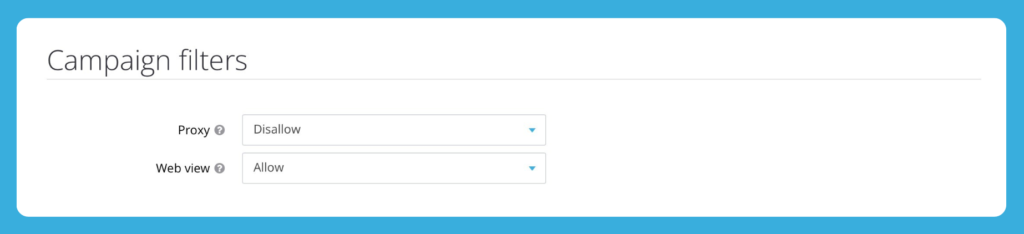
Proxy traffic was disabled, while WebView traffic remained available as part of the campaign setup.
Next comes the GEO and target conversion cost. For the campaign analyzed in this case:
- GEO – Indonesia (ID)
- CPA Goal – $14
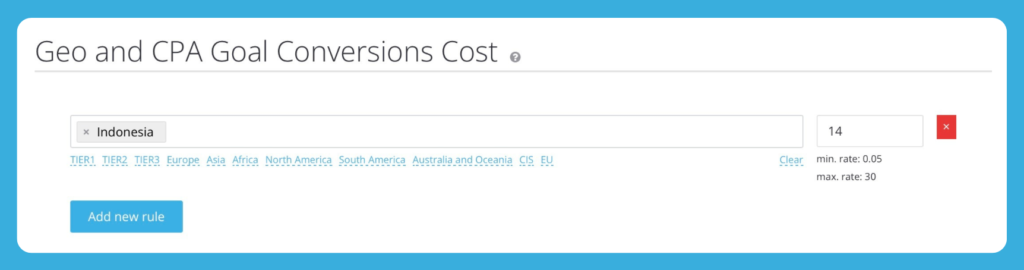
The advertiser did not use the same CPA target across every traffic segment. In the broader campaign setup, separate campaigns were also launched with $7, $11, and $14 CPA Goals, depending on the expected economics of each segment.
More expensive traffic, such as iPhone users on mobile connections, could therefore be evaluated separately from Android, Wi-Fi, and other traffic instead of forcing every user type into the same acquisition-cost target.
Rob
Sales Manager at HilltopAds
We separated traffic into different CPA levels instead of putting everything under one target. We had campaigns at $7, $11, and $14 depending on the segment, because different traffic groups have different acquisition economics.
After setting the GEO and conversion cost, configure the CPA Goal optimization rules. For this campaign:
- Start optimization after – 2 conversions
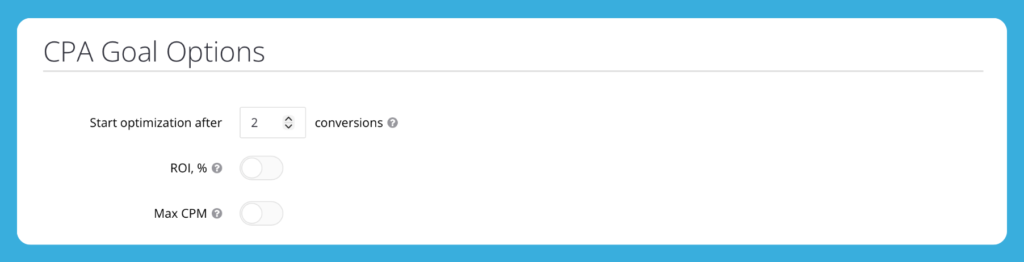
The campaign started automated optimization after two registered conversions.
This was a campaign-specific setup rather than a universal rule for every casino offer. In this case, registration was used because it generated enough events to give CPA Goal a faster feedback loop.
HilltopAds also allows advertisers to set:
- daily impression limits;
- monthly impression limits;
- total impression limits;
- daily, monthly, and total budget limits.
Finally, the Сampaign schedule can be adjusted by day and hour.
During optimization, traffic from 2 AM to 6 AM local time was disabled because this period was not performing efficiently enough to justify continued spend.
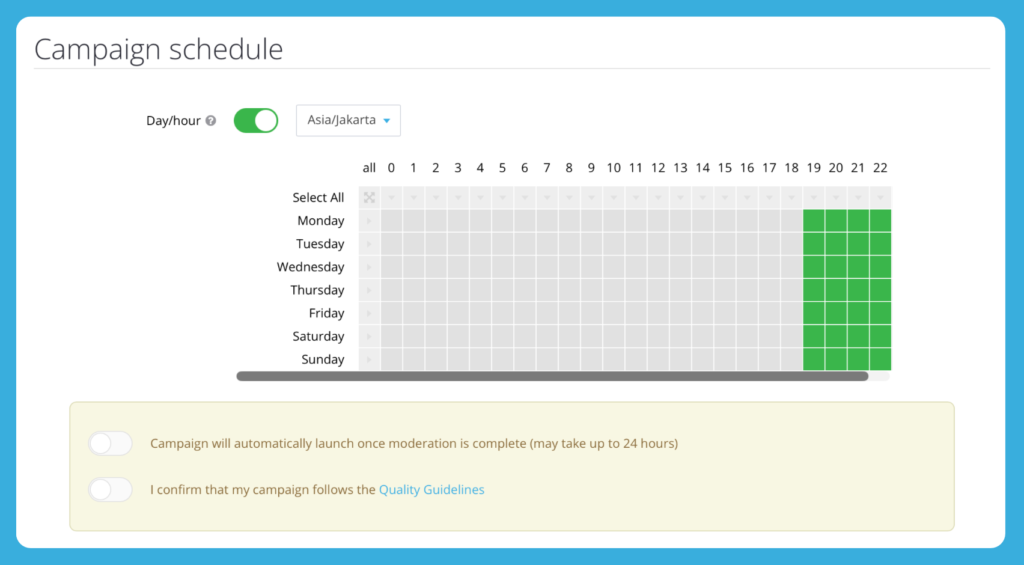
This helped reduce unnecessary traffic during weaker hours and keep more budget available for periods with better user activity.
Advice from HilltopAds: for casino campaigns, do not treat CPA Goal as a single universal number for the whole audience. Device type, connection type, OS version, traffic category, and even time of day can change the economics of a user. Start with enough traffic to collect data, then separate and optimize the segments that behave differently.
Put CPA Goal to work on your next campaign
sign up with HilltopAds and start optimizing your traffic.
Why We Used Registrations as the Primary Conversion
Why optimize on registration when FTD is more valuable? Because optimization needs data. FTDs happen deeper in the funnel and therefore occur less frequently. If the campaign waited only for first deposits before making traffic decisions, the feedback loop would be much slower and individual zones could require significantly more spend before there was enough information to evaluate them.
Registrations provided a denser signal. With more conversion events coming back through Postback, CPA Goal had more information to work with when evaluating zone performance. That does not mean registration became the ultimate KPI. It simply became the most practical event for the automated part of optimization.
We chose registration because there were more events in the statistics. That gives the system much more information to optimize on. FTD is more valuable as a business event, but there are naturally fewer of them. This distinction is important. Registration was the learning signal. FTD was the quality signal. The two metrics answered different questions, so there was no reason to force one metric to do both jobs.
We recommend reading the article on how to create conversion creatives in dating:

FTD and Deposit Value: The Second Layer of Optimization
This is where the campaign moved beyond basic CPA optimization. But the advertiser went one step further. The deposit amount was included in the FTD label, giving the team additional context around player value. You can see this in the campaign statistics below, where FTDs are grouped by deposit amount.
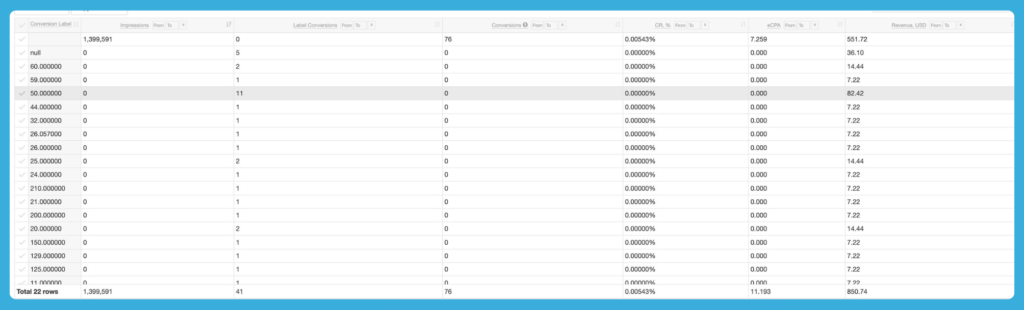
This made it easier to see whether a zone was bringing mostly small deposits or users with higher deposit values.
Instead of simply seeing (Zone A → FTD) the team could see whether a zone was bringing mostly small deposits or users with higher deposit values.
That changes how you look at a source. A zone may produce registrations cheaply but mostly lead to small deposits. Another may have a slightly more expensive registration CPA but bring users who deposit considerably more.
If you look only at the first conversion, the cheaper zone appears stronger. If you look deeper into the funnel, the second zone may be the better scaling opportunity.
Rob
Sales Manager at HilltopAds
We also passed FTD as a Label Conversion and included the deposit amount in the event name. That gives us another way to evaluate zones. You can see not only that a first deposit happened, but also which sources are bringing higher deposit values.
Some zones in the wider campaign mix, for example, produced deposits as low as around $5. That is exactly why raw conversion volume could not be the only scaling criterion.
In practice, the logic was straightforward: use registrations to find traffic that converts, then use FTDs and deposit values to decide which of those sources are actually worth scaling.
Different Players, Different CPA Targets
Another important lesson from this campaign was that not every traffic segment should be forced into the same CPA target. The advertiser used several campaign segments with CPA Goal rates of $7, $11, and $14 because different traffic segments came with different acquisition economics.
For example, premium mobile segments such as newer iPhones on cellular connections may cost more to acquire than some Android or Wi-Fi traffic. But a higher acquisition cost does not automatically make the segment worse if the users it brings also show stronger downstream value.
One universal CPA target can make those differences harder to see. Set the target too low and you may cut expensive but valuable traffic before it has a chance to prove itself. Set it too high and weaker segments may receive more budget than their economics justify.
Rob
Sales Manager at HilltopAds
We separated traffic into different CPA levels instead of forcing everything under one target. We had campaigns around $7, $11, and $14 depending on the segment. More expensive mobile traffic needs different economics from cheaper Android or Wi-Fi segments.
Recent iOS traffic also stood out in the advertiser’s broader testing. According to Rob, iOS 18, 26, and 27 were among the stronger-performing versions. These exact CPA levels or OS versions are not something every advertiser should copy. The useful part is the principle: the target should match the economics of the traffic segment you are buying.

Register with HilltopAds and get
- Advanced targeting options
- Direct traffic sources
- Self-serve platform
- Fully-managed service
- Postback tracking
Optimization Strategy
As the data accumulated, Rob and the advertiser started narrowing the traffic based on what was actually working. Blacklists and whitelists were updated as source-level results became clearer. Browser segments were reviewed and adjusted based on performance, and OS versions were optimized as more data accumulated.
The team also applied dayparting. Traffic from 2 AM to 6 AM local time was disabled because that window did not justify continued spend. Device behavior mattered as well. Mobile performed better than tablet in the campaign mix, while Rob’s broader testing with the advertiser also showed mobile outperforming desktop traffic.
Most importantly, mainstream and non-mainstream traffic were not evaluated by exactly the same standard. The campaign needed both cheap acquisition and player quality, and the two traffic categories contributed differently to those goals. CPA Goal handled part of the source filtering automatically, while Rob and the advertiser kept looking at deeper signals – especially FTD cost and deposit value – before deciding what deserved more budget.
The strategy is to test as many sources as possible first. CPA Goal helps because you get automated rules and you can enter source testing without pushing CPM too high. Once the data is there, the next step is optimizing around deposit cost and deposit value.
We recommend that you study the successful cases of our advertisers:


What Mainstream and Non-mainstream Traffic Taught Us
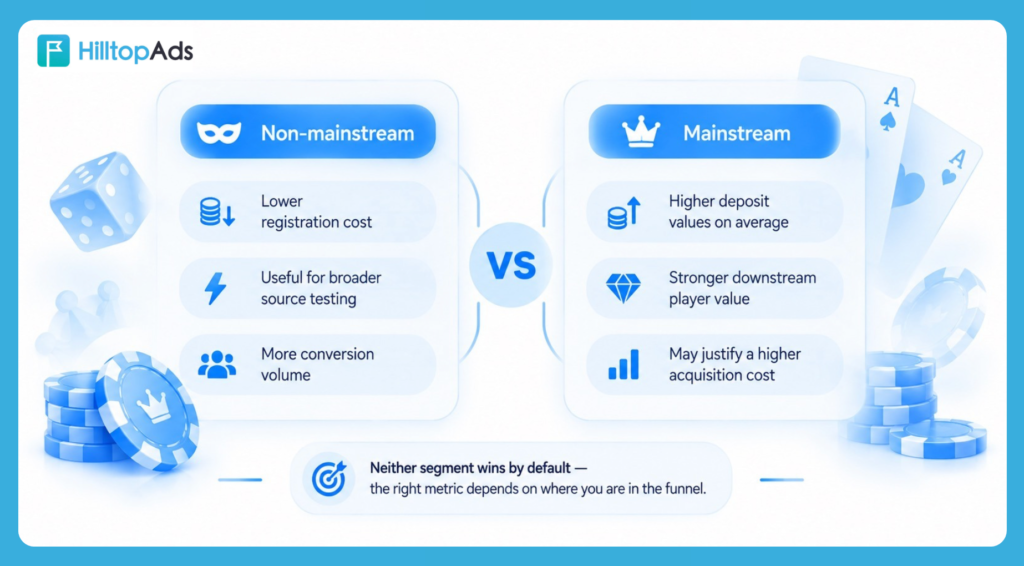
One of the most useful findings was that there was no simple winner between mainstream and non-mainstream traffic. They played different roles. Non-mainstream traffic tended to deliver cheaper registrations. That made it useful for testing a wider range of sources and collecting conversion data at a lower acquisition cost. Mainstream traffic, on the other hand, tended to bring larger deposits.
The acquisition cost could look less attractive at the registration level, but deeper in the funnel those users could be more valuable. If you judge the campaign only by registration CPA, the cheaper traffic naturally looks better. Once deposit value enters the picture, that comparison becomes much less straightforward.
That is why the campaign did not reduce the decision to “mainstream vs non-mainstream”. Both segments could work — but they needed the right targets, the right source selection, and different expectations around acquisition cost.
The Label Conversion data helped make that difference visible by showing not just how cheaply a segment generated registrations, but what happened to those users afterward.
Results
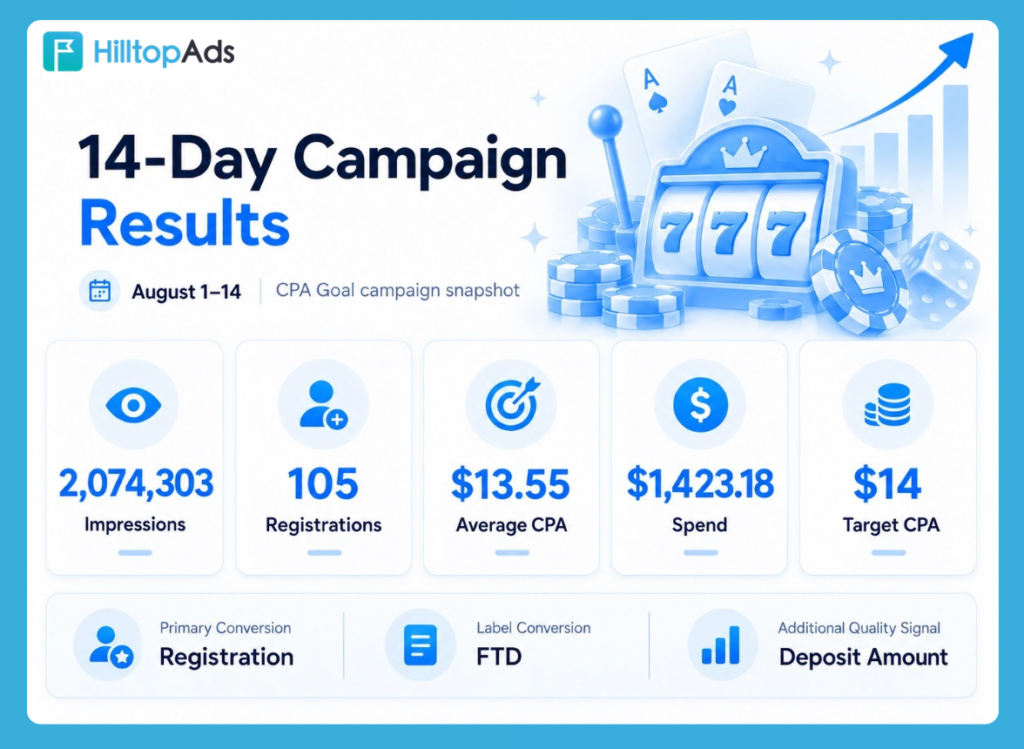
For this case study, we analyzed the campaign from August 1 to August 14, 2026. During those two weeks, it generated:
- 2,074,303 impressions
- 105 registrations
- $1,423.18 spend
- $13.55 average CPA
The main CPA Goal for the campaign shown was $14, which means the final average CPA finished slightly below the target. Finishing below the target was a solid result, but the more useful part was what the advertiser could do with the data behind it.
The campaign also collected FTD signals through Label Conversions and passed deposit values for deeper source analysis. That gave the advertiser a second layer of information for deciding which zones should receive more budget after the initial CPA Goal optimization.
In other words, the campaign did not simply deliver 105 registrations at $13.55. It created a process for separating three different types of traffic:
- traffic that could not convert efficiently;
- traffic that produced cheap registrations but limited downstream value;
- and traffic that justified further scaling because registrations turned into stronger deposits.
That distinction is what made the data useful beyond the two-week test window.
Conclusion
The main result here wasn’t simply that the campaign finished at a $13.55 CPA against a $14 target.
What mattered was how the data was used. Registrations gave CPA Goal enough signals to optimize traffic, while FTDs and deposit amounts helped the advertiser judge which zones were actually worth scaling. Different traffic segments were also given different CPA expectations instead of being forced under one universal target.
Mainstream and non-mainstream traffic reinforced the same point: the cheapest registrations and the most valuable players do not always come from the same places.
For casino advertisers, that leads to a more useful way of thinking about optimization:
use frequent events to learn, use deeper events to measure value, and scale the sources that can deliver both.
Want to test your own iGaming offer with CPA Goal? Register as a HilltopAds advertiser, set up conversion tracking, and start testing which traffic sources work best for your funnel.